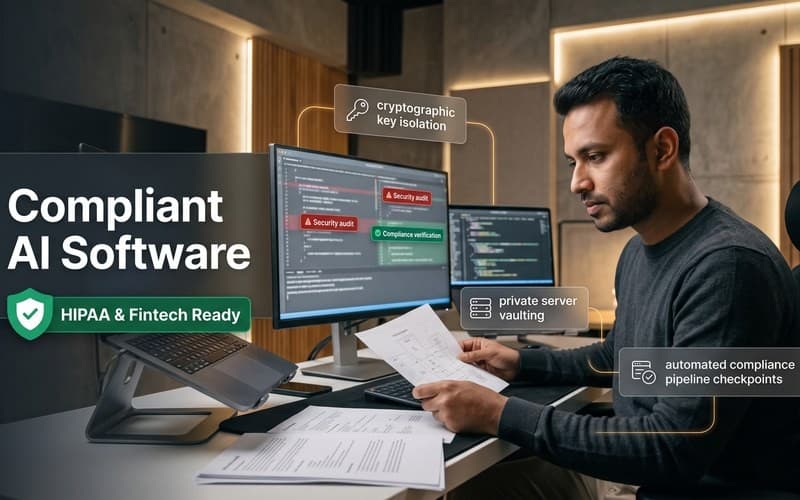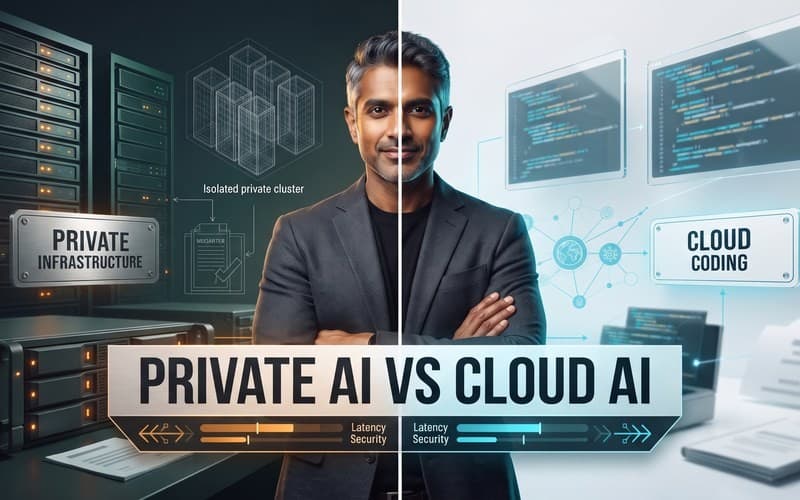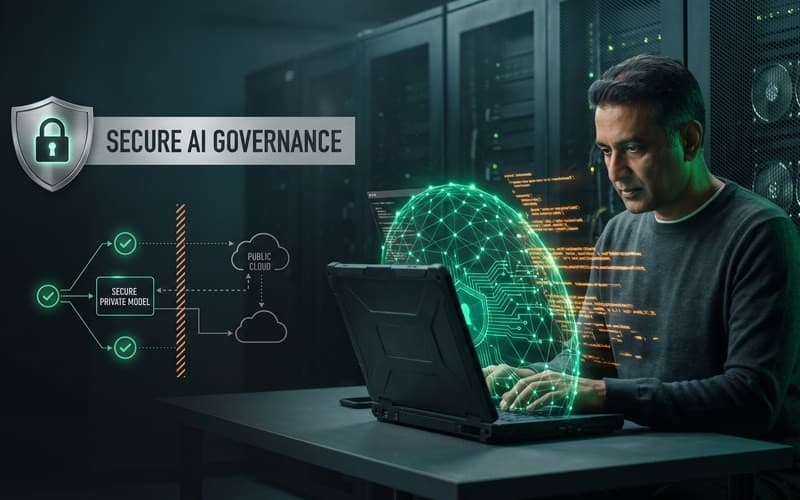
This illustrative case study outlines how an enterprise managing sensitive financial intelligence can deploy private AI coding infrastructure within fully isolated virtual private cloud (VPC) perimeters. When strict regulatory governance prevents source code from reaching public model vendors, engineering organizations face an artificial choice between developer productivity and IP security. By establishing self-hosted coding models inside a zero-egress perimeter, development teams capture the operational advantages of modern coding assistance while ensuring that proprietary algorithms and confidential financial pipelines never leave client-controlled infrastructure.
Summary: What Does Isolated Private AI Engineering Achieve at a Glance?
Executive overview of the VPC-isolated AI coding implementation
Deploying dedicated private AI coding infrastructure enables engineering teams to run code generation and refactoring workflows entirely within an isolated virtual private cloud. Rather than relying on multitenant external APIs, this architecture isolates open-weight models behind strict network perimeters, providing responsive inline completion while enforcing total data sovereignty across proprietary codebases.
Key security boundaries and developer enablement outcomes
By preventing external data transit, the implementation safeguards enterprise AI code security without degrading engineering workflows. Developers gain IDE-integrated coding assistance for routine syntax, boilerplate, and test scaffolding. Meanwhile, senior engineering leads maintain complete oversight of system architecture, code review pipelines, and production release criteria.
The Client Challenge: Why Were Commercial SaaS Coding Assistants Blocked by Compliance?
Regulatory constraints surrounding proprietary financial data and codebase IP
In quantitative finance and proprietary data processing, software repositories represent core intellectual property. For the enterprise in this scenario, security governance mandated that algorithmic source code, database schemas, and proprietary analytical models remain strictly within isolated infrastructure. Standard terms of service from external cloud-hosted AI providers created immediate compliance friction, as third-party model ingestion and external telemetry clashed with rigorous enterprise AI code security frameworks.
The productivity impasse between engineering demands and vendor data policies
Development teams recognized the speed advantages of modern AI-assisted coding, particularly for complex refactoring and repetitive boilerplate generation. However, organizational security mandates strictly prohibited sending proprietary code across multi-tenant external APIs. This created an operational dilemma: developers experienced manual friction while leadership sought to modernize engineering practices. Resolving this tension required a private AI engineering environment that delivered modern coding velocity without routing intellectual property beyond internal firewalls.
What Was at Stake: What Are the Real Risks of Codebase Ingestion versus Engineering Stagnation?
Intellectual property and security vulnerabilities of external model ingestion
Transmitting proprietary codebases to external cloud services introduces significant risk exposure for financial enterprises. Beyond the threat of intercepted network transit, organizations face operational ambiguity regarding how third-party multi-tenant model providers store, log, or potentially retrain on submitted source files. For institutions subject to strict regulatory compliance, inadvertent exposure of proprietary execution logic, pricing algorithms, or internal data ingestion routines compromises enterprise AI code security at an architectural level.
The competitive cost of withholding modern AI tooling from developers
Conversely, imposing an outright ban on modern AI coding assistants leaves engineering teams at a persistent competitive disadvantage. Developers handling complex algorithmic maintenance, data transformation pipelines, and repetitive unit test orchestration spend considerable time on manual boilerplate tasks that automated tooling handles efficiently. Withholding these capabilities dampens developer velocity and increases engineering overhead. Establishing dedicated private AI coding infrastructure resolves this friction, equipping development teams with responsive code generation while enforcing strict internal perimeter governance.
The Strategic Approach: How Was the Private / Local AI Engineering Architecture Structured?
Hosting open-weight coding models inside client-controlled VPC infrastructure
The solution centered on a private AI engineering environment hosted within the client's dedicated virtual private cloud. Rather than relying on commercial cloud APIs, the infrastructure team orchestrated an open weight model deployment using vetted code-generation models. Hosting instances on dedicated private compute kept all prompt tokens and completions within network boundaries governed by enterprise security policies.
Establishing zero-egress network controls and secure local endpoints
To eliminate unauthorized data exfiltration, the architecture enforced strict zero-egress network policies. Model endpoints were exposed exclusively over private subnets protected by mutual TLS and enterprise identity management. Operating a self hosted coding llm behind isolated internal gateways ensured developer IDEs communicated directly with internal clusters, eliminating external telemetry, third-party logging, and model-training exposure.
Preserving human architectural ownership, code review, and release governance
Automated coding assistants served as velocity multipliers rather than autonomous decision-makers. While models accelerated routine syntax and boilerplate generation, experienced engineers retained full architectural ownership. Every generated diff was subjected to mandatory peer code reviews, automated CI suites, and human-led release governance before reaching production.
Implementation: How Did the Team Deploy, Harden, and Integrate the Models into Daily Workflows?
Provisioning dedicated private cloud GPU compute and inference runtimes
Deploying an effective open weight model deployment required dedicated private cloud GPU infrastructure tailored for continuous inference workloads. The engineering team configured secure compute instances running optimized inference engines such as vLLM and TensorRT-LLM. Utilizing high-throughput quantization techniques enabled the self hosted coding llm to deliver responsive token generation while operating strictly within internal infrastructure boundaries, keeping all code tokens and prompts insulated from external networks.
Configuring IDE extensions and developer tooling without external telemetry
To ensure widespread adoption across the development organization, the setup integrated directly into developers' everyday environments using isolated ai developer tooling. Standard IDE plugins were patched and configured to route code completion requests strictly to the private VPC endpoint. All default telemetry, outbound analytic pings, and external logging mechanisms were systematically disabled, guaranteeing that local code indexing, syntax parsing, and context caching remained localized on developer workstations and secure internal servers.
Resolving deployment trade-offs: Hardware sizing, inference latency, and context limits
Balancing infrastructure costs with developer expectations introduced several practical engineering trade-offs. While commercial cloud APIs offer virtually boundless hardware elasticity, self-hosted environments require deliberate resource planning across GPU memory capacity, concurrent batch processing, and context window limits. The team optimized inference serving by establishing context caching protocols and dynamic model quantization, ensuring sub-second completion latency during peak working hours without incurring runaway infrastructure overhead.
Workflow Comparison: How Did the Development Process Change Before and After Deployment?
Pre-deployment workflow: Manual boilerplate creation and restricted developer tooling
Prior to adopting an in-VPC architecture, developers operated under strict compliance guardrails that barred all external AI assistance. Engineers spent substantial time writing repetitive data access objects, drafting routine serialization logic, and manually structuring mock test fixtures for complex financial calculation pipelines. Without isolated ai developer tooling, routine development cycles were bogged down by manual drafting, and senior engineers spent valuable review hours identifying syntactic oversights rather than optimizing high-level distributed systems design.
Post-deployment workflow: Secure in-VPC code completion paired with senior human oversight
Integrating private ai coding infrastructure fundamentally altered day-to-day engineering mechanics without compromising organizational security boundaries. Developers leveraged low-latency inline completions and context-aware test generation directly inside their IDEs, accelerating initial feature drafting. Critically, the workflow maintained human-led rigor: AI agents accelerated drafting, while experienced engineers continued to direct architectural decisions, perform deep code reviews, and oversee all production deployments to safeguard business-critical systems.
Lessons and Next Steps: How Can IP-Conscious Organizations Safely Adopt AI Velocity?
Realistic trade-offs: Where AI assistance excels and where human validation is mandatory
Deploying private ai coding infrastructure demonstrates that models excel at routine syntax, boilerplate, and test scaffolding. However, they struggle with system architecture and subtle edge cases, requiring experienced engineers to direct development and approve releases.
Critical oversight domains: Security audits, data governance, payments, and system scale
Adopting local ai engineering demands human scrutiny across vital operational areas. Automated tools cannot independently guarantee security audits, data governance, payment integrity, or system scale, making expert code review mandatory.
Initiating a scoped Private / Local AI Engineering assessment via Canvas Developers
Canvas Developers delivers Private / Local AI Engineering deployments for IP-conscious organizations. Teams evaluating isolated models can request a scoped assessment via the contact form at https://www.canvasdevelopers.com/contact.