Building an application with AI coding assistants can produce a functioning prototype in hours, but moving that prototype to a live cloud environment reveals an immediate operational reality: localhost execution is not production readiness. Achieving true production readiness for AI software requires bridging the gap between raw generated files and the resilient, scalable infrastructure needed to support enterprise traffic.
When software is generated at high speed, standard DevOps fundamentals—such as secrets management, database connection pooling, container orchestration, and automated CI/CD pipelines—are frequently omitted. Engineering leaders must bridge this gap by enforcing production standards before opening prototypes to live traffic.
Why Does Your AI-Generated Prototype Break Beyond Localhost?
The Illusion of Localhost: When Fast Prompting Meets Production Traffic
A software prototype running smoothly on a developer workstation often conceals critical structural vulnerabilities. Local single-user environments execute with predictable memory allocations, zero network latency, and unconstrained administrative access. However, when teams attempt to deploy vibe coded app to production infrastructure, concurrent multi-tenant workloads immediately expose race conditions, unhandled socket timeouts, and thread exhaustion that local browser sessions never reveal.
Where AI Coding Excels and Where Raw File Generation Falls Short
Modern AI coding assistants excel at generating clean user interface components, writing domain models, and scaffolding boilerplate endpoints. Yet isolated file generation fails to account for broader operational environments. Generative models focus on localized logic rather than system interactions, leaving out distributed state synchronization, network backpressure, egress quotas, and persistent volume management.
Why Senior Engineers Must Direct Architecture, Code Review, and Releases
Establishing true production readiness for AI software requires disciplined engineering governance. While coding agents accelerate task execution, experienced engineers must direct system architecture, enforce rigorous peer review, and decide every production release. Experienced technical leadership guarantees that independently generated components adhere to strict enterprise standards for data security, operational reliability, and long-term maintainability.
What Are the Critical Infrastructure Gaps in AI-Generated Codebases?
Unindexed Databases, Connection Pool Exhaustion, and Concurrency Flaws
AI generators routinely produce working database schemas, but they rarely establish query execution plans, indexing strategies, or connection pooling policies. Under minimal testing, unindexed foreign keys and full table scans complete without perceptible latency. However, when concurrent production traffic hits unindexed tables, CPU utilization surges and connection pool exhaustion locks the database engine. Without explicit pool sizing, read replica routing, and asynchronous query handling, backend worker processes stall while waiting for sockets, triggering cascading timeouts across dependent services.
Exposed Secrets, Root-Level .env Files, and Fragile API Integrations
Local development patterns prioritize speed, routinely placing database credentials, third-party authentication tokens, and private model API keys directly into root-level .env files. When deploying cloud infrastructure AI code into multi-tenant cloud environments, unencrypted credential files present significant security liabilities. Furthermore, third-party API integrations written by AI assistants frequently omit exponential backoff, circuit breakers, and webhook signature verification. If an upstream service or model provider encounters brief latency spikes, unthrottled client requests quickly overwhelm local thread pools.
The Missing Non-Functionals: Rate Limiting, Error Handling, and Log Aggregation
Prompt-driven code synthesis concentrates on happy-path business logic, leaving critical non-functional operational requirements unaddressed. Implementing mature DevOps for AI applications requires production safeguards that simple code prompts never specify: token bucket rate limiting to block abusive traffic, structured JSON logging for unified observability, and graceful container shutdown handlers. Without structured error boundaries and centralized log aggregation, diagnosing failure states in asynchronous background jobs becomes nearly impossible once applications run in live production.
How Do You Containerize and Secure AI-Built Applications for the Cloud?
Standardizing Environments with Multi-Stage Docker Builds
Deploying AI-generated code directly onto virtual machines introduces dependency drift, missing system libraries, and bloated container images. A standardized Docker Kubernetes AI app deployment workflow begins with multi-stage Docker builds. In the initial build stage, compilers, build toolchains, and package managers compile assets and resolve dependencies. The final production stage copies only compiled binaries, production dependencies, or minimal runtime environments into an unprivileged base image. This separation reduces the attack surface, eliminates unnecessary build tools, and minimizes image pull latency across cluster nodes during auto-scaling events. Furthermore, enforcing unprivileged runtime users within the container configuration prevents arbitrary code execution from compromising the underlying container host.
Managing Secrets Securely: Moving Beyond Local Storage to Cloud KMS
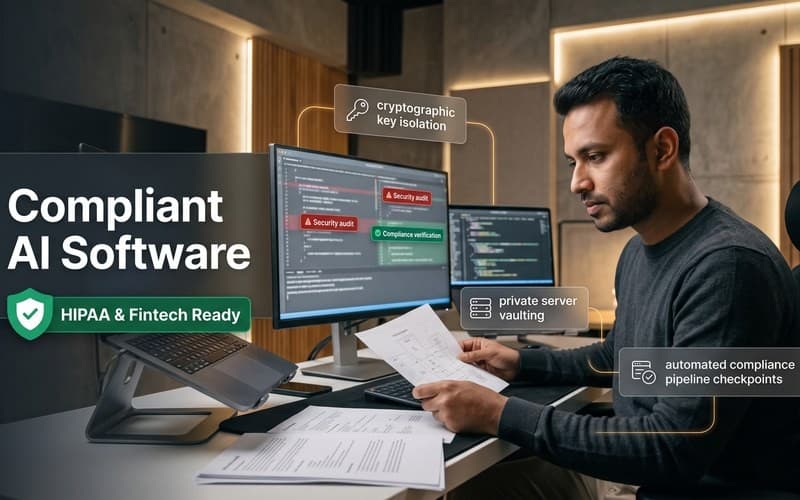
While local development workflows rely on plaintext configuration files, hardened cloud infrastructure AI code mandates centralized secrets management. Production deployments isolate sensitive API tokens, database credentials, and signing certificates through cloud key management services (KMS) or dedicated secret vaults. Secrets are injected dynamically into container runtimes as short-lived environment variables or in-memory mounted volumes, ensuring sensitive keys never persist in container layers, image registries, or version control repositories. Implementing fine-grained Identity and Access Management (IAM) roles ensures application services access only the specific cryptographic keys required for their runtime scope, establishing strict least-privilege boundaries.
Isolating Model Dependencies: Private Local Workloads vs. Managed API Gateways
Architecting AI applications requires deliberate isolation between application business logic and model execution layers. When deploying proprietary models or latency-sensitive workloads, organizations often choose between private hosting and managed cloud APIs. For sensitive data and strict data sovereignty, running private local engineering with open-weight models inside client-controlled virtual private clouds guarantees that data never leaves isolated tenant boundaries. Conversely, when consuming external commercial foundation models, traffic must route through secure API gateways configured with request validation, exponential backoff retries, and strict egress controls. Decoupling model inference from the primary web application prevents slow token generation or upstream provider throttling from exhausting web worker threads and degrading overall end-user responsiveness.
How Should You Architect CI/CD and Database Layers for Production Resilience?
Automated CI Verification: Linting, Unit Testing, and Static Security Scans
Rapid generation of application code often creates inconsistent coding standards and hidden regressions across interrelated modules. Building a robust CI CD pipeline AI software workflow establishes an automated gatekeeper before any code reaches production branches. The pipeline executes deterministic linting, type checking, and unit test suites on every pull request to catch syntax drift and structural breakage immediately. Crucially, automated static application security testing (SAST) and software composition analysis (SCA) scan third-party dependencies for known vulnerabilities, misconfigurations, and outdated packages. This continuous verification prevents defective code from reaching staging environments while preserving rapid development velocity.
Database Hardening: Migration Versioning, Connection Pooling, and Index Tuning
AI coding assistants frequently alter data schemas dynamically without accounting for version control or rollback strategies. Production data stores require deterministic database migration files managed through schema migration tools, ensuring every alteration is versioned, peer-reviewed, and test-executed against staging replicas. Alongside migration governance, rigorous DevOps for AI applications demands dedicated connection pooling utilities—such as PgBouncer for PostgreSQL—to multiplex client connections and prevent connection saturation under sudden traffic spikes. Senior database engineers must also analyze query execution plans, adding composite indexes on high-cardinality search columns and configuring read replicas to offload reporting queries from primary transactional instances.
Zero-Downtime Deployments: Rolling Updates and Ingress Routing
Terminating active user requests during application updates introduces unnecessary downtime and potential data loss. Resilient cloud environments utilize rolling updates or blue-green deployment strategies orchestrated by container schedulers. During a deployment, new container instances must pass HTTP readiness and liveness probes before the ingress controller or load balancer shifts live traffic toward them. If an updated service crashes or fails health verification, the ingress routing layer automatically halts traffic propagation and falls back to existing healthy pods. This structured deployment pipeline guarantees uninterrupted availability for end users during continuous software releases.
How Does Hobby PaaS Hosting Compare to Scalable Cloud Infrastructure?
The Limits of Hobby Platforms: Ephemeral Storage, Cold Starts, and Cost Scaling
Many teams attempt to deploy vibe coded app to production environments using hobby platform-as-a-service tiers. While convenient for rapid prototyping, these platforms quickly expose operational limitations under real business demands. Serverless runtimes introduce cold start latency that degrades user responsiveness during intermittent traffic. Ephemeral container file systems reset state upon redeployment, wiping out unpersisted file uploads or local cache directories. Furthermore, as usage expands, resource-based pricing on entry-level PaaS tiers scales steeply compared to well-architected cloud infrastructure.
Production Cloud Architecture: Managed VPCs, Auto-Scaling Groups, and Load Balancers
Transitioning to reliable cloud infrastructure AI code deployments requires structured, isolated networking. Production environments run within virtual private clouds with isolated private subnets, shielding database instances and internal worker services from direct internet exposure. Application load balancers distribute incoming HTTPS traffic across auto-scaling compute groups or Kubernetes worker nodes. This architecture ensures sudden spikes in user activity trigger horizontal scaling, preserving system throughput without exhausting underlying compute resources.
Comprehensive Observability: Metrics, Distributed Tracing, and Proactive Alerting
Maintaining high availability across distributed services requires comprehensive observability. Production engineering teams configure centralized telemetry pipelines that aggregate CPU utilization, memory thresholds, HTTP error rates, and distributed request traces. Instrumenting API endpoints and background workers reveals precise latency bottlenecks across database queries and external model inference calls. Automated alerting notifies engineering teams of threshold breaches before operational anomalies degrade end-user service.
What Belongs on Your Production Hardening Checklist Before Launch?
Security and Compliance Auditing: Authentication, Sanitization, and Payments
Before exposing an application to public networks, conducting a thorough security and compliance audit is essential. A comprehensive production hardening checklist begins with validating authentication protocols, session handling, and credential hashing mechanisms. Rapidly generated prototypes frequently suffer from insecure direct object references (IDOR) and missing input sanitization across database endpoints, exposing systems to injection vulnerabilities. Furthermore, payment workflows and sensitive transaction flows must never rely on client-side state; server-side verification, idempotent transaction handling, and cryptographic webhook signatures must be strictly enforced to prevent financial inconsistencies.
Load and Stress Testing: Identifying Bottlenecks Before Real Users Arrive
Simulating realistic production traffic allows engineering teams to identify infrastructure bottlenecks before real users encounter service degradation. Establishing verified production readiness for AI software requires executing automated stress tests across critical application workflows. Synthetic load tests simulate concurrent user traffic, stressing API endpoints, background worker queues, and database connection pools to identify saturation thresholds. This profiling identifies memory leaks, slow database locks, and unoptimized queries, enabling teams to tune autoscaling policies and compute limits with precision.
Backup Strategies and Disaster Recovery Runbooks
Data durability requires proactive disaster recovery planning rather than reactive troubleshooting. Production deployments mandate automated, point-in-time database snapshots and cross-region replication for critical application state and object stores. Alongside automated backups, operational disaster recovery runbooks define actionable recovery time objectives (RTO) and recovery point objectives (RPO). Having verified restoration procedures ensures engineering teams can rapidly restore services and preserve data integrity during hardware failures or cloud zone disruptions.
How Do You Transition an AI Prototype into a Resilient Production System?
Balancing AI Development Velocity with Professional DevOps Ownership
AI coding assistants accelerate prototyping, but sustainable systems require engineering governance. While generative tools speed development, experienced engineers must direct architecture, audit security, and decide releases. Pairing AI speed with senior-led DevOps for AI applications ensures velocity never compromises operational resilience or security.
Choosing Between Private Local Infrastructure and Approved Commercial Tooling
Teams can adopt Private / Local AI Engineering—hosting open-weight models in client-controlled infrastructure—for strict isolation, or use Claude Code / OpenAI Codex Engineering with client-approved cloud configurations for compliant commercial development.
Getting Started: Scoping Your Deployment Hardening via Canvas Developers
Canvas Developers is a software engineering company with an office in Dhaka that builds custom software and hardens AI-built applications. Our senior engineers direct architecture and releases to achieve true production readiness for AI software. Request a scoped assessment at https://www.canvasdevelopers.com/contact.