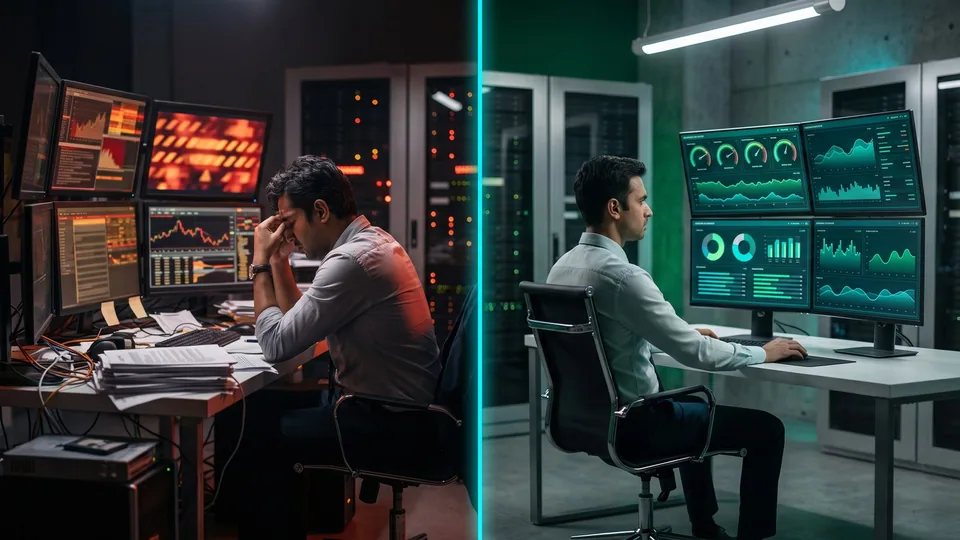
This illustrative case study examines how Canvas Developers designs an institutional OANDA and FXCM risk management integration for multi-account currency trading groups. In volatile foreign exchange conditions, fragmented broker portals expose prop desks and fund managers to asymmetric drawdown and desynchronized margin calls.
By establishing a unified supervisory service across heterogeneous broker APIs, trading operations can aggregate real-time equity telemetry, rebalance risk dynamically, and execute coordinated emergency stops before localized losses compromise aggregate capital.
How Does Unified Multi-Broker Telemetry Prevent Cascading Margin Calls?
In distributed trading setups, maintaining segregated accounts across multiple venues creates operational blind spots during sudden market volatility. When market depth shifts abruptly, an OANDA and FXCM risk management integration substantially curtails telemetry latency and bridges data gaps by consolidating segregated account metrics into a single supervisory pipeline. Rather than calculating risk post-trade or relying on manual refreshes, a centralized supervisory service provides real time margin monitoring OANDA FXCM infrastructure to track composite leverage, floating profit and loss, and net exposure continuously.
By continuously ingesting account-level balance and margin utilization updates, the supervisory layer calculates aggregate risk exposure across all sub-accounts. If exposure on one venue spikes while another remains stagnant, the engine detects the imbalance rapidly, helping trading groups prevent isolated margin stress from triggering cascading liquidations across the broader portfolio.
Why Did Fragmented OANDA and FXCM Portals Threaten Capital Preservation?
In this illustrative scenario, the trading group operated multiple segregated trading books across OANDA and FXCM, relying on disparate browser consoles to monitor open positions. Disconnected broker portals created severe operational friction for risk officers trying to track aggregate margin utilization in real time. Reconciling margin requirements manually across separate logins introduced latency that made proactive risk management impossible during volatile trading sessions.
Without automated multi broker margin management OANDA FXCM, position allocation across accounts suffered from uneven lot-sizing. Traders often applied uniform order sizes across client accounts with unequal balances, inadvertently over-leveraging smaller sub-accounts while under-allocating capital in larger portfolios. Because the group lacked synchronized OANDA FXCM account equity tracking, margin deficits on volatile currency pairs were discovered only after brokers initiated warning notices or liquidated positions. This fragmented posture turned routine currency swings into compounding capital preservation risks across the firm, highlighting the urgent need for a cohesive supervisory layer.
What Operational Risks Arise When Cross-Broker Feeds Desynchronize During Flash Swings?
During sudden currency flash moves or liquidity contractions, broker pricing engines and execution venues diverge rapidly. If exchange rates gap, one broker might trigger stop-outs while another maintains open positions due to distinct spread markups and tick processing speeds. In the absence of an integrated cross broker drawdown protection API, trading operations suffer asymmetric margin liquidations, where positions on one platform are forcefully closed at peak slippage while offsetting exposures on the other venue remain unhedged.
Furthermore, relying on uncoordinated REST polling introduces telemetry lag and risks hitting aggressive broker rate limits. When a firm exceeds endpoint quotas during turbulent sessions, pricing data drifts, leading to stale equity calculations. A dedicated forex group risk control system minimizes polling overhead by maintaining persistent streaming subscriptions, mitigating data drift hazards that could otherwise obscure critical margin depletion when volatility spikes.
How Does a Centralized Risk Supervisory Engine Enforce Coordinated Drawdown Protection?
To mitigate operational desynchronization, the centralized risk supervisory engine establishes continuous streaming pipelines to each broker venue. The ingestion worker connects directly to the OANDA v20 streaming endpoint to parse live pricing and account transaction ticks, while concurrently maintaining a persistent FXCM Socket.IO connection to capture real-time account balances and open position tables. Normalizing these disparate event structures into a unified in-memory state engine gives risk managers near-instantaneous visibility across every managed sub-account.
Using this unified state layer, the supervisory service enforces dynamic equity-weighted sizing algorithms before orders reach broker matching engines. Instead of allocating static lot quantities across client portfolios, order parameters are scaled proportionally according to each account's real-time free margin and equity weighting. This dynamic calculation ensures smaller accounts avoid taking on disproportionate exposure during correlated currency rallies or liquidity gaps across currency pairs.
Crucially, the architecture deploys an automated emergency circuit breaker forex API to protect against catastrophic tail-risk events. The system tracks aggregate portfolio drawdown against predefined risk limits. When market turbulence breaches composite thresholds, the cross broker drawdown protection API triggers coordinated, non-blocking liquidation calls simultaneously across OANDA and FXCM. The engine cancels resting orders and initiates rapid market exposure flattening to help preserve capital before brokers trigger forced liquidations.
How Was the Real-Time Integration Architected, Tested, and Hardened?
Engineering a dependable OANDA and FXCM risk management integration requires resilient data pipelines and disciplined engineering standards. At Canvas Developers, our team accelerated API wrapper scaffolding, data models, and test generation using AI coding agents. While AI tools excel at speeding up repetitive boilerplate and test harnesses, they routinely fail on complex distributed systems: AI models frequently generate naive reconnect loops that cause broker rate-limit bans, hallucinate subtle broker API parameters, and overlook thread-safety race conditions in real-time balance mutations. Experienced senior engineers owned the architecture, audited security and API token boundaries, and reviewed every line before release.
The supervisory backend leverages Supabase to store normalized account telemetry, manage audit logs, and maintain risk threshold configurations. Resilient WebSocket handshakes maintain persistent streams with broker servers, using automated heartbeat detection and exponential backoff reconnection strategies to prevent silent disconnects during market hours.
To harden the pipeline against production edge cases, our engineers stress-tested scenarios involving stale price ticks, broker socket drops, and partial order fills. The system applies defensive state reconciliation and idempotent command processing. If a broker feed stalls during rapid market action, the engine isolates the affected account while sustaining real time margin monitoring OANDA FXCM across remaining books, preventing degraded feeds from corrupting portfolio-wide risk decisions.
What Structural Shifts Occur When Moving from Manual Tracking to Automated Circuit Breakers?
Transitioning from disparate trading terminals to an integrated supervisory platform alters day-to-day risk posture. Previously, managing fragmented broker interfaces forced risk operators to piece together spreadsheets or toggle between tabs, creating delays that compromised capital safety. Implementing continuous OANDA FXCM account equity tracking replaces fragmented views with unified observability, projecting real-time margin utilization, net currency exposure, and aggregate leverage onto a single monitoring dashboard.
More importantly, this architectural shift transforms crisis response from discretionary panic into deterministic execution. In volatile markets, human traders hesitate, recalculate margin deficits, or struggle with manual broker order entry. A deterministic forex group risk control system enforces programmatic guardrails, liquidating high-risk exposures or locking accounts with programmatic speed when drawdown ceilings are touched. This systematic discipline enforces programmatic risk boundaries without emotional bias, helping trading groups curtail compounding losses during severe market dislocation.
What Should Trading Groups Consider Before Building Custom Risk Infrastructure?
Building custom multi broker margin management OANDA FXCM platforms requires balancing development speed with rigorous risk controls. While AI tools accelerate boilerplate and test generation, they struggle with concurrency hazards, network partitions, and strict secret isolation without expert direction. Experienced senior engineers must supervise architecture, security audits, and deployment decisions. Typical bespoke implementations span a realistic 6- to 10-week timeline across four phases: API protocol auditing and scoping, streaming ingestion and sizing development, sandbox stress-testing under simulated volatility, and supervised production rollout.
Core deliverables include normalized broker ingestion workers, dynamic equity-weighting middleware, and automated kill-switch circuit breakers. Clients should expect milestone reviews, latency profiling under load, and failover documentation. Trading groups can evaluate their architecture or commission a scoped integration assessment through the contact form at Canvas Developers.