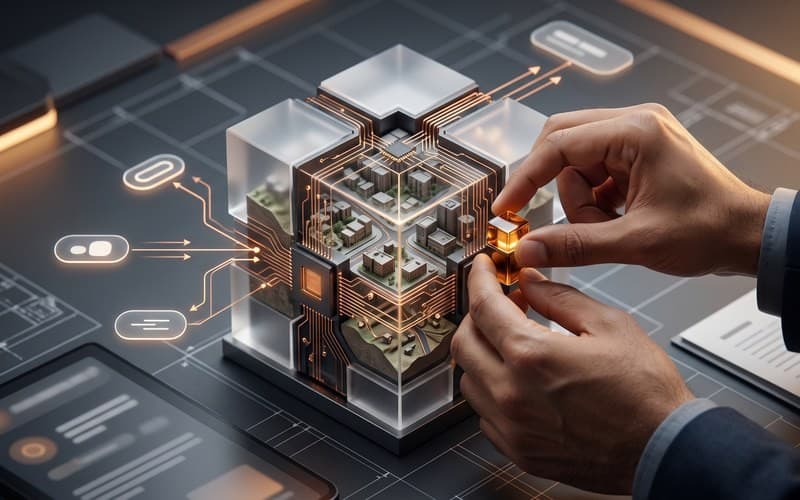
A resilient property management real estate API integration synchronizes tenant leasing states, rent payment ledgers, and maintenance workflows between modern tenant applications and core property management systems. This illustrative example demonstrates a middle-tier architecture designed by Canvas Developers to show what our engineering team can build for proptech platforms, rather than delivered client work.
By utilizing asynchronous webhook listeners, idempotent worker queues, and automated reconciliation routines, the design ensures that tenant ledgers and lease renewals reflect across corporate ERPs in real time while maintaining transactional integrity.
Project at a Glance: What Does This Real Estate Integration Architecture Entail?
Modern proptech SaaS platforms and multifamily operations require seamless accounting bridges between resident interfaces and back-office general ledgers. This concept highlights a robust property management real estate API integration designed to connect disparate operational platforms, including Yardi, AppFolio, and public property record pipelines indexed via RealEstateAPI schemas.
As a software engineering company, Canvas Developers provides full-stack integration architecture and protocol design. The team establishes bidirectional data pipelines that translate tenant interactions into structured enterprise resource planning records without relying on fragile manual uploads or delayed batch imports.
The Integration Brief: Why Do Tenant Apps and Legacy PMS Ledgers Fall Out of Sync?
Maintaining consistency across residential operations is difficult when custom resident mobile portals interact with traditional property management suites. In a standard multifamily property data sync, tenant actions such as signing lease agreements or submitting security deposits must reflect instantaneously across central accounting records. Without automated pipelines, staff members must re-key entries, introducing reconciliation delays and human error into corporate ERP platforms.
Legacy property management systems often enforce restrictive API rate limits, batch update windows, or complex SOAP interfaces that struggle with synchronous traffic. A dedicated real estate accounting API integration decouples client-facing frontends from these core databases. By queuing outgoing payloads and handling asynchronous responses, the middle tier guarantees ledger updates occur reliably without blocking resident transactions.
Approach & Process: How Does Canvas Developers Combine AI Speed with Human Review?
To build a dependable property management real estate API integration efficiently, Canvas Developers pairs AI coding agents with human architectural oversight. Automated agent harnesses accelerate initial boilerplate creation, webhook scaffolding, and schema mapping. While AI coding tools rapidly generate standard endpoints, they frequently struggle with edge cases, multi-step transaction rollbacks, and financial precision.
Experienced senior engineers direct the development process, reviewing every code modification and making all deployment decisions. Depending on client security standards, projects are delivered through either Private or Local AI Engineering—running private open-weight models in self-hosted or isolated environments—or commercial Claude Code and OpenAI Codex tooling configured under strict corporate data protections.
Technical Blueprint: What Are the Key Architectural Decisions Behind the Data Bridge?
At the foundation of this automated rent ledger API bridge lies an event-driven, decoupled architecture. Inbound webhooks from resident apps and payment gateways hit lightweight ingest listeners that immediately validate signatures and push payload events into distributed worker queues. Each job executes with strict idempotency controls—storing unique event identifiers and payload hashes in an operational cache—so repeated deliveries, network retries, or server restarts never create duplicate debits or credits in the financial ledger.
A resilient PMS bi-directional data connector manages schema transformations between modern tenant-facing JSON models and legacy property management formats. Automated ledger reconciliation routines run continuous background integrity sweeps, auditing resident rent roll balances against core general ledger accounts to flag and quarantine discrepancies before monthly closing.
Furthermore, custom state mapping modules normalize complex tenant lifecycles across resident onboarding, lease renewal options, and maintenance dispatch tickets. By synchronizing status definitions across platforms, property teams avoid record drift and operational blind spots.
Intended Impact & Trade-Offs: How Does Resilient Synchronization Mitigate Operational Risk?
Deploying a dedicated tenant portal integration engine removes dual-entry overhead and prevents rent ledger discrepancies across regional property portfolios. During end-of-month cycles or seasonal leasing surges, reliable queue processing protects underlying accounting databases from traffic spikes, ensuring that high-volume renewal waves execute without dropped requests.
However, automated synchronization introduces architectural trade-offs that require rigorous human oversight. In a large-scale multifamily property data sync, engineers must configure adaptive backoff strategies and token buckets to handle upstream API rate limits. Furthermore, webhook validation and idempotency routines must be audited manually to prevent phantom transactions and payment gateway re-submission loops.
Start a Similar Project: How Can You Scope a Custom PMS Integration with Canvas Developers?
Every engineering initiative at Canvas Developers begins with structured technical scoping to map endpoints, authentication flows, and data reconciliation rules. Engagements advance across agreed, milestone-driven development phases covering queue load testing, security review, and final operational handover.
Whether you require a new property management real estate API integration or need to harden existing synchronization pipelines, our team can help. Schedule a scoped integration assessment through the contact form at https://www.canvasdevelopers.com/contact to review your architecture and data requirements.