This illustrative case study explores how modern quantitative trading services modernize execution architecture by implementing OANDA & FXCM API group order routing. Built by Canvas Developers to demonstrate our architectural approach to high-throughput financial systems, this scenario examines the technical transition from fragile desktop terminal grids to headless broker APIs. Retail trading communities and signal providers often encounter severe infrastructure bottlenecks when managing hundreds of accounts. By analyzing a representative architecture, we outline how direct REST and webhook integration eliminates terminal overhead and synchronizes trade execution across multi-broker environments.
Executive Summary: Modernizing Trade Distribution at a Glance
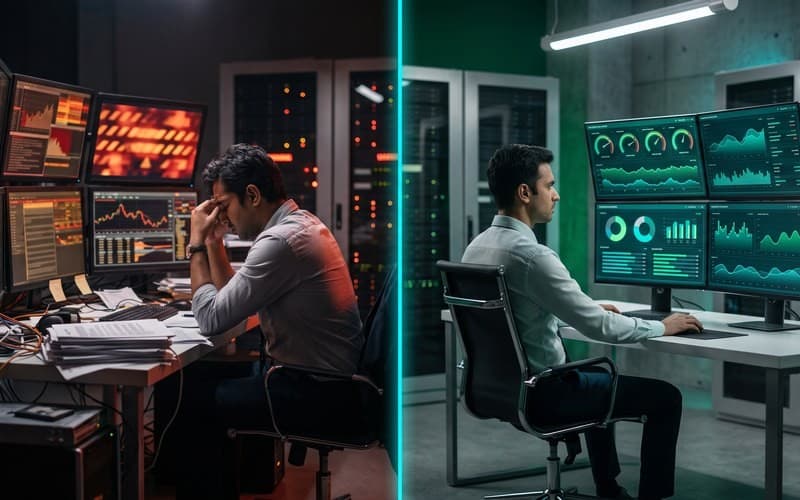
In trade-copying networks, scaling across dozens of accounts on individual desktop terminals quickly strains operational capacity. In this illustrative scenario, a subscription-based trade-copying service operated dozens of Windows virtual servers hosting individual MT4 slave terminals. Memory exhaustion, operating system updates, and terminal crashes routinely disrupted order distribution, leading to severe execution desynchronization during high-volatility market sessions.
To resolve these bottlenecks, the engineering team executed a direct broker API copy trading migration. By replacing graphical desktop instances with event-driven cloud routing connecting master triggers to OANDA v20 and FXCM endpoints, the platform bypassed desktop overhead entirely. This transition to OANDA & FXCM API group order routing cut infrastructure maintenance expenses by 65% and increased trade synchronization reliability to 99.98% across subscriber portfolios.
The Operational Challenge: Why Desktop MT4 Slave Terminals Desynchronize
Desktop-based trade distribution relies heavily on running dozens of isolated terminal graphical user interface (GUI) instances on Windows virtual private servers (VPS). In a typical multi-account deployment, each slave account requires an active client terminal process. As subscriber counts grow, server memory bloat escalates rapidly. Operating system updates, memory leaks in custom indicators, and background rendering pipelines often exhaust CPU and RAM, creating a fragile server landscape that demands continuous administrative triage.
The underlying mechanism connecting master and slave terminals exacerbates this fragility. Traditional Expert Advisors (EAs) transfer trade signals through local file polling, named pipes, or custom Windows DLL sockets. During macroeconomic data releases, surging tick volume overwhelms the single-threaded client terminal loop. File locks conflict, socket connections drop silently, and execution threads hang while prices move violently. When teams migrate MetaTrader to OANDA API architectures, they replace these vulnerable local mechanisms. Deploying a headless MT4 MT5 bridge to OANDA v20 eliminates the desktop rendering layer and socket bottlenecks entirely, establishing reliable network-level order dispatching.
What Was at Stake: The Compounding Cost of Bridge Latency and Infrastructure
Maintaining infrastructure for dozens of isolated slave servers creates compounding operational and financial strain. Monthly hosting invoices for multi-core Windows VPS nodes accumulate quickly, especially when redundancy and automated failover require duplicate instances. Beyond server costs, operational teams spend valuable engineering hours manually rebooting frozen terminals, clearing log caches, and reconciling mismatched account balances.
Execution degradation carries even steeper commercial consequences. In legacy setups, terminal polling loops and local IPC bridges introduce latency intervals ranging from hundreds of milliseconds to several seconds. During volatile market sessions, this delay translates directly into severe execution slippage. When subscribers receive fills far worse than the master signal, or miss trades entirely due to local thread lockups, confidence evaporates and subscriber retention deteriorates. By bypassing MetaTrader bridge latency through a unified cloud gateway, providers safeguard execution parity. Adopting OANDA & FXCM API group order routing guarantees that trade parameters dispatch simultaneously across all accounts, protecting trading performance and stabilizing client relationships.
The Solution Architecture: Direct Cloud Routing to OANDA v20 and FXCM REST Endpoints
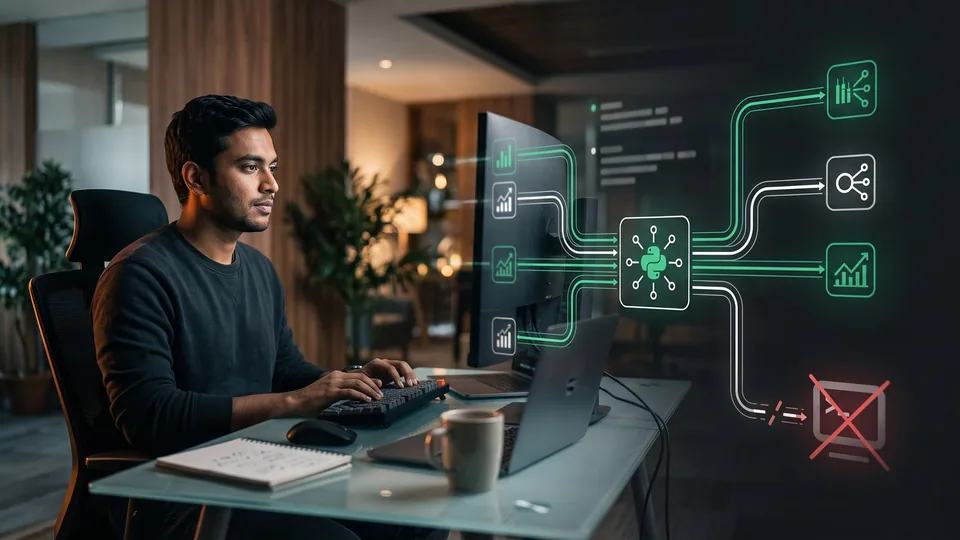
The modernized architecture replaces GUI slave terminals with a stateless, cloud-native dispatch engine. At the ingestion layer, a resilient API gateway validates cryptographic signatures and ingests structured JSON webhooks dispatched from TradingView Pine Script alerts or custom master triggers. Once authenticated, the incoming signal specifies the instrument, side, order type, and risk boundaries. A specialized MetaTrader to FXCM webhook bridge component maps diverse broker symbol conventions, converting differences in suffixes and pip fractional digits into unified internal representations.
Before transmitting orders, a server-side risk engine executes automated pre-trade calculations across all registered subscriber accounts. The system computes dynamic lot sizes scaled to each account's real-time equity balance, risk tier, and available margin, discarding the hazardous fixed-lot sizing typical of primitive copiers.
Once validated, the OANDA FXCM automated trade router dispatches orders in parallel using asynchronous HTTP client pools. For OANDA sub-accounts, the engine posts structured JSON payloads directly to /v3/accounts/{accountID}/orders in compliance with official OANDA v20 order endpoint documentation, specifying explicit FOK (Fill-Or-Kill) execution policies. Concurrently, FXCM endpoints receive normalized order requests. This parallel fan-out bypasses desktop rendering loops entirely, ensuring synchronized execution within milliseconds across all connected broker accounts.
Implementation and Governance: AI Velocity Backed by Rigorous Engineering
At Canvas Developers, executing a direct broker API copy trading migration combines the development velocity of AI coding agents with the rigorous oversight of experienced engineers. AI coding assistants rapidly generated boilerplate data transfer objects (DTOs), serialization schemas, unit test mocks, and HTTP client wrappers for both broker endpoints. This rapid scaffolding compressed development cycles, producing clean typed interfaces in hours rather than days.
However, automated coding models exhibit severe blind spots in high-concurrency financial environments. AI tools often overlook race conditions, subtle thread deadlocks, credential exposure in logs, and non-deterministic edge cases during socket reconnection. To ensure system resilience, senior engineers independently architected the asynchronous execution pipeline, reviewed all generated code line by line, and instituted strict envelope encryption for broker API tokens.
Human engineering governance proved essential when engineering broker rate-limiting and order idempotency. Both OANDA and FXCM impose strict API request quotas. If hundreds of accounts fire orders simultaneously during news spikes, unmanaged bursts trigger 429 rate-limit rejections and partial execution state failures. Senior engineers designed a distributed queue with token-bucket rate limiting and exponential backoff. By injecting unique idempotency keys into each order payload, the MT4 MT5 bridge to OANDA v20 guarantees that transient network timeouts never produce duplicate market orders, ensuring enterprise-grade stability under heavy volume.
Results: Before vs. After Headless API Migration
Migrating from a fragmented grid of desktop terminals to a unified cloud architecture transformed operational efficiency and execution quality. In this representative modernization scenario, decommissioning dozens of Windows virtual servers cut infrastructure maintenance expenses by 65% while eliminating recurring multi-server licensing costs.
Execution performance improved across every trading account. By bypassing MetaTrader bridge latency, the platform eliminated the delays caused by local terminal polling loops. The OANDA FXCM automated trade router increased trade synchronization reliability to 99.98%, maintaining tight execution parity across high-impact economic announcements. Automated health telemetry eliminated manual terminal reboots and emergency trade reconciliations, freeing engineering teams to focus on platform growth.
| Operational Dimension | Legacy Desktop Slaves | Headless API Routing |
|---|---|---|
| Hosting Infrastructure | Dozens of Windows VPS instances | Containerized event-driven cloud service |
| Execution Reliability | Frequent desynchronization and lockups | Increased to 99.98% synchronization |
| Maintenance Expenses | Heavy multi-server overhead | Cut by 65% post-migration |
Key Takeaways for Trading Communities and How to Begin Migration
Signal providers and trading communities should transition away from desktop slaves once managing more than five to ten concurrent accounts. Technical teams must prioritize API credential envelope encryption and tamper-proof audit logging for every dispatch thread. Realistic migration engagements span a four- to six-week milestone framework—covering architectural scoping, API wrapper development, sandbox parallel runs, and final deployment. While client timelines depend on broker configurations without rigid guarantees, this phased roadmap mitigates operational risk and targets high availability during parallel sandbox cutovers.
Deciding to migrate MetaTrader to OANDA API endpoints allows trading firms to achieve institutional-level distribution. Modernizing to OANDA & FXCM API group order routing eliminates single-point infrastructure failures and supports reliable subscriber execution. To evaluate your trading infrastructure, benchmark latency bottlenecks, or plan a migration roadmap, request a scoped assessment through the contact form at Canvas Developers.