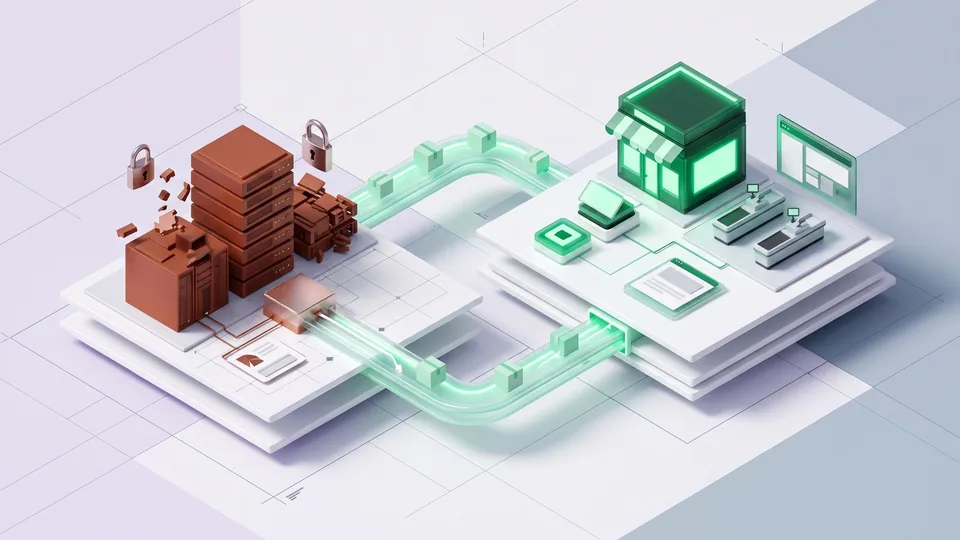
This illustrative case study examines how an omnichannel apparel distributor resolved checkout bottlenecks and catalog contention through an enterprise Shopify development migration. Facing severe database locking and inventory synchronization lag during peak promotional events on a legacy Magento monolith, the business required a modern, distributed architecture capable of handling 85,000 SKUs, high-concurrency checkout spikes, and multi-channel fulfillment across Amazon and direct storefronts.
Summary: How Do You Eliminate Flash-Sale Database Locks Across High-Volume Channels?
High-volume flash sales expose the architectural limits of monolithic e-commerce platforms. When catalog querying, inventory indexing, and checkout transactions compete for row locks in a single relational database, checkout processes stall and revenue drops. In an enterprise Shopify development migration, isolating catalog presentation from transaction processing eliminates monolithic database contention entirely.
By pairing Shopify Plus with an event-driven architecture, high-volume Shopify development separates consumer traffic spikes from backend data flows. While Shopify handles customer-facing checkout elasticity at enterprise scale, background event streams process marketplace updates asynchronously, keeping direct-to-consumer and external sales channels synchronized without threatening database availability during critical promotional windows.
The Context: Why Do Legacy Magento Monoliths Fail Under High-SKU Flash Sales?
Legacy Magento monoliths store product data across extensive entity-attribute-value (EAV) schemas. For an omnichannel distributor managing 85,000 SKUs across segmented retail channels, even a standard product lookup requires joining dozens of database tables. Under normal operations, caching layers conceal this overhead. During flash sales, however, surging traffic bypasses cached views as shoppers execute dynamic searches and add items to carts simultaneously.
When concurrent shoppers access shared inventory records, row-level database locks quickly cascade across the system. Background indexers and inventory recalculation routines contend with live checkout transactions, triggering connection timeouts and cart abandonment. A Magento to Shopify Plus migration resolves this fundamental bottleneck. Shifting catalog and transaction workloads into a modern Shopify multi-channel catalog architecture isolates checkout processing from backend inventory queries, preventing promotional traffic spikes from freezing commerce operations.
What Was at Stake: The Operational Cost of Database Contention and Inventory Lag
When checkout transactions fail during promotional spikes, the operational damage extends far beyond immediate cart abandonment. Database contention degrades entire storefront response times, frustrating shoppers across catalog categories. Concurrency timeouts during peak promotional windows directly undermine campaign profitability while driving high-intent buyers to competing merchants.
Furthermore, latency in synchronizing inventory counts between monolithic databases and external marketplaces introduces severe commercial liabilities. When flash sales clear physical warehouse stock while marketplace counts lag, orders continue to clear against depleted inventory. This cross-platform overselling damages seller performance metrics and threatens account standing. Through high-volume Shopify development and a custom Shopify ERP integration, engineering teams isolate order routing and inventory state management, ensuring real-time stock deductions protect fulfillment integrity across direct and marketplace channels.
The Solution Architecture: Designing Event-Driven Middleware for Shopify Plus and Amazon SP-API
To eliminate database locking without introducing inventory desynchronization, we engineered a decoupled, event-driven middleware microservice. Rather than relying on periodic polling against store databases, the microservice integrates directly with the Amazon SP-API Notifications API. Subscribing to asynchronous event streams via cloud message queues ensures that marketplace orders and catalog events are processed in real time without creating synchronous database locks on checkout servers.
Concurrently, the microservice manages bidirectional Shopify Amazon SP-API inventory sync across multiple regional fulfillment centers. By leveraging Shopify GraphQL mutations to manage inventory quantities and states across location nodes, the system maintains accurate available, committed, and reserved counts across distributed warehouses. As an integral component of this custom Shopify ERP integration, dynamic order routing evaluates inventory proximity and automatically routes orders to the optimal facility, broadcasting atomic stock updates back across all sales channels within milliseconds. Built-in dead-letter queues and automated reconciliation workers monitor message throughput, ensuring transient network timeouts or API rate limits never cause mismatched stock levels.
Implementation: Dual-Track Migration Pipelines and Rigorous Engineering Oversight
Executing an enterprise Shopify development migration at this scale required a robust, dual-track ETL pipeline. Over a typical eight-week data pipeline phase, engineering teams extracted, cleaned, and mapped 85,000 SKUs, historical customer accounts, and complex order records from Magento's EAV tables into Shopify's normalized schemas. A continuous delta synchronization daemon ran alongside the staging environment to capture live transactions, ensuring the production cutover achieved zero transactional downtime.
Throughout this Magento to Shopify Plus migration, Canvas Developers deployed AI coding agents to accelerate repetitive engineering workflows, including writing data transformation scripts, generating schema mapping functions, and expanding test suites. However, relying purely on automated code generators introduces real risks: AI models frequently miss critical edge cases in database concurrency, webhook idempotency, and cryptographic payload validation. Experienced senior engineers directed the architecture, reviewed every code commit, and rigorously tested payment tokenization, transactional consistency, and API rate limits before release. Clients choose between Private / Local AI Engineering using isolated open-weight models or commercial AI coding toolchains under strict enterprise data policies, guaranteeing intellectual property and customer records remain fully protected.
Operational Results: Validating High-Volume Throughput and Real-Time Replenishment
By replacing a monolithic database with an elastic hosted commerce engine, checkout operations no longer experience database deadlocks during promotional traffic spikes. Direct-to-consumer storefront checkouts proceed smoothly because catalog browsing and order processing run independently of backend inventory reconciliation. Store administrators maintain continuous visibility into order fulfillment pipelines without experiencing administrative panel freezing or checkout timeouts.
Operationally, the event-driven middleware automates inventory replenishment between warehouses, retail storefronts, and third-party marketplaces. The bidirectional Shopify Amazon SP-API inventory sync eliminates manual spreadsheet reconciliations and end-of-day batch processing delays. By combining high-volume Shopify development with robust queue consumers, stock allocations reflect real-time warehouse availability across channels, preventing accidental overselling and protecting seller performance ratings.
Architecture Lessons: How Enterprise Teams Should Plan Multi-Channel Replatforming
Replatforming complex retail infrastructure requires separating front-end presentation from channel integration. An enterprise Shopify development migration succeeds when organizations treat middleware as an independent integration layer rather than embedding synchronization logic inside theme templates or monolithic extensions. Adopting a modular Shopify multi-channel catalog architecture ensures new marketplace channels and fulfillment nodes can be added without refactoring core checkout systems.
Enterprises planning similar modernization can typically expect a realistic 12-to-16-week engagement. Deliverables encompass initial technical scoping, automated catalog migration pipelines, custom event-driven middleware, and comprehensive load testing before a zero-downtime cutover. Canvas Developers pairs AI coding agents with senior engineers who direct architecture, audit security, and govern production releases. To discuss your timeline or explore a tailored architecture plan, request a scoped technical assessment through the Canvas Developers contact form.