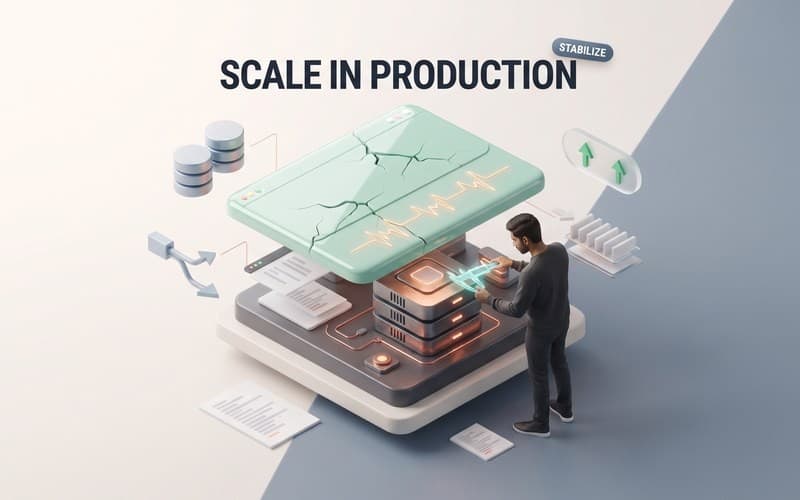
This illustrative case study examines how software engineering teams approach a vibe coded saas rescue when an early-stage product outpaces its underlying architecture. When non-technical founders use AI code generators to build initial software, feature delivery can move remarkably fast. However, bridging the gap between an interactive prototype and production-ready software requires senior engineering oversight.
In this typical scenario, Canvas Developers stabilized a multi-tenant subscription platform where rapid prototyping introduced critical security gaps and cross-tenant session leakage prior to public launch.
Executive Summary: How Can a Broken AI-Generated SaaS MVP Be Stabilized for Production?
The AI Prototyping Dilemma: Rapid Feature Velocity vs. Critical Architectural Gaps
In this illustrative scenario, a non-technical founder assembled a multi-tenant subscription tool using prompt-assisted AI coding. While the interface functioned cleanly during single-user demos, pilot testing revealed severe architectural gaps. The AI-generated code blurred client and server boundaries, causing cross-account session bleed and exposing third-party API keys directly inside the client browser.
The Resolution at a Glance: Preserving UI Logic While Hardening Backend State and Isolation
Resolving these critical liabilities required a systematic vibe coded saas rescue rather than discarding the working frontend. Canvas Developers audited the architecture, separating client-server logic and establishing robust database-level tenant isolation. By moving exposed keys to protected server environments, senior engineers converted the vulnerable prototype into dependable, production ready ai software while retaining all completed interface functionality.
The Scenario: What Happens When AI Code Generators Build a Multi-Tenant SaaS Without Architecture?
The Non-Technical Founder's Build: Assembling a Working Subscription Tool via AI Prompts
In this typical scenario, an entrepreneurial founder leveraged AI coding tools to assemble a subscription SaaS tool. Over several weeks of prompt iterations, the application gained core user flows: account registration, custom onboarding questionnaires, tiered billing selections, and interactive reporting dashboards. On the surface, the product appeared ready for customer validation.
Uncovering Critical Faults: Cross-Account Session Bleed During Initial Pilot Testing
The fragility of the system emerged during early pilot testing with concurrent users. User sessions began bleeding across tenant boundaries. Testers discovered that refreshing a page occasionally rendered another organization's records, while background actions updated accounts arbitrarily. The application lacked coherent server boundaries to differentiate active tenant contexts.
The Architectural Blind Spot: Missing Relational Models and API Keys Exposed in the Browser
A technical evaluation exposed the root cause: the AI assistant placed tenant identity in client-side state without backend relational constraints. Furthermore, third-party payment secret keys were embedded directly in frontend scripts, visible within browser inspection tools. To stabilize vibe coded app architecture and protect users, teams must fix broken mvp code at the foundational data layer.
The Stakes: Why Can't a Vibe-Coded Application Launch with Session Bleed and Exposed Secrets?
Data Isolation Liabilities: The Threat of Tenant Data Bleed in a B2B SaaS Environment
In B2B SaaS, tenant data isolation is non-negotiable. When user sessions bleed across accounts, clients can view proprietary metrics, employee records, and confidential operational workflows belonging to peer firms. Such cross-tenant leaks destroy customer trust instantly, creating severe regulatory liabilities and contractual exposure before a product even launches.
Security and Credential Risks: Why Frontend-Exposed Secret Keys Halt Public Launches
Exposing third-party API keys within browser bundles introduces immediate operational peril. Malicious actors inspecting client assets can extract payment processor credentials and private database tokens, enabling quota abuse and unauthorized data access. These vulnerabilities make any public software release impossible until credentials move server-side.
The Commercial Dilemma: The Cost of a Complete Ground-Up Rebuild vs. Targeted Stabilization
Founders often assume broken architectures require discarding the entire project. However, full rewrites forfeit weeks of design progress. A thorough saas technical debt audit reveals that presentation logic can be preserved. A targeted vibe coded saas rescue stabilizes the flawed backend while keeping the working user interface intact.
The Strategy: How Do Experienced Engineers Refactor AI-Generated Code Without a Complete Rewrite?
Human Oversight vs. AI Generation: Why Senior Engineers Must Own Architecture, Review, and Releases
At Canvas Developers, experienced engineers direct the work, own the architecture, review every change, and decide releases. While AI coding tools accelerate initial development, they lack structural awareness of security and state boundaries. Senior engineering oversight ensures that data models, authorization barriers, and production deployments meet professional standards.
Honest Trade-offs of AI Coding: Speeding Prototyping vs. Blind Spots in Security and Relational Data
AI coding provides remarkable velocity for prototyping interfaces and scaffolding repetitive components. However, AI assistants exhibit persistent blind spots in data normalization, cross-tenant isolation, and third-party payment security. Teams must recognize these trade-offs and refactor ai generated code before unvetted logic reaches active business customers.
The Surgical Refactoring Thesis: Keeping Working Frontends While Replacing Faulty Core Logic
Surgical refactoring preserves validated user interfaces while replacing flawed backend implementations. Rather than discarding functional front-facing workflows, senior engineers decouple client components and route requests through robust server endpoints. This focused remediation transforms fragile prototypes into secure, production ready ai software efficiently.
The Engineering Execution: What Milestones Are Required to Stabilize a Vulnerable MVP?
Milestone 1: Scoped Codebase Audit to Map Client-Server Boundaries and Secret Exposure
Every remediation engagement begins with a scoped saas technical debt audit to evaluate application structure. Experienced engineers inspect package dependencies and map where client code directly interfaces with databases or external APIs. This audit pinpoints where credentials leak into browser bundles and establishes clear engineering boundaries before modifying source files.
Milestone 2: Relocating Third-Party API Keys and Payment Logic to Secure Server Endpoints
During the second milestone, engineers extract exposed payment secrets, webhook keys, and third-party credentials from frontend scripts. Dedicated server-side API proxy routes and protected environment variables replace direct browser calls. This restructuring guarantees that payment processing and external interactions execute strictly within trusted server environments.
Milestone 3: Implementing Strict Multi-Tenant Relational Schemas and Authorization Guards
To stabilize vibe coded app data structures, engineers overhaul database models to enforce explicit tenant ownership across tables. Server-side authorization middleware verifies that active user sessions match requested tenant identifiers on every query. Implementing strict relational constraints ensures tenant records remain protected and isolated during concurrent operations.
Milestone 4: QA, Rigorous Multi-Session Testing, and DevOps Release Assurance
The final phase applies Canvas Developers' QA and DevOps release assurance capabilities. Specialists perform multi-session concurrency testing to verify that session leakage cannot recur under heavy loads. Paired with reliable staging environments and deployment pipelines, engineers refactor ai generated code into a dependable system ready for public launch.
The Outcome: What Does a Before-and-After Comparison of Hardened SaaS Architecture Look Like?
Before vs. After Security: From Browser-Exposed Credentials to Zero Frontend Secrets
Prior to refactoring, sensitive API tokens and payment credentials resided in client bundles, accessible to anyone inspecting browser network traffic. Following remediation, the client application contains zero secrets. All external interactions route through authenticated backend proxies, protecting commercial accounts and eliminating credential theft risks.
Before vs. After Isolation: From Intermittent Session Leakage to Strict Database-Level Tenant Partitioning
The prototype previously stored tenant identifiers in mutable frontend storage, resulting in cross-account data bleeding during pilot user sessions. The stabilized architecture enforces tenant partitioning at the database query layer, ensuring users only access verified organizational data.
Before vs. After Maintainability: Transforming Fragile One-Off Code into a Documented, Testable Codebase
Engineering interventions fix broken mvp code by replacing tangled prompts with clean, modular components. Structured data models, automated test coverage, and clear architectural documentation convert an unstable experiment into maintainable, production ready ai software equipped for commercial scale.
Lessons for Founders: How Can Teams Balance AI Coding Velocity with Production-Grade Security?
Where AI Assistants Excel and What Human Engineers Must Always Verify (Data, Sessions, Security)
AI coding assistants accelerate early prototyping and UI creation. However, human engineers must verify relational schemas, multi-tenant isolation, payments, and security before launch.
Why Launching Requires Dedicated QA and Architectural Oversight Beyond Prompting
Prompt-driven tools cannot replace holistic architecture or testing. Launching requires senior engineers who manage code reviews, integration, and DevOps release assurance.
Next Steps: Requesting a Scoped Codebase Assessment via Canvas Developers
Founders seeking a vibe coded saas rescue or saas technical debt audit can request a scoped assessment at https://www.canvasdevelopers.com/contact.