AI Agents & Automation
Machine Learning Models
Custom machine learning models that turn your data into forecasts, scores and recommendations, validated against clear baselines and monitored once they're in production.

Models tied to the decisions you make
Machine learning is worth building when a better prediction changes a decision: what to stock, which transactions to review, which customers need attention, what to recommend. We develop custom models with scikit-learn, PyTorch or TensorFlow, from data preparation to production, and test them against simple baselines so you know what the model adds. You receive a model that runs inside your systems, explains its predictions, and is monitored as your data changes.
AI-assisted, expert-led ML engineering
How AI assists
- AI assists data profiling, drafts cleaning scripts and suggests features, which data scientists verify.
- Coding agents draft training pipelines, evaluation code and serving APIs for engineer review.
- AI summarizes experiment results and error patterns by segment for engineers to review.
What our experts own
- Problem framing, the success metric and the baseline a model must beat
- Feature choices, leakage checks and validation design
- Fairness review, and which predictions need a person's review before action
- Promotion of each model version to production
A model's path from data to production
Typical lifecycle for a predictive model; gates and thresholds are agreed with your team per project.
Data audit
Profile the records the model will learn from: coverage, label quality and fields that leak the outcome.
Baseline
Set the simple method to beat, such as last period's figures or your current rule.
Training
Train candidate models on older history, keeping the most recent period aside to test them.
Offline evaluation
Candidates are scored against the baseline on held-out data, overall and for each important segment.
Checkpoint: Proceeds only if it beats baseline
Shadow or limited rollout
The model scores live cases in the background, or for a small group first, while current decisions continue.
Checkpoint: You approve wider use
Drift monitoring
Input drift and prediction quality are tracked against agreed thresholds, with alerts when retraining should be considered.
When something fails: If a candidate doesn't beat the baseline, or shadow results differ from offline tests, it isn't promoted and the current method keeps running.
Who brings us a prediction problem
Planning and review decisions still run on spreadsheets and fixed rules, while the sales, transaction or sensor history that could sharpen them sits unused in your databases.
- Buying and planning teams forecasting demand from past sales
- Risk and fraud analysts deciding which transactions or claims to review first
- Maintenance teams with sensor data that could flag failing equipment early
What you receive
From raw data to a monitored model
Forecasting and predictive models
Sales forecasting, demand prediction and risk scoring, using methods such as gradient boosting, Prophet or LSTM networks, chosen by results on your data.
Classification and anomaly detection
Customer segmentation, fraud and spam detection, and outlier detection in transactions, sensor data or user behavior, with review queues for flagged cases.
Recommendation engines
Collaborative, content-based or hybrid recommendations for products and content, tested against simple baselines before launch.
Evaluation report and model card
Holdout and backtest results, errors by segment, explanations with SHAP or feature importance, and a model card that states known limits.
Production API or batch jobs
Models served as REST APIs or scheduled batch jobs, integrated with your systems, with logging and versioned releases.
MLOps and drift monitoring
Drift and performance monitoring, retraining pipelines, model versioning and A/B tests, so quality is tracked as your data changes.
What model work doesn't include
- Text, documents and images are handled by Natural Language Processing and Computer Vision; this service models structured records such as orders, transactions and sensor readings.
- Generated text, such as summaries or answers drawn from documents, is LLM Integration; models here predict numbers, scores or categories from your history.
- Company-wide data warehousing isn't included: we prepare the data a model needs, and if the history was never recorded, collecting it comes first.
- Regulatory approval for models used in credit, insurance or health decisions stays with your compliance team; we supply the model card and evaluation evidence for their review.
Typical modeling requests
Typical scenarios we scope, not client case studies.
Stock orders set from spreadsheets
Buyers set order quantities from last year's figures plus judgment. We would test a forecasting model against that method for each product group and show suggested quantities in their planning tool, where buyers accept, adjust or reject them.
More flagged transactions than analysts can check
Fixed fraud rules flag more transactions than the team can review. We would train a scoring model on past review decisions, rank the queue by risk, and leave the final call on every case with an analyst.
An inherited model of unknown quality
A churn model left by a former employee still runs, but nobody has measured it lately. We would rebuild its evaluation on recent data, compare it with a simple baseline and add drift monitoring, so you can decide whether to retrain or retire it.
How we develop an ML model
- 01
Problem definition
Define the decision the model supports, the success measure, the baseline to beat, and whether machine learning is the right tool at all.
- 02
Data preparation
Audit, clean and label data, engineer features, and check for leakage and bias. Data gaps are reported before training starts.
- 03
Training and validation
Train and compare candidate models, validate them on held-out data and by segment, and record results and limits in a model card.
- 04
Deploy and monitor
Deploy as an API or batch job, integrate it with your systems, and monitor drift and performance, with retraining on an agreed schedule.
Two ways to work with AI tools
Choose where AI coding agents may process your code while we build. The engineering standard is the same either way.
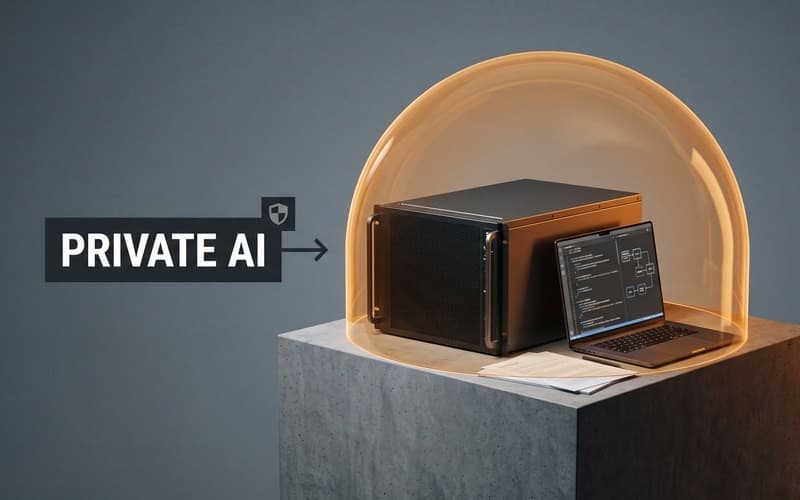
- Private / Local AI Engineering
Privately hosted models inside infrastructure you control or an agreed isolated environment.
Discuss with this package - Claude Code / OpenAI Codex Engineering
Claude Code and/or OpenAI Codex with cloud settings your organization approves.
Discuss with this package
Not sure? We'll recommend one during scoping. Compare AI delivery options
How design, QA and operations support your model
Predictions people can act on
Designers shape how scores, confidence and reasons appear in your tools, and how staff override a prediction, so the model supports decisions instead of hiding them.
QA of the whole pipeline
QA checks data validation, edge cases, errors by segment and fairness, and runs regression tests before a retrained model is promoted.
Infrastructure sized to the model
DevOps runs serving, scheduled jobs, monitoring and rollback. Many models run well on standard infrastructure; GPUs are added only when training or inference needs them.
Retraining with oversight
We monitor drift, retrain on fresh data, and compare each new version with the current one before it replaces it, with your approval on promotion.
FAQ
Frequently asked questions
How much data do we need?
It depends on the problem, how noisy your data is and how many outcomes you're predicting. We assess your data during problem definition and tell you whether it's enough, whether more labeling would help, or whether a simpler rule-based approach would serve you better.
How do you check models for bias and fairness?
We audit training data, compare error rates across relevant segments, and document known limits in a model card. Explainability tools such as SHAP show which factors drive predictions. Where a decision significantly affects people, we design for human review rather than automatic action.
What happens when our data changes?
Monitoring tracks input drift and prediction quality. When performance falls below the threshold you approved, a retraining pipeline produces a new version, which is compared with the current model before anyone promotes it.
Can our training data stay in our environment?
Yes. Training and serving can run in your cloud account or on infrastructure you control, so the data can stay inside it. For our development work, Private / Local AI Engineering runs the AI coding models inside an agreed boundary, while Claude Code / OpenAI Codex Engineering uses commercial coding agents under agreed account terms.
Related case studies

Related projects


Related articles


Related Services

Vibe Coding Consulting & Governance
Architectural guardrails, automated testing enforcement, and code audits for AI-generated codebases....
Learn more
LLM Integration
Add large language models to your product with retrieval over your own data, evaluation on real ques...
Learn more
Computer Vision
Vision systems that inspect, detect, count and read from images and video, tested in your real condi...
Learn more
AI Chatbots
Chatbots for your website, WhatsApp and other channels that answer from your own content, hand off t...
Learn more
Turn your data into a working model
Bring the decision you want to improve and a sample of your data. We'll assess feasibility, the baseline to beat, and what it takes to run in production.