This illustrative example demonstrates an enterprise architecture for AI legal document review software designed by Canvas Developers to show what our engineering teams can build. It is an illustrative product design rather than delivered client work, engineered specifically for corporate legal departments handling high-volume non-disclosure agreements (NDAs), master service agreements (MSAs), and vendor contracts.
Routine contract triage frequently strains legal operations when manual clause verification creates review bottlenecks. This concept pairs split-screen clause comparison with zero-retention private model deployments, ensuring sensitive terms match company playbooks without exposing confidential legal data to external shared environments.
Project at a Glance: What Is This Contract Review Tool and Who Is It For?
This concept design targets in-house legal counsel, corporate legal operations, and contract administrators who handle repetitive commercial agreements. As an illustrative implementation of ai legal document review software, the platform automates standard clause verification across routine NDAs, vendor terms, and master service agreements without introducing external compliance liabilities.
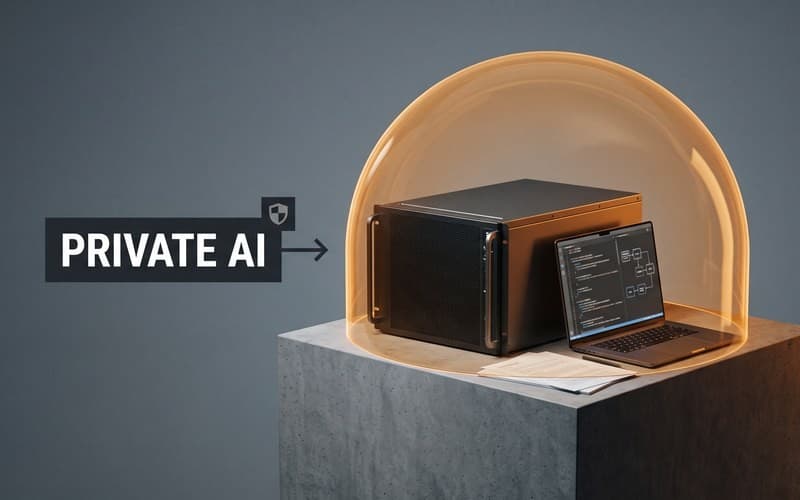
The system provides real-time split-screen redlining against defined corporate playbooks, highlighting deviations and suggesting approved alternate phrasing. Built through dedicated legal ai assistant engineering, the application deploys under our Private / Local AI Engineering framework directly on client-controlled infrastructure, maintaining total isolation from multi-tenant cloud environments.
The Brief: How Do You Automate Contract Redlines Without Exposing Confidential IP?
Corporate legal departments routinely face severe operational friction when managing high-volume standard agreements. Incoming non-disclosure agreements, master service agreements, and vendor contracts demand meticulous sentence-by-sentence evaluation, yet manual triage consumes hundreds of hours that senior counsel should dedicate to strategic matters.
The primary constraint in automating this workload is data sovereignty. Commercial legal agreements contain proprietary intellectual property and confidential deal structures that corporate governance forbids transmitting to shared third-party model APIs. A viable custom contract review tool architecture must enforce zero data retention and execute within isolated infrastructure boundaries.
Functionally, the tool must evaluate counterparty redlines directly against internal playbook rules. Rather than general summarisation, the workflow requires precise private ai legal document analysis to flag deviations in indemnification, liability caps, and governing law clauses instantly.
Approach & Process: How Does Human Engineering Bridge Where AI Coding Fails?
Modern engineering harnesses and AI coding agents accelerate the initial build phases of ai legaltech software development, particularly when scaffolding responsive split-screen UI components, state management routines, and boilerplate parsing endpoints. This velocity reduces initial prototype turnaround, but relying on unguided code generation introduces critical vulnerabilities.
AI coding assistants excel at syntax generation and standard interface layouts, yet they fail systematically when securing zero-retention data pipelines, preventing memory leaks during large file diffs, and handling edge-case document encodings. In legal applications, automated agents cannot evaluate risk exposure or guarantee tenant isolation.
At Canvas Developers, senior software engineers own the custom contract review tool architecture from inception to deployment. Experienced engineers direct the AI agents, conduct rigorous line-by-line code reviews, design data isolation mechanisms, and maintain strict release assurance standards across every build milestone.
What Was Built: What Core Capabilities Power the Clause Comparison Platform?
The conceptual platform centers on a synchronized split-screen interface featuring a dual-pane document canvas with lock-step scrolling and interactive navigation anchors. Operating as an automated clause comparison system, the left viewport renders the counterparty agreement alongside color-coded diff markup, while the right viewport displays internal playbook provisions. Automated layout parsing preserves original typographic styling, dynamically aligning matching sections across complex commercial agreements.
To accelerate contract triage, an interactive sidebar computes risk scores across detected clauses, categorizing contractual deviations as low, moderate, or critical against preconfigured playbook rules. Counsel reviews automated redline suggestions directly in context and applies approved fallback provisions with a single click, standardizing commitments across indemnification, liability caps, warranties, and termination rights.
Because enterprise legal compliance demands rigorous governance, the system records every redline, prompt suggestion, and manual override in an immutable audit log. This provides complete version histories and full traceability across multi-round negotiations. Through disciplined contract redlining software development, the interface pairs intuitive review tools with uncompromising enterprise oversight.
Technical Decisions: Why Couple Deterministic Diffing with Private Open-Weight Models?
Coupling deterministic text diffing algorithms with open-weight neural engines eliminates generative hallucination. While semantic parsing evaluates contractual meaning and intent, deterministic diffing algorithms compute character and token-level discrepancies. This ensures punctuation shifts, deleted sub-clauses, and modified liability thresholds are captured with mathematical precision during private ai legal document analysis.
The modular application stack couples a responsive TypeScript split-screen interface with containerized Python document-parsing microservices and PostgreSQL append-only audit storage. Operating under Canvas Developers' Private / Local AI Engineering package, dedicated open-weight engines execute inside client-controlled virtual private clouds or isolated on-premises clusters. This custom contract review tool architecture guarantees proprietary agreement terms never leave secure internal firewalls or train third-party commercial systems.
Enterprise data governance is enforced through AES-256 storage encryption, TLS in transit, and granular role-based access controls that restrict sensitive agreement views strictly according to internal department authorizations.
Anticipated Impact: How Does the Architecture Streamline Legal Workflow Bottlenecks?
Deploying specialized ai legal document review software within corporate legal workflows substantially reduces the manual burden of commercial contract intake. By automating routine triage across non-disclosure and vendor agreements, legal teams can identify non-standard commitments immediately, eliminating multi-day review bottlenecks without sacrificing analytical precision.
Crucially, integrating an automated clause comparison system on private infrastructure empowers legal counsel to scale their review capacity while upholding strict enterprise data governance. Routine reviews progress rapidly through verified playbook rules, freeing in-house attorneys to concentrate on complex transaction structures and high-risk commercial negotiations.
Start a Similar Project: How Can You Scope a Custom Legal Tech Solution with Canvas Developers?
Organizations planning custom ai legaltech software development can structure tailored engineering engagements with Canvas Developers. Every enterprise build begins with rigorous technical scoping to define infrastructure boundaries and security protocols, followed by agreed development milestones, release testing, and clean handover.
To evaluate a custom deployment or request a scoped assessment for your organization, reach out through the contact form at https://www.canvasdevelopers.com/contact.