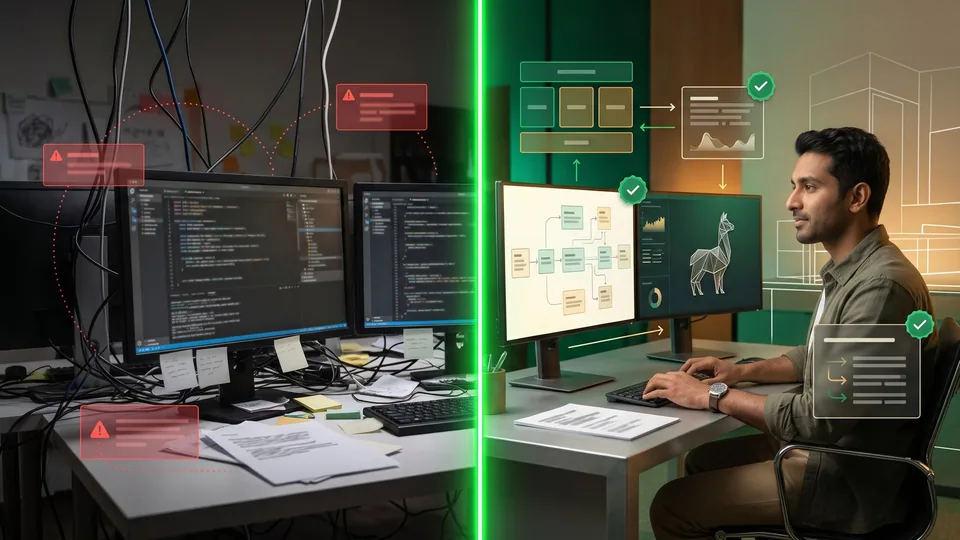
Defining comprehensive Alpaca development requirements before engaging an engineering team or vibe coder is the difference between an executable fintech product and an unstable prototype. AI generation tools make it effortless to scaffold basic client libraries or fire a test order, but financial systems require strict rigor around state management, execution certainty, and regulatory boundaries.
Whether you plan to build an automated trading desk or a multi-tenant investment portal, upfront scoping establishes how your application handles order state transitions, enforces network idempotency, and protects brokerage credentials. Scoping these specifications early prevents costly architectural rewrites and ensures your engineering pipeline transitions safely from sandbox validation to live capital execution.
What Are the Essential Alpaca Development Requirements to Define Upfront?
Launching a financial application powered by Alpaca demands rigorous architectural planning before touching a single line of code. When teams begin scoping their Alpaca development requirements, they must first clarify whether the product relies on the individual Trading API for algorithmic execution or the multi-tenant Broker API for end-user sub-accounts. Conflating these two architectures is the most frequent scoping error, leading to wasted iterations and incompatible database schemas.
An effective specification defines explicit boundaries across four core operational pillars:
- Account Topology: Determining whether your backend interacts with a single master custodial account or orchestrates isolated tenant ledgers with regulatory onboarding requirements.
- Execution Routing: Specifying supported order types (market, limit, stop-loss, bracket orders), time-in-force parameters, and extended-hours eligibility.
- Data Ingestion Streams: Mapping required market data frequency, quote depth, and websocket event handling against Alpaca tier entitlements.
- Risk and Ledger Synchronisation: Establishing reconciliation loops between your local persistence layer and Alpaca trade updates.
Hiring an Alpaca developer without these foundational requirements invites brittle implementations. At Canvas Developers, every engagement begins with an engineering-led scoping phase that formalises these data contracts and failure modes before automated scaffolding or code generation begins.
Where Does Alpaca Vibe Coding Succeed, and Where Does It Break?
Fast Scaffolding for SDK Boilerplate and Standard Order Endpoints
Modern AI coding agents and development harnesses excel at generating standard boilerplate code. When prototyping an investment interface, Alpaca vibe coding dramatically reduces the time required to configure software development kits, establish REST transport clients, map account balance schemas, and generate basic UI components. Rapid prompt iteration allows teams to assemble functional frontend dashboards and trigger simple market orders within hours rather than days.
This automated scaffolding provides genuine utility by compressing initial feedback loops, reducing routine development overhead, and accelerating early visual prototyping. However, when founders decide to hire a vibe coder for Alpaca without senior engineering oversight, they frequently mistake a superficial UI prototype for production-ready financial software. Scaffolding standard order endpoints represents only a fraction of an operational trading integration; the true complexity lies in resilient state management, data integrity, and network fault tolerance.
Where AI Prompts Fail: Websockets, Rate Limits, and Idempotency Keys
Autonomous AI generators consistently fail when encountering asynchronous distributed systems and strict exchange protocols. As detailed in Alpaca's streaming market data documentation, standard accounts are limited to a single active stream connection per endpoint; initiating a second concurrent stream immediately returns an error 406 connection limit exceeded. AI code generators routinely open redundant connections across serverless functions or client browser tabs, inadvertently disconnecting active feeds.
Furthermore, prompt-generated logic rarely accounts for Alpaca's ten-second websocket authentication window or server buffer disconnections triggered by slow client processing. Similar vulnerabilities emerge in order execution: an AI agent will readily write a standard POST /v2/orders call but neglect to attach a unique client_order_id idempotency key. In volatile markets, an intermittent network timeout could trigger an automated retry that inadvertently duplicates an order and creates unhedged financial liability. Unmanaged requests also run afoul of the default 200 requests-per-minute rate limit, throwing unhandled HTTP 429 exceptions unless backed by a token-bucket limiter and exponential backoff.
At Canvas Developers, senior software engineers direct AI coding agents and harnesses such as Antigravity for rapid boilerplate assembly, while maintaining rigorous ownership of network resilience, idempotency contracts, and production release criteria.
Which Technical Specifications Must Your Alpaca Trading API Integration Define?
Authentication Protocol, Environment Separation, and Credential Security
A production alpaca trading api integration must strictly isolate paper-trading sandbox environments from live brokerage production accounts. Using separate API keys, secrets, and base URLs (api.alpaca.markets versus paper-api.alpaca.markets) is non-negotiable. Furthermore, API secrets must never reside in client-side bundles, repository commits, or unencrypted configuration files.
Production systems should enforce secure vault storage, dynamic key rotation, and isolated transport layers. An experienced alpaca api developer designs an intermediate backend proxy that authenticates incoming client traffic, verifies session permissions, and signs upstream requests to Alpaca with server-side credentials, ensuring trading keys remain completely shielded from end-user devices.
Bidirectional Data Mapping Across Market Feeds and Order Payloads
Market data ingestion and order dispatch require deterministic type mapping across your application schema and Alpaca's data structures. For outbound execution, payloads must validate order parameters—such as symbol ticker format, asset class (such as US equities), and quantity precision. In Alpaca's order schema, qty (supporting up to 9 decimal places for equities) and notional (supporting up to 2 decimal places for cash amounts) are strictly mutually exclusive fields.
On the inbound path, market feeds deliver high-throughput quotes, trades, and aggregate bars that must be parsed, deduplicated, and mapped to internal domain entities. When handling volatile market sessions, ingestion systems must decouple websocket stream consumption from database writes using an asynchronous buffer, such as Redis Streams or message queues. This architectural pattern prevents slow-client disconnections (error 407) and thread starvation under sudden volume spikes. Through our dedicated Alpaca integration framework, our team leverages AI-assisted scaffolding to accelerate schema decoders while senior engineers build custom ring buffers, backpressure management, and stream reconnection routines.
Order State Lifecycle, Webhook Deliverability, and Execution Semantics
Financial orders undergo complex lifecycle transitions: new, accepted, pending_new, partially_filled, filled, done_for_day, canceled, expired, and rejected. An integration must maintain state alignment across these transitions through asynchronous trade updates and transactional webhook consumers.
Because network interruptions or transient dropouts can compromise webhook delivery, systems cannot rely solely on push notifications. Resilient architectures implement idempotency guards using unique client order IDs, alongside periodic polling reconciliation routines that verify pending order statuses directly against Alpaca's REST endpoints upon stream reconnection.
How Should You Separate an Alpaca MVP from Later Brokerage Features?
Phase 1: Paper Trading Validation, Market Orders, and Portfolio Reads
Building a viable fintech minimum viable product (MVP) requires deliberate feature separation. The most common pitfall when scoping Alpaca development requirements is attempting to implement full-scale multi-tenant brokerage functionality before validating core application logic. An effective Phase 1 MVP focuses on single-account architecture or administrative trading using Alpaca's paper trading sandbox.
In this initial phase, the engineering scope should restrict execution to standard market and limit orders, basic portfolio position queries, and account balance synchronisation (cash, equity, and buying power). Validating order submission pipelines, basic data feeds, and local transaction logging in paper mode allows founders to test user experience, execution latency, and business logic without taking on the regulatory overhead of user funds or real-market clearing.
Recognising when a simpler option fits is an essential scoping discipline. If your application only requires periodic portfolio rebalancing or end-of-day execution, building a persistent real-time streaming pipeline introduces unnecessary complexity. A scheduled cron worker executing standard REST calls or using Alpaca's native interface achieves the target outcome with substantially lower operational overhead.
Phase 2: Broker API Sub-Accounts, Fractional Shares, and Margin Rules
Once the core product mechanics demonstrate clear user engagement, development expands to a comprehensive alpaca brokerage api integration. Transitioning to the Broker API fundamentally alters your application architecture: instead of a single API key pair, your backend acts as a registered correspondent or omnibus broker managing isolated sub-accounts via path-based endpoints (such as /v1/trading/accounts/{account_id}/orders).
Phase 2 introduces sophisticated execution and account mechanics, including:
- Fractional Trading: Enabling dollar-based notional investing or fractional equity purchases (configured per account and restricted to Day orders under Alpaca's order rules).
- KYC and Onboarding Compliance: Integrating identity verification, tax documentation, and regulatory checks through Alpaca's Accounts API before account activation.
- Margin and Risk Rules: Managing margin multipliers, maintenance requirements, and Pattern Day Trader (PDT) limits to prevent account suspension.
- Fee Structures and Sub-tagging: Configuring custom commissions (notional, per-share, or basis points) and omnibus trade surveillance sub-tags.
Separating these phases prevents teams from over-engineering regulatory and ledger systems before market validation. Canvas Developers helps clients map clear milestone roadmaps, transitioning smoothly from initial prototype validation to enterprise brokerage infrastructure.
What Acceptance Criteria and Edge Tests Protect You Before Final Handoff?
Simulating Network Retries, Partial Fills, and Rejected Orders in Sandbox
Acceptance testing for a trading integration cannot rely on happy-path transactions executed during calm market conditions. Before deploying code to production, your test framework must rigorously simulate real-world exchange anomalies within Alpaca's paper-trading sandbox.
Essential edge-case test suites include:
- Network Drops and Retry Idempotency: Injecting simulated network timeouts during order dispatch to verify that retry mechanisms properly utilize client order IDs and reject duplicate submissions without double-buying.
- Partial Fills and Incremental Fills: Validating that order state handlers properly process
partially_filledevents, adjusting outstanding quantity and available buying power accurately without corrupting local ledger balances. - Order Rejections and Limit Expirations: Triggering intentional rejections (such as insufficient buying power, invalid ticker symbols, or trading outside market hours without extended-hours authorization) to confirm that error states bubble cleanly to the user interface.
Architecture Ownership, Code Quality Standards, and Test Coverage Pass Criteria
When organizations prepare to hire alpaca trading developer expertise, they must establish formal acceptance gates rather than accepting visual UI demonstrations as proof of completion. A competent Alpaca developer delivers clean, documented, and maintainable software backed by comprehensive test suites.
Formal delivery standards should mandate:
- Automated Test Coverage: High test coverage across core integration services, including mocked API responses, network retry behavior, and webhook payload decoders.
- Resilient Error Boundaries: Decoupled architectures where a streaming feed drop or rate-limit throttle cannot crash the web application or compromise database state.
- Auditable Trade Logging: Structured logs capturing every outbound payload, raw API response, and internal state transition with correlated trace identifiers.
- Production Acceptance Checklist: Verifying token-bucket rate limiters, single-connection streaming guards, ten-second websocket authentication timers, and automated reconciliation routines before final deployment.
At Canvas Developers, experienced software engineers own the complete system architecture, conduct line-by-line code reviews on all AI-assisted scaffolding, and ensure every acceptance threshold passes before code reaches production environments.
What Information Do You Need to Provide for a Scoped Estimate?
To obtain an accurate, predictable technical estimate before you hire a vibe coder for Alpaca or engage an engineering partner, you must clearly document your technical constraints and operational goals. Preparing your specifications upfront eliminates ambiguity and allows engineers to evaluate integration scope, risk surfaces, and architectural complexity.
When compiling your Alpaca development requirements for Canvas Developers, assemble the following project specifics:
- Account Topology: Specify whether you require individual algorithmic execution via the Trading API or multi-tenant sub-account orchestration via the Broker API.
- Asset Classes and Order Mechanics: Detail your target asset classes (such as US equities), fractional trading needs, order types, and real-time market data streaming frequency.
- Existing Stack and Security Policies: Document your application frameworks, database persistence layers, key storage rules, and regulatory compliance obligations.
- Delivery Model: Define your target release milestones and choose between Private / Local AI Engineering or Claude Code / OpenAI Codex Engineering workflows directed by experienced engineers.
Providing your current stack, workflow constraints, and target outcomes allows our engineering team to assess integration boundaries, leverage reusable components, and establish clear acceptance criteria. Share your project requirements through our contact form to initiate a structured technical scoping assessment.