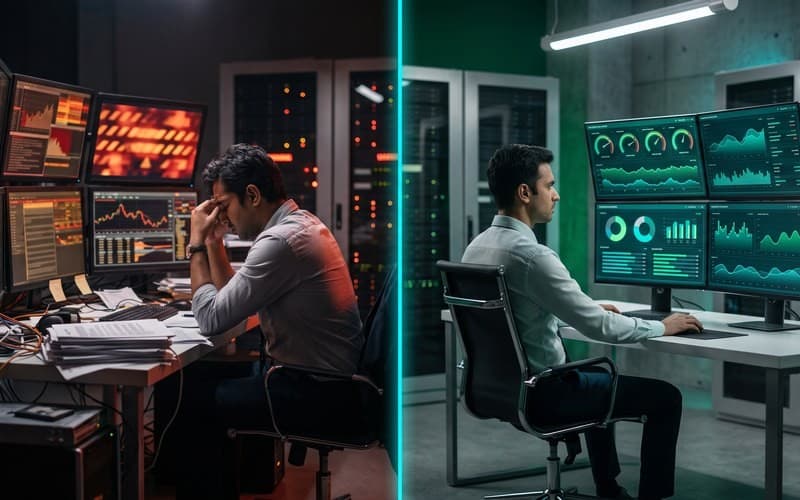
This illustrative case study examines how boutique currency funds and algorithmic trading desks overcome severe order latency when distributing master trading signals across hundreds of disparate client accounts. Synchronizing orders across heterogeneous broker platforms presents acute engineering challenges, where sequential loop execution rapidly degrades during volatile macroeconomic releases.
To solve these bottlenecks, Canvas Developers architected an event-driven worker engine that achieves reliable OANDA & FXCM group trading execution across 500+ accounts. By decoupling ingestion from execution via Redis Streams and concurrent Go workers, aggregate execution lag dropped from 1.4 seconds to under 85ms while eliminating dropped orders.
Summary: Sub-85ms Parallel Execution at a Glance
Managing asset allocations across diverse retail and institutional brokerages often exposes severe architectural bottlenecks. When a fund broadcasts trade signals across hundreds of discrete subaccounts, traditional sequential execution loops create high-frequency allocation bottlenecks. During volatile economic announcements, trailing accounts suffer severe price slippage, while broker gateway rate limits cause rejected transactions.
To address these challenges, this scenario showcases how an event-driven trade distributor achieves reliable OANDA & FXCM group trading execution across 500+ subaccounts. By decoupling signal ingestion from execution workers using Go and Redis Streams, aggregate group execution latency dropped from 1.4 seconds to under 85ms. This forex group trading latency optimization eliminated dropped orders during fast-moving market conditions, ensuring equitable order fills across all participating client portfolios.
The Challenge: Synchronizing 500+ Accounts Across Heterogeneous Broker APIs
Synchronizing order execution across 500+ accounts requires managing distinct broker interfaces and transport constraints. Unlike single-broker systems or standard PAMM multi account allocation OANDA setups that rely on unified omnibus accounts, multi-broker trade distribution demands independent API sessions for every subaccount. OANDA v20 operates on REST endpoints and HTTP streaming, where broker policies enforce strict thresholds: according to the OANDA Development Guide, REST traffic is capped at 120 requests per second per IP, with new connection handshakes limited to 2 per second. In contrast, an FXCM group trading trade copier integrates over persistent WebSocket or socket streams with distinct message limits and session lifecycles.
When trade copiers iterate sequentially across hundreds of accounts, network latency compounds with every socket write. Uncoordinated order bursts trigger HTTP 429 throttling errors on REST gateways and session drops on broker sockets. This serial fan-out creates severe execution drift across subaccounts while risking dropped fills during volatile market shifts.
What Was at Stake: Slippage, Execution Drift, and Missed Fills
In high-frequency foreign exchange trading, execution timing dictates fill quality and realized returns. Prior to this architectural refactor, sequential dispatch produced a cumulative execution lag of 1.4 seconds from the first subaccount to the 500th subaccount. During high-impact macroeconomic releases, currency quotes can swing multiple pips within milliseconds. Consequently, accounts situated toward the tail of the iteration loop suffered severe price slippage or outright gateway rejection.
As documented in this multi broker copy trading case study, uneven execution across managed portfolios damages investor confidence and disrupts balance proportionality. Client accounts expected consistent execution performance relative to the master signal. Instead, the 1.4-second aggregate delay generated persistent allocation discrepancies, where early accounts captured optimal entry prices while trailing accounts incurred unexpected execution drift, mismatched position sizes, and adverse fills.
The Solution: A Distributed Worker Engine Built on Go and Redis Streams
To eliminate serial dispatch latency, Canvas Developers designed an event-driven trade replication pipeline built around Go and Redis Streams. At the ingestion layer, master execution events are published directly into an in-memory Redis Stream. This architecture cleanly decouples upstream signal generation from downstream order routing, establishing a resilient, non-blocking queue that prevents message loss even when multiple trade signals fire simultaneously during sudden macroeconomic events.
Behind the ingestion stream, a distributed trade execution engine forex processes order events using concurrent Go worker pools organized into Redis consumer groups. Go goroutines consume allocation messages and immediately perform proportional lot-size calculations in memory. Accounts are partitioned into deterministic execution groups. Instead of broadcasting unthrottled requests that trigger broker rejections, the engine embeds per-broker token bucket rate limiters that calibrate request velocity against upstream gateway policies.
For the OANDA v20 subaccounts, worker nodes maintain persistent HTTP/1.1 connections with keep-alive headers, achieving high speed OANDA multi account execution without incurring repeated TCP handshakes or violating the 120 requests per second gateway ceiling. Concurrently, dedicated FXCM worker routines manage persistent socket connections with asynchronous message queues and acknowledgment tracking. This distributed parallel design replaces linear execution loops with controlled, sub-millisecond concurrent fan-out across all 500+ subaccounts.
Implementation: Engineering Phases, AI Scaffolding, and Rigorous Hardening
For high-throughput trade copiers, structured delivery phases ensure stability without risking capital. Engagements typically span a realistic timeline range of 4 to 8 weeks, advancing through upfront technical scoping, milestone-based pipeline engineering, simulated load testing, and production handover. During initial sprints, Canvas Developers leverages commercial AI coding harnesses to rapidly scaffold data models, protocol definitions, and boilerplate handlers, accelerating integration across heterogeneous broker interfaces.
However, AI coding tools have distinct boundaries in financial engineering. While AI efficiently generates boilerplate and client stubs, it consistently struggles with low-level concurrency hazards, race conditions, memory leakage under sustained load, and fine-grained financial security. To ensure the reliability of this distributed trade execution engine forex, experienced senior engineers direct system architecture, review every pull request, and govern all release decisions. Human expertise remains essential to verify thread safety across Go channel primitives and enforce secure credential isolation across hundreds of subaccount tokens.
Senior engineers also build the resilience layer required for production OANDA & FXCM group trading execution. This includes stateful circuit breakers, exponential backoff with jitter, automated socket re-authentication, and network partition recovery, isolating degraded connections without stalling group execution.
Results: Before and After Performance Metrics
The architectural shift from sequential processing to an event-driven worker pipeline delivered substantial performance gains for multi-account trade distribution. By executing allocations in parallel through broker-compliant connection pools, aggregate group execution latency dropped from 1.4 seconds to under 85ms across 500+ heterogeneous client accounts. Every subaccount received allocation commands within the same market tick, eliminating the severe execution drift that previously degraded trailing accounts.
Equally important, the system eliminated dropped orders during high-volatility news events. When sudden macroeconomic announcements triggered surges in market data and order flow, the decoupled Redis queue and token-bucket limiters prevented gateway timeouts and rate-limit rejections. This forex group trading latency optimization ensured that subaccounts across both OANDA and FXCM environments maintained uniform fill quality and consistent portfolio balances.
Lessons for Multi-Account Systems and Getting Started
This multi broker copy trading case study illustrates that scalable trade replication hinges on event-driven decoupling, persistent connection management, and strict rate-limit governance. For funds distributing signals across hundreds of discrete client logins, linear execution loops inevitably fail under high market volatility. Designing concurrent worker pools that balance rapid order dispatch against upstream broker thresholds is essential for dependable OANDA & FXCM group trading execution.
Building low-latency financial systems requires rigorous engineering discipline. While Canvas Developers uses advanced AI harnesses to accelerate development, our senior engineers direct system architecture, review every line of code, and validate critical concurrency and security logic. Whether developing high-speed trading engines, enterprise platforms, or custom integrations, teams can start with a scoped technical assessment or reach out through the contact form at Canvas Developers.