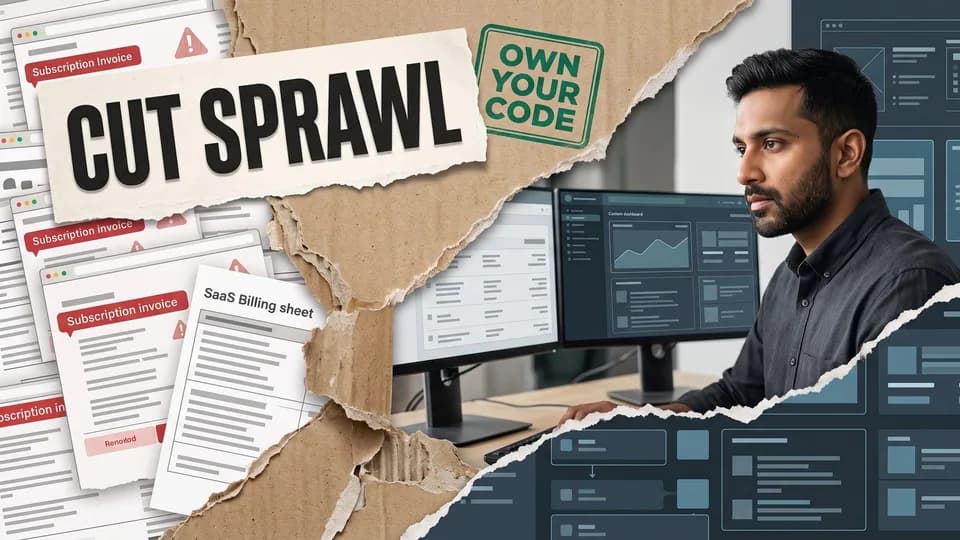
Evaluating custom internal tools vs SaaS has become a central priority for operational leaders seeking to eliminate software subscription redundancy and reclaim data control. While off-the-shelf software promises rapid deployment, the steady accumulation of disconnected point solutions frequently creates fragmented data silos, rising recurring seat licenses, and operational bottlenecks.
Modern engineering workflows that pair experienced software developers with AI coding tools now provide a sustainable alternative: purpose-built internal applications engineered around exact organizational workflows without ongoing licensing overhead.
Why Is SaaS Subscription Sprawl Draining Operations and Budgets?
The Hidden Friction of Compounding Per-Seat Subscription Fees
Modern enterprises frequently adopt specialized software solutions to address isolated operational requirements across departments. Over time, recurring per-seat subscription models transform modest software expenses into compounding fixed operational overhead. As headcount expands, licensing commitments scale linearly with organizational headcount, regardless of whether staff members actively require or utilize the advanced features bundled within each platform.
When leadership teams evaluate custom internal tools vs SaaS, the structural financial friction of seat-based licensing models becomes evident. Vendor pricing tiers often impose artificial limits on administrative roles, requiring expensive subscription upgrades simply to grant view-only access or basic approval rights to cross-functional stakeholders. This pricing dynamic penalizes organizational growth while delivering negligible incremental utility.
Manual Data Re-Entry Across Disconnected Third-Party Portals
Beyond direct subscription expenses, tool fragmentation introduces severe administrative inefficiencies across day-to-day operations. Disconnected third-party portals force personnel into repetitive manual data re-entry to synchronize customer records, inventory movements, and accounting entries across siloed platforms. When critical operational records reside in separate proprietary databases, routine reporting requires manual spreadsheet consolidation and error-prone reconciliation.
This administrative friction creates operational latency, introduces transcription discrepancies, and limits executive visibility into real-time business health. To replace SaaS sprawl sustainably, organizations require unified operational interfaces that connect directly to owned relational databases, ensuring consistent data governance and seamless departmental workflows.
How Did Off-the-Shelf SaaS Stop Serving Custom Business Workflows?
Paying for Bloated Feature Sets While Lacking Core Functionality
Commercial off-the-shelf software packages are deliberately architected to appeal to the broadest possible commercial market. Consequently, vendor product roadmaps prioritize peripheral capabilities designed for generic use cases while neglecting the nuanced edge cases unique to specific operational environments. Businesses frequently find themselves paying substantial subscription premiums for extensive feature catalogs that remain entirely unused across their operational teams.
Meanwhile, essential operational requirements—such as specialized billing calculations, custom approval chains, or proprietary milestone tracking—remain unsupported by off-the-shelf tooling. Internal teams are forced to construct fragile manual workarounds, maintaining supplemental spreadsheets alongside expensive software simply to complete everyday responsibilities. When organizations decide to replace SaaS sprawl, they redirect capital toward dedicated systems where every interface element and database field directly supports daily business execution.
Vendor Lock-In and Inflexible Third-Party Data Schemas
Rigid relational data structures in multi-tenant software environments prevent businesses from modifying core entities to mirror their operational workflows. When an enterprise attempts to adjust client classifications, track non-standard inventory attributes, or integrate legacy internal endpoints, off-the-shelf platforms restrict custom fields, enforce strict API rate ceilings, or gate programmatic webhook access behind expensive enterprise tiers.
These technical constraints impede operational agility and entrench severe vendor lock-in. Because data exports are frequently restricted to truncated flat files or nested proprietary formats, migrating historical operational records becomes technically arduous and costly. Investing in tailored architectures enables companies to streamline business workflows on their own terms, maintaining full ownership over underlying relational databases, backup pipelines, and long-term schema evolution without external vendor friction.
How Does AI-Assisted Engineering Make Custom Business Software Viable?
Accelerating Boilerplate Code, Admin UI, and Routine CRUD Logic
Historically, commissioning bespoke internal software required extensive development cycles dedicated to foundational plumbing. Developers spent weeks writing database migrations, wiring repetitive create, read, update, and delete (CRUD) endpoints, designing standard admin dashboards, and configuring form validation. This overhead inflated initial development investments, leading many teams to default to commercial SaaS subscriptions.
Modern AI coding agents and disciplined development harnesses compress these repetitive phases. In modern custom business software development, AI tools rapidly scaffold administrative interfaces, type-safe API controllers, and database schemas from structured specifications. By handling repetitive coding mechanics, development cycles accelerate, making bespoke software economically accessible for businesses seeking dedicated operational systems.
Why Senior Engineers Must Direct Architecture and Code Review
While AI coding agents accelerate implementation, unguided AI output introduces severe architectural vulnerabilities and technical debt. Generative models produce plausible syntax based on probabilistic patterns, but they lack contextual understanding of data integrity, complex transaction boundaries, and system resilience. Without rigorous oversight, automated code generation results in brittle architectures that fail in production.
Sustainable AI assisted business software requires experienced engineers, designers, and QA specialists directing the work. Senior engineers must establish core architecture, design database schemas, review every code change line by line, and retain sole authority over release decisions. AI speeds up engineering tasks, but experienced human professionals guarantee reliability, security, and long-term maintainability.
Local Controlled Model Harnesses vs Managed Cloud AI Tooling
Organizations transitioning away from subscription sprawl require development workflows that respect internal governance and data privacy. Engineering teams typically operate across two practical delivery packages based on organizational requirements.
The first model utilizes private or local AI engineering, deploying open-weight models within client-controlled infrastructure or agreed isolated environments. This ensures proprietary source code, operational workflows, and relational data never exit the organizational boundary. The second model applies commercial developer platforms, such as Claude Code or OpenAI Codex, under explicit enterprise cloud configurations approved by the client. Both models enable teams to accelerate delivery while maintaining complete authority over their technical assets.
Which SaaS Tools Should You Consolidate Into Bespoke Internal Systems?
Unifying Fragmented Sales Tracking and Invoicing into Custom Portals
Many growing enterprises manage commercial operations through fragmented software subscriptions: a standalone customer relationship management platform for deal tracking, a third-party accounting suite for invoicing, and separate digital signature portals for contract execution. Because these tools lack native relational synchronization, administrative personnel spend substantial time manually copying client records, contract values, and billing milestones across separate browser tabs. This disconnection routinely introduces billing lag, data discrepancies, and fractured customer histories.
When organizations build custom ERP CRM capabilities within a unified internal portal, they eliminate cross-platform friction. A tailored sales and billing module automates transaction progression directly from client acceptance to ledger entry, tax calculation, and payment dispatch. Through focused internal dashboard development, management gains immediate visibility into real-time receivables, pipeline health, and fulfillment queues from a single secure interface, removing the need to license multiple overlapping third-party sales tools.
Building Tailored ERP and Inventory Modules for Real Operations
Standard enterprise resource planning platforms and off-the-shelf inventory packages frequently impose rigid operational models that conflict with real-world distribution workflows. Companies managing custom manufacturing assemblies, specialized perishable lots, or complex multi-warehouse transfers often find commercial software incapable of tracking multi-tiered item states, custom unit conversions, or non-standard warehouse transit states.
Developing dedicated operational software allows companies to construct bespoke inventory modules that match physical warehouse logistics precisely. Internal systems can integrate directly with existing barcode scanners, automate supplier restocking triggers based on proprietary consumption formulas, and synchronize dispatch confirmations across regional distribution centers without third-party API restrictions. Rather than forcing staff into clumsy operational compromises to satisfy third-party software constraints, bespoke systems establish structured operational continuity while eliminating recurring enterprise licensing commitments.
Custom Internal Tools vs SaaS: What Does a Real-World Transition Look Like?
Scenario: Consolidating a Multi-Location Distribution Workflow
Consider a distribution enterprise managing operations across several regional facilities. In a typical SaaS environment, dispatch teams manage transit schedules in one tool, warehouse crews log stock in a separate platform, and accounting generates invoices through a third service. Because these systems do not share an underlying database, personnel spend hours re-entering order IDs, transfer quantities, and delivery confirmations across platforms.
By choosing custom internal tools vs SaaS, the enterprise consolidates these fragmented tools into a unified operations portal. A single relational database maintains inventory and shipment records in real time, eliminating synchronization lag and data discrepancies. Warehouse staff register stock movements through streamlined web interfaces, which immediately update inventory levels and trigger dispatch notifications across regional hubs. Consolidating these separate systems helps streamline business workflows across every department while removing administrative delays.
Comparing Upfront Capital Investment to Recurring License Overhead
Evaluating the transition from third-party subscriptions to owned software requires balancing initial capital costs against ongoing operational expenses. Commercial SaaS models impose recurring per-user fees, tier-based feature upgrades, and connector subscriptions that compound as headcount grows. Over several operational cycles, accumulated subscription fees can easily exceed the capital required to architect and deploy a purpose-built system.
Building tailored internal software involves an upfront investment in system architecture, engineering, and deployment testing. Once deployed onto cloud infrastructure controlled by the business, ongoing costs are limited to infrastructure hosting and routine maintenance. The business retains complete ownership of its code and data assets, adding team members and expanding operational throughput without incurring extra per-seat license penalties.
What Are the Honest Technical Trade-Offs of Building Custom Internal Tools?
Where AI Coding Fails: Complex Relational Logic and Data Scale
While modern generative models excel at standard boilerplate and predictable user interface components, autonomous AI systems encounter severe limitations when confronted with intricate architectural demands. In custom business software development, applications must enforce ACID compliance across complex relational schemas, preserve multi-table foreign key constraints, and maintain query performance under substantial data loads.
AI coding assistants lack deep structural context regarding distributed transaction isolation, database indexing strategies, and database concurrency controls. When generating database migrations or high-volume query logic without architectural direction, generative tools often introduce unindexed lookups, circular dependencies, or memory leaks that trigger system degradation under real-world operational scale.
Mandatory Human Oversight for Security, Authentication, and Payments
Deploying production-ready internal tools demands rigorous technical governance across sensitive attack surfaces. When building AI assisted business software, automated code generation cannot replace specialized engineering oversight for user authentication, role-based access control (RBAC), and session management. Generative tools frequently omit essential input sanitization, miss subtle privilege-escalation vectors, or generate outdated cryptographic implementations.
Similarly, workflows that process financial transactions, billing webhooks, or sensitive corporate records require strict human validation. Experienced software engineers, DevOps specialists, and QA professionals must audit every endpoint, implement secure payment gateway integrations, and verify token handling. AI tools accelerate initial code authoring, but human technical leadership remains mandatory to guarantee security compliance and operational stability.
How Can Your Business Plan a Scoped Migration to Owned Software?
Identifying High-Impact Operational Bottlenecks for an Initial MVP
Replacing subscription sprawl does not require a disruptive overnight overhaul of every internal tool. Organizations achieve the highest return by auditing current software subscriptions to identify acute operational bottlenecks—such as manual data reconciliation between sales and fulfillment. Scoping a focused initial minimum viable product (MVP) allows teams to replace SaaS sprawl incrementally, delivering immediate operational relief while validating core workflow improvements.
Beginning with a Scoped Assessment via Canvas Developers
Canvas Developers helps companies design and build bespoke business platforms that replace fragmented third-party subscriptions with owned software assets. Operating with an office in Dhaka, its experienced software engineers, designers, and DevOps specialists direct AI coding agents to accelerate delivery while rigorously governing architecture, security, and releases. To explore custom business software development for your operations, begin with a scoped assessment through the contact form at https://www.canvasdevelopers.com/contact.