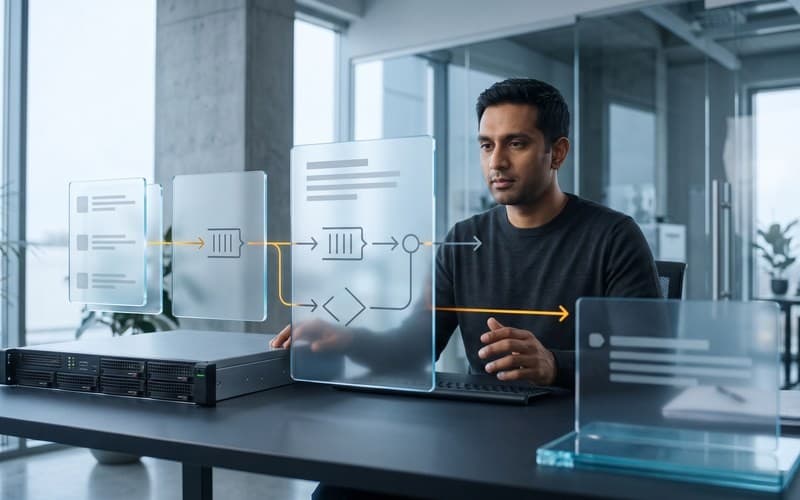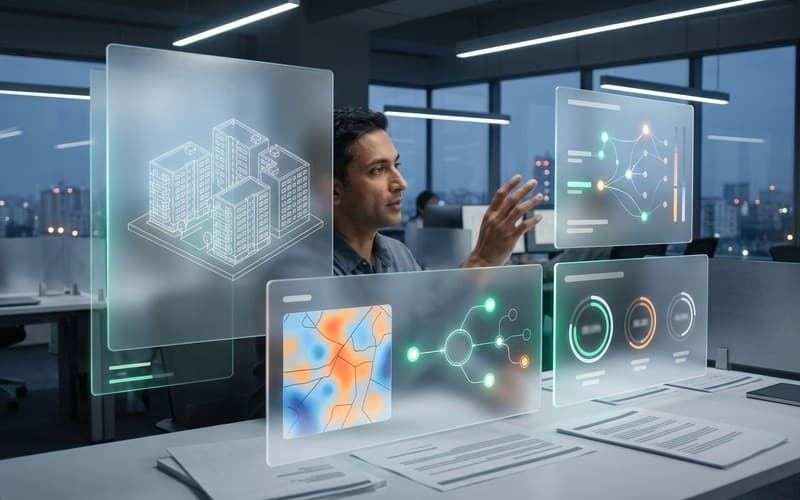
This illustrative example is a concept design created by Canvas Developers to demonstrate how engineering teams can implement a secure salesforce ai agent integration. Rather than delivered client work, this portfolio reference illustrates how autonomous agents can safely interact with enterprise CRM environments.
What Is the ApexBridge Illustrative example at a Glance?
ApexBridge is an illustrative architecture designed to showcase how autonomous agents connect with enterprise CRM platforms through a reliable salesforce ai agent integration, spanning Salesforce, Microsoft Dynamics 365, and Zoho CRM datasets. Built with Node.js and TypeScript on the open Model Context Protocol specification, the concept acts as a secure salesforce api agent bridge that converts CRM entities into validated JSON-RPC tool calls. At Canvas Developers, implementations combine an AI coding harness to accelerate interface scaffolding with senior engineers who direct system design, enforce strict validation, and approve production code.
Why Do Autonomous LLM Agents Need a Secure Salesforce Bridge?
Deploying autonomous LLM agents against production customer records introduces operational risks that direct API scripting rarely addresses. Without mediation, agentic loops can quickly exhaust Salesforce API request quotas and trip per-transaction governor limits through redundant queries or unconstrained retries. A dedicated, secure salesforce api agent bridge establishes essential rate-limiting barriers and throttles external requests before platform thresholds trigger service disruptions.
Furthermore, enterprise environments often partition customer relationship data across disparate platforms, requiring consistent semantic handling across Salesforce, Dynamics 365, and Zoho datasets. Uncontrolled agent writes pose significant data integrity and compliance hazards if field modifications lack strict role-based access control (RBAC). A hardened salesforce ai agent integration enforces field-level permissions, sanitizes incoming context, and ensures models operate exclusively within explicit security boundaries.
How Did Canvas Developers Combine AI Speed with Senior Engineering Oversight?
During salesforce mcp server development, Canvas Developers applies an engineered delivery methodology that pairs modern AI harness acceleration with rigorous human oversight. Autonomous coding agents generate type definitions, adapter scaffolding, and test fixtures rapidly, significantly compressing routine development cycles. However, autonomous generation alone cannot guarantee enterprise reliability.
Experienced software engineers direct the architectural blueprint, design the role-based access control (RBAC) boundaries, and conduct mandatory code reviews on every commit before release approval. Depending on corporate compliance requirements, client engagements select either Private / Local AI Engineering—hosting open-weight models within client-controlled infrastructure—or Claude Code / OpenAI Codex Engineering using approved commercial cloud environments. This dual approach ensures rapid interface construction while human specialists maintain complete accountability over data governance, system security, and API stability.
What Technical Architecture Powers the ApexBridge MCP Server?
ApexBridge implements modular Node.js and TypeScript services that expose core Salesforce objects—specifically Opportunities, Cases, and Accounts—as strongly typed tool calls under the Model Context Protocol. Rather than permitting direct database manipulation, the server defines discrete JSON schemas for querying records and updating fields. This structure establishes a reliable salesforce llm automated workflow, delivering structured context to models while enforcing deterministic execution across client requests.
To preserve platform stability, the architecture integrates token-efficient response caching alongside governor-limit throttling. High-frequency queries resolve through localized cache layers, minimizing redundant API calls and conserving context tokens. Simultaneously, outbound mutation requests are throttled against Salesforce platform quotas to prevent disruption during intensive agent operations.
Critical safety controls include automated human-in-the-loop review triggers for high-value deal modifications, requiring manager sign-off before committing major pipeline changes. Additionally, unified data adapter schemas normalize records across Zoho CRM and Microsoft Dynamics 365, enabling the server to serve as a versatile ai agent salesforce dynamics connector. This reusable design accelerates enterprise salesforce mcp server development across complex multi-CRM ecosystems.
What Are the Realistic Trade-offs of Autonomous CRM Workflows?
Deploying a salesforce crm autonomous pipeline tool delivers substantial efficiency for structured, routine tasks. Autonomous agents excel at retrieving account summaries, synthesizing support notes, and updating standard opportunity fields. These capabilities reduce administrative overhead across enterprise sales operations.
However, automation encounters limitations when handling complex validation logic, multi-stage approval hierarchies, or financial triggers. Unsupervised agents risk generating conflicting stage updates or triggering cascading workflow errors. Implementing mandatory human guardrails and escalation thresholds ensures that enterprise data governance remains protected without sacrificing operational responsiveness.
How Can Enterprise Teams Scope a Similar CRM AI Agent Integration?
Enterprise organizations planning a salesforce ai agent integration should begin by evaluating infrastructure requirements, weighing on-premise isolated models against managed commercial cloud APIs based on data compliance needs. Canvas Developers delivers tailored solutions across web apps, business systems, and AI integrations, starting with a scoped architecture assessment to define boundaries, milestone schedules, and security protocols before implementation. Explore your project requirements through the contact form at https://www.canvasdevelopers.com/contact.