The problem
Operational document systems must remain resilient against unstructured formatting variations, missing metadata, and model extraction drift. In enterprise document intake, unvalidated statistical predictions risk triggering irreversible business actions if automated models execute unilateral mutations against production databases. Additionally, reviewers cannot reliably audit model predictions without direct access to original source records, token offsets, and probabilistic confidence metrics.
Approach
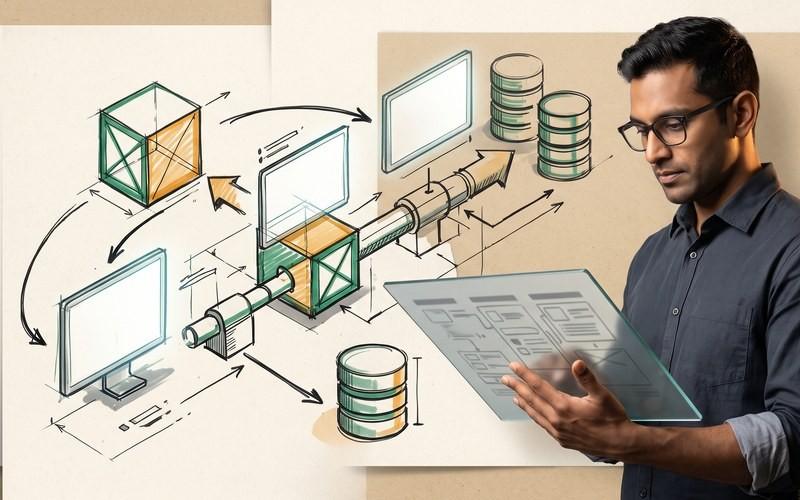
The architecture pairs modular extraction pipelines with human-in-the-loop governance by creating an immutable reviewable AI task upon document ingestion. Raw file ingestion, relational state machines in PostgreSQL, and linguistic extraction pipelines in spaCy are decoupled across asynchronous message boundaries to isolate inference latency from transactional state persistence. The system traces items across work queue, assignment detail, and activity timeline screens while gating all consequential downstream mutations behind explicit human approval.
Outcome
Automated acceptance tests verify that retried intake events mutate business state exactly once while exposing actionable failure states. Engineering oversight and continuous code reviews catch regressions early, reducing engineering rework and shortening feedback loops without compromising release stability.
Deploying a dependable Natural Language Processing (NLP) document intake and review system requires isolating text extraction from downstream operational state management. In operational environments, unstructured records must be parsed into auditable tasks where confidence metrics, source text, and human approvals govern every business mutation.
At Canvas Developers, our engineering approach pairs modular extraction pipelines with human-in-the-loop governance to mitigate unverified automation risks and manage operational uncertainty. This case study details our architectural blueprint for structuring reviewable tasks, tracing queue events, enforcing idempotent retries, and using engineering-led vibe coding to accelerate delivery without sacrificing release control.
How Does NLP Document Intake and Review Fit Operations Workspaces?
Modern operations workspaces depend on consistent data contracts to convert raw files into structured business transactions. In our approach to Natural Language Processing (NLP) document intake and review, incoming files do not trigger uncontrolled updates. Instead, every ingestion event generates a distinct work item that couples extracted text entities with workflow governance.
The Core Record: Structuring the Reviewable AI Task
The foundation of this architecture is the reviewable AI task. Rather than passing raw model outputs directly to databases or downstream ERP ledgers, our pipeline creates an immutable core record upon document ingestion. This task envelope encapsulates the raw document reference, the extracted structured payload, individual token confidence metrics, and lifecycle state flags.
By treating the extracted entity graph as an uncommitted draft subject to review, the record isolates untrusted machine predictions from consequential database writes. The record defines explicit fields for entity values, bounding boxes or text offsets, validation states, and audit stamps, ensuring complete provenance across the intake lifecycle.
Role Handoffs Across Queue, Assignment, and Timeline Screens
Effective document intake and review development requires clear separation of duties across three primary workspace interfaces: the work queue, assignment detail, and activity timeline screens.
Knowledge workers ingest and categorize source files through the work queue, where automated prioritization surfaces high-volume items. Reviewers operate primarily within the assignment detail screen, inspecting side-by-side comparisons between the source document and NLP-inferred fields before approving changes. Meanwhile, workspace administrators monitor the activity timeline screen to inspect throughput, track reassignments, and audit processing states. This role-based workflow guarantees that handoffs remain transparent, observable, and strictly governed from initial receipt to final sign-off.
What Constraints and Failure Modes Must Document Workflows Handle?
Operational document systems must remain resilient against unstructured formatting variations, missing metadata, and model extraction drift. In enterprise document intake, effective Natural Language Processing (NLP) integration requires establishing strict visibility safeguards and architectural barriers that prevent unvalidated statistical predictions from triggering irreversible business actions.
Preserving Source Access and Confidence Scores for Reviewers
Reviewers cannot reliably audit model predictions without direct access to original source records. In our Natural Language Processing (NLP) document intake and review architecture, extraction payloads retain exact pointer references to source files, including page indices, token offsets, and visual bounding coordinates. Alongside each extracted entity, the interface displays probabilistic confidence scores generated during inference.
When an entity score falls below a defined operational threshold established by workspace administrators, the workspace automatically flags the field in the assignment detail screen. Reviewers inspect the source snippet side-by-side with the parsed output, resolving ambiguities and catching edge cases before verifying critical data.
Gating Consequential Operations Behind Visible Human Approval
Statistical extractors must never execute unilateral mutations against production databases or external APIs. Our architecture gates all consequential downstream actions—such as enterprise ledger adjustments, client notifications, or vendor payments—behind mandatory human approval.
The reviewable AI task enforces a deterministic state machine where processing cannot advance to a completion state while low-confidence alerts or unassigned review tasks persist. When a reviewer overrides an extracted entity, the platform records the manual correction, logs the reviewer identity in the activity timeline, and preserves the initial model prediction for auditing. This human-in-the-loop gate ensures that automated parsing accelerates intake without exposing core business state to unvetted outputs.
Which Architecture Isolates NLP Extraction From Non-NLP Orchestration?
Decoupling machine learning inference from business logic is essential for stable enterprise operations. In our Natural Language Processing (NLP) development strategy, we isolate model inference services behind asynchronous message boundaries so that heavy linguistic processing never blocks ingestion or transactional state persistence.
Separating Document Ingestion and State Machines from Model Calls
Our architecture separates raw file ingestion, relational state machines, and extraction pipelines into independent services. When an incoming file lands in object storage, an ingestion worker parses the file structure and registers an unassigned task in PostgreSQL before emitting an extraction event. Model inference does not occur in-process within the web server. Instead, dedicated workers pull extraction jobs and run modular linguistic pipelines—such as custom pipelines configured in spaCy processing pipelines that segment tokens and extract named entities without executing database mutations.
This strict boundary protects the workspace state machine from inference latency, memory pressure, or external API timeouts. If an NLP model container crashes or throttles, the ingestion engine and review queues remain fully operational, buffering tasks until model capacity resumes.
Maintaining Traceable Queue Events from Intake to Completion
Robust document intake and review development requires continuous observability as items progress through operational states. Our design traces each document through five distinct states: INGESTED, EXTRACTION_PENDING, REVIEW_REQUIRED, CHANGES_REQUESTED, and COMPLETED.
Every lifecycle transition generates an immutable event log captured in the activity timeline. When a queued event moves to assignment, the system records the timestamp, assigning user, model version ID, and extraction payload hash. By decoupling state orchestration from inference workers, administrators can audit processing bottlenecks, review queue depth, and ensure complete accountability across every document from initial intake to final verified completion.
How Are Idempotent Retries and Intake Boundaries Verified?
A production-ready data pipeline must enforce rigorous boundary checks and fault-tolerant execution semantics. In practical Natural Language Processing (NLP) integration, transient network partitions, worker timeouts, or duplicate webhook payloads must never compromise data integrity or trigger duplicate business transactions.
Acceptance Criteria for Single State Mutation and Actionable Errors
Our acceptance criteria mandate strict idempotency across all intake stages. When an ingestion message or extraction job is retried, the database transaction boundary guarantees that business state mutates exactly once via deterministic idempotency keys derived from the file hash.
The reviewable task lifecycle is verified against three automated acceptance checks:
- Idempotent persistence: Retried intake events update existing task records without creating duplicate ledger entries or database mutations.
- Actionable failure states: Corrupted payloads or worker timeouts immediately flag the task with diagnostic error codes and reviewer alerts.
- Approval enforcement: Consequential downstream mutations remain strictly locked until an authorized reviewer explicitly logs approval.
Evaluating Simpler Rule Extraction Versus Full NLP Pipelines
Disciplined document intake and review development requires selecting the simplest extraction mechanism that satisfies business requirements. While statistical machine learning excels at variable correspondence, deploying heavy models for fixed formats introduces unnecessary latency, operational costs, and non-deterministic variability.
Where documents follow rigid templates, our engineering practice evaluates deterministic regular expressions or template parsers before invoking statistical extractors. By isolating non-NLP deterministic logic into dedicated pre-processors, we reserve complex NLP pipelines exclusively for genuinely unstructured text, ensuring maintainable boundaries and predictable execution across the workspace.
How Does Engineering-Led Vibe Coding Accelerate Implementation?
Engineering teams can significantly compress build cycles by combining generative tooling with disciplined engineering oversight. When approaching Natural Language Processing (NLP) vibe coding, rapid generative scaffolding must remain anchored to strict architectural standards.
AI Scaffolding Paired with Human Code Review and Release Control
At Canvas Developers, AI coding agents and a leading AI harness speed up design, engineering, QA, and DevOps workflows—scaffolding queue user interfaces, assignment detail panels, and typed API endpoints in rapid iterations. However, while AI coding tools accelerate initial scaffolding, experienced engineers direct the work, own the architecture, review every code change, and decide all releases.
AI tools excel at boilerplate generation and initial component layout, but they often overlook nuanced edge cases, authentication boundaries, and transactional consistency. Experienced engineers verify data validation logic, audit security perimeters, and implement automated acceptance tests that catch regressions early, reducing engineering rework and shortening feedback loops without compromising release stability.
Choosing Between Private Local AI and Cloud Harness Deployments
Deploying enterprise Natural Language Processing (NLP) development requires selecting a delivery architecture aligned with organizational governance and privacy requirements. Canvas Developers provides two structured delivery paths: 'Private / Local AI Engineering' for organizations requiring privately hosted open-weight models deployed inside client-controlled infrastructure or isolated virtual private clouds, and 'Claude Code / OpenAI Codex Engineering' for teams utilizing commercial AI coding tools with client-approved cloud security settings.
Every engagement begins with thorough scoping, progressing through agreed milestones, automated test suites, and structured handover. Teams evaluating a document intake architecture can request a scoped technical assessment detailing their current stack, intake volume, and validation constraints through the contact form at https://www.canvasdevelopers.com/contact.