The problem
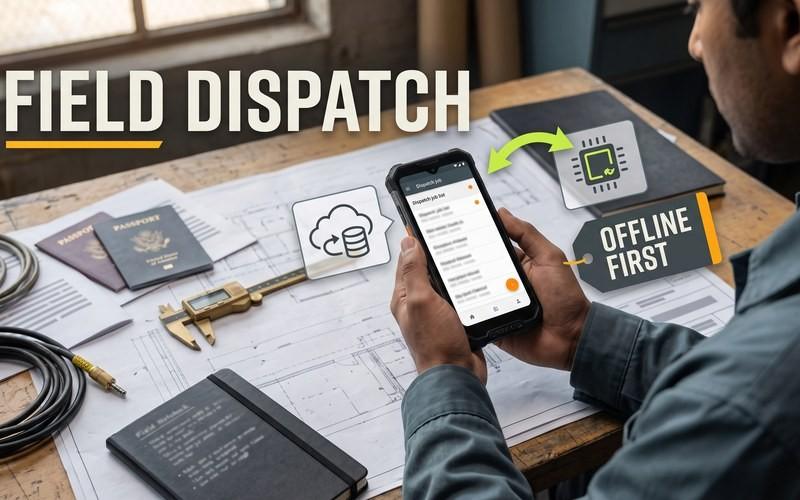
Coordinating field operations demands strict precision across customer intake, technician allocation, and on-site completion. In high-volume dispatch operations, uncoordinated edits create race conditions, split ownership, and duplicate technician assignments. Furthermore, mobile dropouts and intermittent network partitions routinely trigger retried status updates that can cause state corruption without robust handling.
Approach
Canvas Developers pairs AI-assisted UI scaffolding with senior architectural oversight to deliver a decoupled field-service dispatch workspace. The architecture enforces explicit state transitions on core service requests and uses optimistic concurrency control with monotonic versioning to prevent conflicting operator edits. Inbound retries are processed idempotently via an append-only transactional deduplication store, while asynchronous outbox workers update read projections and anti-corruption layers isolate external capabilities.
Outcome
By pairing rapid UI scaffolding with senior architectural controls, engineering teams aim to reduce delivery cycles and rework while maintaining stability across dispatch operations.
Coordinating field operations demands strict precision across customer intake, technician allocation, and on-site completion. When engineering a modern Vibe-Coding Consulting & Governance field-service dispatch workspace, technical teams must reconcile responsive operator interfaces with deterministic backend integrity. Rapid AI scaffolding can generate clean operational layouts and triage views in hours, yet enterprise-grade dispatch workflows require resilient state machines and robust event boundaries.
At Canvas Developers, our engineering team builds mission-critical applications by pairing AI-assisted interface iteration with senior architectural oversight. This architectural walkthrough examines how core service requests flow across operational roles, how event-driven handlers resolve concurrency conflicts, and how verifiable acceptance tests guarantee idempotent execution across distributed dispatch systems.
How Does a Field-Service Dispatch Workspace Coordinate Requests Across Roles?
Mapping core records across work queues, assignment details, and activity timelines
Effective field-service dispatch workspace development centers on a unified domain entity: the service request. In a multi-role operational environment, three primary stakeholders interact with this record across dedicated user surfaces. Customers submit initial service requests and track technician arrival windows; service operators triage incoming tickets, assess technician availability, and balance regional workloads; and organization administrators manage skill requirements, territorial routing policies, and audit logs.
To maintain operational cohesion without data fragmentation, the workspace projects the underlying service request record across three distinct synchronized views:
- Work queue: A real-time triage view presenting pending tickets, priority tiers, regional tags, and SLA countdowns for service operators.
- Assignment detail: A dedicated workspace pane displaying customer diagnostic telemetry, required spare parts, technician schedule conflicts, and vehicle routing constraints.
- Activity timeline: An append-only chronological log detailing state changes, internal operator notes, technician transit updates, and customer communications.
Tracking state transitions from customer intake to verified operational completion
Maintaining operational reliability across these views requires explicit lifecycle modeling. Rather than permitting arbitrary field edits, the core domain engine enforces formal dispatch queue state transitions. A service request begins in QUEUED upon customer intake, shifts to ASSIGNED once an operator designates a technician, moves to IN_PROGRESS when on-site diagnostics begin, and reaches COMPLETED upon verified operational sign-off.
Every transition validates prerequisite domain invariants before committing state changes. For example, moving a request from QUEUED to ASSIGNED requires a valid technician identifier, confirmed regional coverage, and an open scheduling slot. Persisting each state mutation directly to the activity timeline ensures that customers, operators, and administrators observe an aligned, tamper-resistant audit trail, substantially mitigating unmonitored ticket loss and conflicting status updates.
How Are Concurrency Conflicts and Event Failures Managed in Dispatch Queues?
Preventing race conditions and split ownership during concurrent operator edits
In high-volume dispatch operations, multiple regional coordinators frequently triage the same service queue simultaneously. Without rigorous concurrency controls, uncoordinated edits create split ownership, double assignments, or silently overwritten technician dispatches. In our system design, we prevent these race conditions using optimistic concurrency control (OCC) anchored by monotonic record versioning.
When an operator opens a service request in the assignment detail view, the client receives the entity's current version identifier. Any state mutation—such as assigning a technician or updating parts requirements—submits a conditional write payload requiring an exact version match (WHERE id = :id AND version = :expected_version). If a concurrent update increments the version first, the database rejects the subsequent mutation. The dispatch workspace captures this conflict and prompts the second operator with an actionable diff view, ensuring ownership transitions remain completely transparent and conflict-free.
Handling retried events idempotently to expose actionable failure states
Mobile dropouts and intermittent network partitions routinely cause technician mobile apps and automated routing webhooks to retry status updates. As established in the event-driven architecture pattern documentation, consumers operating over at-least-once delivery channels require robust idempotent event processing to prevent state corruption. Our architecture implements an append-only transactional deduplication store keyed on unique event and request identifiers.
When an inbound event arrives, the consumer checks the idempotency table within the database transaction boundary. If the event was already committed, the handler returns the cached acknowledgment without re-executing downstream side effects or generating duplicate notifications. If an unrecoverable validation failure occurs—such as a technician attempting an invalid transition from QUEUED directly to COMPLETED—the system logs an actionable error in the activity timeline, surfaces a visual alert in the work queue, and diverts the payload to an operational dead-letter queue. This structured fault tolerance provides the necessary architectural guardrails for reliable Vibe-Coding Consulting & Governance integration across real-time dispatch systems.
Which Architecture Enforces Explicit Ownership and State Machine Transitions?
Decoupling reactive UI screens from domain event handlers and audit persistence
A dependable field-service dispatch architecture enforces strict boundaries between responsive operator interfaces and core domain state machines. In our architectural approach, the front-end dispatch workspace—comprising the work queue, assignment detail, and activity timeline—communicates with the backend exclusively through typed command gateways and real-time subscription streams. When an operator triggers a ticket reclassification, the client dispatches a discrete command intent rather than executing direct database mutations.
The command handler validates operator permissions, confirms state machine constraints, and writes the resulting domain event to a transactional outbox table within the same transaction that updates the core aggregate. Asynchronous background workers project these events into specialized read stores optimized for low-latency filtering in the work queue and historical audit logging in the activity timeline. Decoupling UI components from persistence logic guarantees that interface re-renders remain fast while preserving a tamper-resistant historical audit trail.
Isolating unsupported service capabilities outside the core dispatch boundary
During Vibe-Coding Consulting & Governance development, maintaining clear boundaries between core domain logic and external systems is vital for operational stability. While rapid AI scaffolding accelerates the creation of operator dashboards, triage queues, and data entry forms, AI-generated components must never dictate distributed state transitions or mission-critical invariants. Similarly, specialized external capabilities—such as automated route optimization algorithms, vehicle telematics feeds, and billing gateways—must remain strictly decoupled from core dispatch coordination.
We isolate these auxiliary services behind anti-corruption layers and asynchronous message boundaries. If a third-party telematics provider experiences an outage or returns malformed coordinates, the core dispatch workspace isolates the disruption. The work queue falls back gracefully to manual operator routing without interrupting technician assignments or corrupting service request states, safeguarding overall system resilience.
How Do Acceptance Tests Validate Idempotency and Operational Trade-Offs?
Verifying single-execution guarantees under synthetic network retries
Engineering a dependable Vibe-Coding Consulting & Governance field-service dispatch workspace requires automated acceptance testing that simulates real-world network instability. During automated test cycles, test harnesses inject duplicated webhooks, delayed technician telemetry, and out-of-order transition payloads directly into the intake pipeline.
Our acceptance suite validates that idempotent event processing holds under concurrent retry storms. When duplicate completion events with identical transaction keys arrive simultaneously, the persistence boundary commits the transition once while returning cached acknowledgments for repeated requests. Furthermore, the test suite verifies that invalid transitions fail explicitly, generating structured error logs on the activity timeline rather than corrupting record states.
Weighing dispatcher latency against strict distributed consistency constraints
Balancing operational responsiveness with data consistency involves clear engineering trade-offs. Enforcing linearizable consistency across every UI interaction introduces coordination latency that degrades operator efficiency during dispatch surges.
To resolve this tension, our architecture applies optimistic locking at the core record boundary while utilizing read projections for the work queue. Key acceptance criteria include:
- Single-execution guarantee: Retried mutation payloads alter business state exactly once, verified by monotonic version assertions.
- Conflict visibility: Concurrent updates surface actionable resolution prompts immediately upon collision detection without stalling queue operations.
- Graceful degradation: When distributed message brokers experience lag, operators retain read-only triage access to local queue snapshots.
For smaller regional dispatch fleets with few concurrent coordinators, a simpler relational database with row-level locks often suffices, avoiding the operational overhead of asynchronous event brokers.
How Does Governed Vibe-Coding Scaffolding Streamline Dispatch Workspace Delivery?
Modern engineering workflows leverage AI coding assistants to accelerate early interface development. In our practice of Vibe-Coding Consulting & Governance, vibe coding workflows allow development teams to utilize a leading AI harness within Canvas Developers' structured delivery packages: 'Private / Local AI Engineering' for privately hosted open-weight models in client-controlled infrastructure, and 'Claude Code / OpenAI Codex Engineering' for approved commercial cloud environments. This automation enables teams to rapidly assemble interactive operator layouts, ticket filters, and state timeline components, shortening early feedback loops without exposing unreviewed code to production.
However, AI-generated prototypes frequently overlook domain boundary discipline, concurrency safeguards, and enterprise security controls. Effective Vibe-Coding Consulting & Governance development bridges this gap through disciplined engineering governance. While AI assistants scaffold UI primitives and boilerplate handlers, experienced senior engineers direct system architecture, enforce deterministic state machine transitions, and conduct line-by-line code reviews. Core responsibilities—such as role-based access control, tenant data isolation, transactional deduplication, and database connection pooling—remain firmly under human engineering oversight.
By pairing rapid UI scaffolding with senior architectural controls, engineering teams aim to reduce delivery cycles and rework while maintaining rigorous stability across dispatch operations. To evaluate your technical requirements, explore our vibe-coding consulting and governance services or reach out through our contact form with your existing stack, dispatch workflows, concurrency constraints, and target outcomes for a scoped technical assessment.