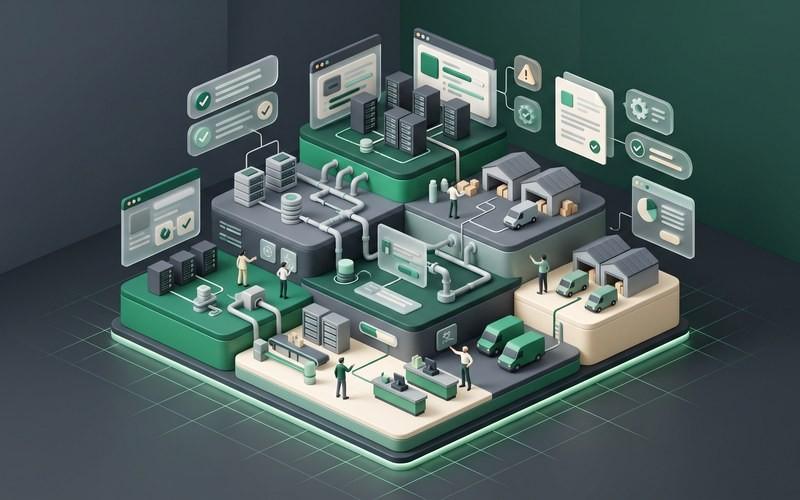
A resilient deployment pipeline requires immediate visibility and deterministic intervention when automated workflows fail under downstream pressure. The Software QA & Testing incident recovery console coordinates release tasks across engineering roles, providing unified health diagnostics, granular job telemetry, and controlled recovery workflows. Designed by Canvas Developers, our approach integrates structured resilience testing and environment safeguards to ensure production outages never corrupt transactional progress or bypass audit gates.
How Does the Incident Recovery Console Coordinate Release Tasks Across Teams?
Modern continuous delivery workflows require a unified operational plane when automated rollouts stall across distributed cloud infrastructure. As part of our Software QA & Testing development methodology, we structure the Software QA & Testing incident recovery console around the release task as an immutable atomic record. Persisted in a PostgreSQL database and synchronized with CI/CD engines like GitHub Actions and ArgoCD, each task encapsulates container digests, database migration scripts, test logs, and target environment configurations.
The console coordinates three distinct engineering roles through specialized telemetry interfaces:
- Developers: Inspect failing test runners, parse stack traces, and link OpenTelemetry span errors directly to pull request diffs.
- Reviewers: Validate automated compliance reports, inspect static analysis output, and approve conditional deployment gates.
- Operations Engineers: Govern Kubernetes deployment boundaries, monitor cluster capacity, and trigger isolated recovery scripts under least-privilege service accounts.
Anchoring multi-service triage to a single record eliminates fragmented debugging across messaging channels. Dual-operator verification gates prevent unverified hotfixes, maintaining clear audit trails between automated testing frameworks and live production systems.
What Do Operators Inspect Across Health Views, Failed Jobs, and Retry Actions?
Real-Time Health Status and Failed-Job Diagnostics
The primary health view delivers an aggregated control panel across active Kubernetes pods and staging environments. Prometheus-backed metrics track pipeline throughput, downstream p99 latency, and remote API availability. When all stages operate within normal thresholds, an empty state displays healthy cluster nodes and upcoming deploy windows. If a network blip or service dependency degrades performance, amber status badges immediately isolate the impacted cluster zone.
Drilling into an alert surfaces the failed-job inspector. Rather than forcing engineers to wade through raw stdout buffers, the interface ingests structured JSON logs from pytest, Playwright, and Docker daemon events. It groups failures by signature—such as schema assertion mismatches, gRPC deadline exceeded errors, or container memory limits. Through our approach to Software QA & Testing integration, developers can immediately determine whether an issue represents a flaky end-to-end test or an unresponsive cloud datastore.
Controlled Retry Workflows Under Least-Privilege Safeguards
When an engineer identifies a transient error, corrective action occurs via a structured retry modal rather than arbitrary shell executions. In our disciplined approach to incident recovery console development, retries require operators to pinpoint the failed lifecycle stage, verify cryptographic idempotency keys in Redis, and select explicit execution bounds before queuing a job.
Role-based access controls and AWS IAM session policies enforce least-privilege execution. Developers can retry non-mutating test suites or staging tasks directly, but executing database seed reruns or production redeployments demands authorized operations approval. Before dispatching tasks, automated pre-flight checks inspect relational tables for uncommitted transactions. If a previous run halted mid-migration, the action aborts until rollback validation succeeds, preventing orphaned database state and duplicate webhook events.
How Does the Data Flow Manage Dependency Outages and Retry Budgets?
Handling Timeouts and Exhausting Retry Budgets Gracefully
When an external dependency falters during a deployment run, unconstrained retries can trigger devastating retry storms. As detailed in the Amazon Builders' Library guide on timeouts and backoff, aggressive client retries amplify backend pressure and convert localized delays into wider outages. In our architecture, every remote release task step defines explicit connection and request timeouts to release thread and socket resources promptly.
Rather than allowing endless retries, the console implements capped exponential backoff with full jitter and a token-bucket retry budget. Adopting resilience standards from Google SRE overload handling, client-side throttling caps retry volume to 10% of overall traffic with a maximum of three attempts. Once a job exhausts its retry budget, the system sheds further attempts, records OpenTelemetry trace diagnostics, and transitions the release task into a paused state.
Preserving Completed Release State in Degraded Modes
The primary acceptance criterion of automated release task recovery is that downstream failures must trigger a visible degraded state without corrupting completed work. Within our Software QA & Testing integration framework, each execution phase is treated as a discrete, transactional checkpoint. Passed test suites, compiled container images, and applied database schema migrations are committed with SHA-256 checksums to the PostgreSQL ledger.
When a dependency outage halts a downstream stage, the console reflects a degraded operational status across health views while freezing upstream state. Because mutating deployment actions require unique Redis idempotency tokens, operations engineers can resume execution precisely from the interrupted step once the dependency recovers. This deterministic boundary guarantees that partial failures never corrupt release integrity, duplicate data modifications, or force time-consuming full pipeline restarts.
How Does Engineering Review Ensure Reliable Scaffolding and Rollback Safety?
At Canvas Developers, rapid interface prototyping and workflow generation benefit significantly from AI-assisted tooling. When adopting Software QA & Testing vibe coding practices, our teams use AI coding models to scaffold Next.js dashboard layouts, TypeScript interfaces, and mock state handlers. This rapid generation shortens feedback loops during early design exploration, allowing engineers to test visual ergonomics and event dispatchers quickly.
However, AI code generation cannot replace rigorous engineering review. While AI models excel at generating boilerplate forms and layout components, they frequently overlook distributed concurrency boundaries, edge-case network partitions, and credential lifecycle rules. Experienced engineers at Canvas Developers directly own the system architecture, inspect every pull request diff, and mandate automated Vitest and Playwright test suites for the resilience testing console.
Our engineering review verifies rollback safety, least-privilege IAM scoping, and transactional idempotency before any generated module connects to production environments. Combining AI-assisted scaffolding with senior human oversight accelerates delivery while preserving enterprise-grade reliability and security governance.
How Can Teams Scope an Incident Recovery Console for Their Deployment Stack?
Teams running simple, single-service pipelines with low deployment volume often find standard CI/CD retry plugins sufficient. A dedicated Software QA & Testing incident recovery console is warranted when multi-service deployments require cross-team coordination, strict rollback verification, and retry budget governance.
Scoping begins with four core implementation milestones:
- Mapping pipeline dependencies and setting granular timeouts.
- Configuring role-based permissions across developers and operations engineers.
- Enforcing transactional idempotency and state checkpoints on release tasks.
- Testing degraded-state resilience under simulated dependency outages.
Canvas Developers helps engineering organizations design, harden, and integrate operational tooling for mission-critical pipelines. Explore our Software QA & Testing services or start a scoped assessment via the Canvas Developers contact form to review your deployment stack, constraints, and recovery goals.
Outcome
Downstream dependency outages trigger a visible degraded operational state across health views while upstream progress remains frozen, ensuring partial failures never corrupt release integrity or force full pipeline restarts.