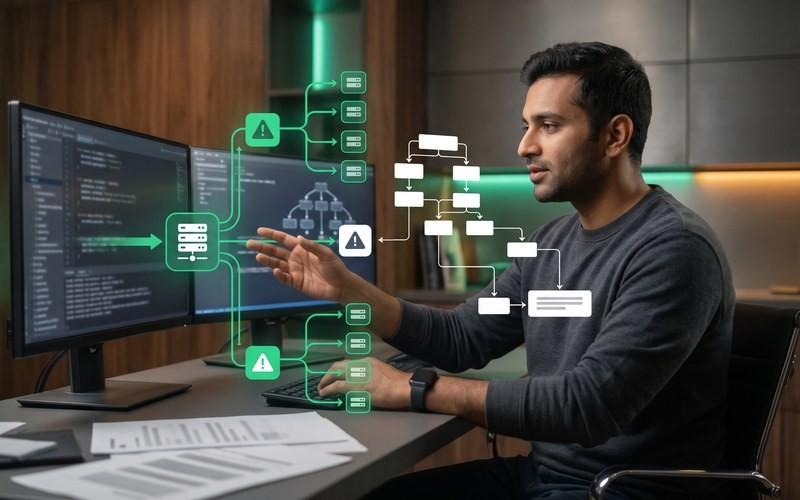
Deploying an algorithmic trading bot directly to production without live-market simulation exposes capital to severe operational risks, from runaway execution loops to unhandled order rejections. An alpaca paper trading integration establishes a protected sandbox environment that mirrors live order routing, real-time quote feeds, and account lifecycle states without financial exposure.
By connecting Alpaca's paper trading environment to automated continuous integration and continuous delivery (CI/CD) pipelines, engineering teams can validate order logic, verify state reconciliation, and enforce strict risk invariants on every pull request. This guide outlines how to build an automated testing sandbox, account for key execution differences between paper and live trading, and implement production-grade quality assurance protocols.
Why Is Pre-Production Sandbox Testing Non-Negotiable for Trading Bots?
In algorithmic trading, software defects translate directly into immediate capital loss. A subtle concurrency bug, an unhandled HTTP retry loop, or an uncaught decimal precision mismatch can dispatch dozens of duplicate orders in seconds, exhausting available margin and triggering forced liquidations. While unit tests verify deterministic business logic and mathematical calculations, they cannot evaluate how execution algorithms behave against asynchronous broker acknowledgments, fluctuating bid-ask spreads, and live streaming market events.
Bridging this gap requires engineering teams to move beyond offline backtesting. Traditional backtests operate under idealized assumptions: historical price bars are clean, fills are modeled instantaneously at exact bar boundaries, slippage is static, and network latency is zero. Real market infrastructure behaves differently. Socket connections drop, market data feeds stutter, and exchange gateways reject malformed requests. Integrating an alpaca paper trading integration into the pre-production workflow creates a resilient bridge between quantitative modeling and live market realities.
By prioritizing testing stock trading bot alpaca paper trading runs inside an isolated pre-production environment, developers can validate the entire order lifecycle—from dispatch and broker acceptance to partial fills, cancellations, and account balance reconciliation. This end-to-end execution testing ensures that position limits, capital protection rules, and order throttling routines operate reliably before real assets are placed on the line.
How Does Alpaca's Paper Trading Environment Differ from Live Trading?
Key Alpaca Paper vs Live API Differences: Endpoints, Auth Keys, and Account States
While Alpaca maintains identical REST schemas across environments, infrastructure access is strictly partitioned. According to Alpaca's authentication documentation, paper trading requests route to https://paper-api.alpaca.markets via the APCA_API_BASE_URL variable, whereas live trading targets https://api.alpaca.markets. Authentication keys are mutually exclusive: paper API credentials fail immediately if directed toward live endpoints, preventing accidental execution bleed.
Both environments share the data endpoint at https://data.alpaca.markets, with paper accounts entitled to real-time IEX feeds. Paper accounts initialize with a default $100,000 balance and can be reset via dashboard controls, while enforcing the standard 200 requests-per-minute rate limit. Understanding these alpaca paper vs live api differences is essential for clean environment isolation.
Simulated Order Execution Mechanics: Immediate Fills, Slippage, and Market Depth Limits
Order simulation in the paper environment mimics live trading but operates on synthetic assumptions. As detailed in Alpaca's paper trading documentation, orders are never routed to physical exchanges; instead, the broker matches orders virtually against the prevailing National Best Bid and Offer (NBBO). Non-marketable limit orders remain open until quotes reach their price, and approximately 10% of eligible executions experience random partial fills to exercise client-side handling logic.
However, the simulated order execution alpaca sandbox does not evaluate available market depth. A large order that would exhaust book liquidity in live trading fills completely in the sandbox without causing market impact or price slippage. Furthermore, the simulation omits queue positioning, exchange latency, regulatory fees, and short-sale borrow fees. Engineering teams must treat sandbox fills as behavioral verifications of bot state rather than predictive models of live market execution economics.
How Do You Architect an Automated Test Harness with Alpaca Paper API?
Isolating Sandbox Credentials and Test Account States per Run
An effective alpaca paper trading integration inside an automated test harness requires strict credential and state isolation across test runs. Because Alpaca paper accounts maintain state across API requests, concurrent test executions or sequential integration runs can easily collide if they operate against the same account without teardown routines. When multiple pipeline jobs dispatch concurrent market orders or alter equity balances, test assertions fail unpredictably due to dirty account state rather than defective bot logic.
To guarantee repeatable execution testing, engineering teams must inject credentials dynamically into isolated execution containers. Test runners authenticate via environment variables—APCA_API_KEY_ID, APCA_API_SECRET_KEY, and APCA_API_BASE_URL pointing to https://paper-api.alpaca.markets—stored in dedicated secrets managers rather than static configuration files. Before executing order workflows, the harness issues an automated pre-flight reset: canceling existing open orders and liquidating lingering positions. For multi-tenant or parallel CI builds, provisioning dedicated paper sub-accounts ensures each test suite starts from a deterministic cash balance with zero active exposure.
Programmatic Synthetic Event Injection and Order State Verification
Beyond credential hygiene, a resilient automated test harness alpaca paper api implementation must programmatically verify how trading algorithms handle complex lifecycle transitions. Real-world execution requires validating that state machines process every broker acknowledgment: order creation, acceptance, partial fills, full fills, and cancellations. Test runners should programmatically inject edge cases, such as simulated socket disconnections, delayed responses, and rejection payloads, confirming that reconnect handlers and exponential backoff mechanisms recover gracefully without dropping orders or submitting unintended duplicates.
Building comprehensive test harnesses involves significant scaffolding. At Canvas Developers, engineers leverage AI coding agents and harness tools to accelerate the initial generation of mock event payloads, WebSocket client stubs, and API schema validators, shortening test suite development cycles. However, AI-generated test scaffolding often overlooks critical financial edge cases, such as concurrent order collision and balance drift. Experienced human engineers direct the architecture, conduct manual code reviews, and establish rigorous financial invariants—such as strict exposure limits and double-entry reconciliation—through structured automated testing services before systems enter staging.
How Do You Integrate Alpaca Paper Trading into a Continuous Delivery Pipeline?
Configuring Automated CI/CD Workflows for Ephemeral Bot Execution Testing
Embedding execution verification directly into continuous delivery prevents flawed strategy logic from reaching production deployments. In a modern GitHub Actions or GitLab CI workflow, every pull request touching trading routines triggers an ephemeral test container. The pipeline provisions isolated runners that configure the bot against https://paper-api.alpaca.markets. These runners execute automated smoke tests that authenticate via short-lived credentials, retrieve account equity, stream live IEX quotes, and submit test orders within a strictly bounded execution window.
An advanced alpaca paper trading backtesting pipeline pairs historical quantitative simulation with live paper verification. First, deterministic historical price bars validate that the mathematical model generates expected signals without lookahead bias. Next, the pipeline streams synthesized tick data into the bot's execution engine connected to Alpaca's paper API. This dual-layer validation ensures that order serialization, bracket order parameters (take-profit and stop-loss limits), and asynchronous WebSocket acknowledgment handlers operate seamlessly under realistic network latency.
Automating State Teardown, Position Liquidation, and Account Reset Between Builds
A CI/CD pipeline must guarantee complete environmental cleanup regardless of test outcomes. If an assertion fails mid-execution, lingering positions or unfilled limit orders can distort subsequent builds and drain paper capital. The pipeline's post-test step must execute an unconditional teardown sequence, invoking DELETE /v2/orders to purge all pending orders and DELETE /v2/positions to liquidate open assets back to cash equity. For containerized test suites, resetting or recreating paper sub-accounts ensures a completely sterile starting balance for every commit.
Furthermore, automated pipelines must enforce rigid financial risk boundary assertions. When testing stock trading bot alpaca paper trading builds, test suites programmatically inject stress scenarios that deliberately trigger portfolio stop-loss safeguards, maximum exposure limits, and margin utilization ceilings. If the bot attempts an unauthorized leveraged order, ignores stop-loss rules, or exceeds Alpaca's standard 200 requests-per-minute rate limit, the CI pipeline halts immediately, failing the build before changes reach staging environments. Engineering teams seeking to harden these continuous delivery pipelines can leverage specialized software QA testing to enforce end-to-end reliability across every deployment.
What Are the Critical Architectural Trade-Offs in Automated Bot Testing?
Where AI-Assisted Code Generation Excels in QA and Where It Leaves Blind Spots
AI coding agents and platforms like Antigravity excel at vibe coding and rapid scaffolding, dramatically shortening the feedback loops required to build automated test harnesses. Engineering teams can quickly generate mock event payloads, parse complex JSON-LD and REST schemas, and scaffold test cases for order state machines. This automated scaffolding reduces initial engineering effort and accelerates iteration when establishing continuous delivery pipelines.
However, automated code generation leaves critical blind spots in quantitative finance. LLM models frequently write tests tailored to idealized happy paths, overlooking subtle simulation constraints such as the random 10% partial fills native to the simulated order execution alpaca sandbox. If trading bot logic assumes atomic, all-or-nothing execution, unguided AI-generated tests will fail to uncover unhandled residual quantities, leading to desynchronized ledgers under pipeline load.
Mandatory Human Oversight: Concurrency Race Conditions, Security Boundaries, and Failure Recovery
Because trading bots manage real financial risk, automated scaffolding cannot replace experienced human engineering. Senior engineers must inspect concurrency race conditions where rapid WebSocket market updates could trigger duplicate order submissions unless protected by thread locks and idempotent client order IDs. Engineers must also safeguard API secrets, design fail-safe circuit breakers, and enforce double-entry audit reconciliation across every ledger mutation.
Furthermore, human governance is essential to bridge architectural alpaca paper vs live api differences, ensuring teams account for market depth limits and exchange latency that the paper sandbox omits. At Canvas Developers, AI tools accelerate initial delivery, while experienced engineers own system architecture, review all code changes, and maintain final release authority.
What Technical Checklist Prepares an Algorithmic Bot for Live Capital?
Transitioning an algorithmic trading bot from sandbox simulation to live market execution requires passing a formal pre-flight technical checklist. Before allocating capital, engineering teams must verify that the bot satisfies the following operational criteria:
- CI/CD Sandbox Verification: The build passes all regression suites within an automated test harness alpaca paper api workflow, validating order submission, partial fill handling, and cancellation states under active rate limits.
- Idempotency and Order Tracking: Every order payload generates and passes a unique, deterministic
client_order_idto prevent accidental duplicate order submission during network retries. - Double-Entry Ledger Audit: Internal bot state maintains a double-entry audit log of every debit, credit, cash movement, and share allocation, reconciling with Alpaca broker records after each fill without balance drift.
- Independent Kill-Switch Mechanism: An out-of-band circuit breaker exists to immediately cancel all open orders and liquidate market positions programmatically if exposure caps or maximum loss limits are breached.
- Credential and Endpoint Segregation: Automated scripts verify that paper credentials cannot authenticate in live environments and that secrets are managed through isolated, encrypted runtime vaults.
Systematically testing stock trading bot alpaca paper trading behavior against these verification standards guarantees that execution logic remains resilient under real financial pressure.
How Can Engineering Teams Bridge the Transition from Sandbox to Live Deployment?
Transitioning from a sandbox prototype to institutional-grade execution demands disciplined architecture. While AI tools accelerate scaffolding and continuous testing, human engineering governance remains the cornerstone of capital safety. Validating your alpaca paper trading integration through automated pipelines ensures that software flaws and race conditions are resolved long before live orders touch the market.
At Canvas Developers, experienced engineers direct AI coding agents to build, stabilize, and harden trading systems and APIs through specialized Alpaca integration workflows. If you are preparing to deploy trading infrastructure or need to harden execution pipelines, submit your stack details, constraints, and target outcomes through our contact form to schedule a scoped architecture and QA assessment.
Step by step
Isolate API Credentials
Configure separate paper trading API keys and set the base URL to paper-api.alpaca.markets in your test environment.
Build the Automated Test Harness
Scaffold programmatic tests to verify order state transitions from acceptance to partial fills and cancellations.
Configure Continuous Integration Workflows
Set up GitHub Actions or GitLab CI to run ephemeral bot execution tests against paper endpoints on every pull request.
Automate Account Teardown and Cleanup
Invoke DELETE endpoints for open orders and positions after every test build to ensure a clean starting state.
Verify Risk Boundaries and Idempotency
Enforce client_order_id tracking, margin caps, and independent kill-switch mechanisms before committing live capital.