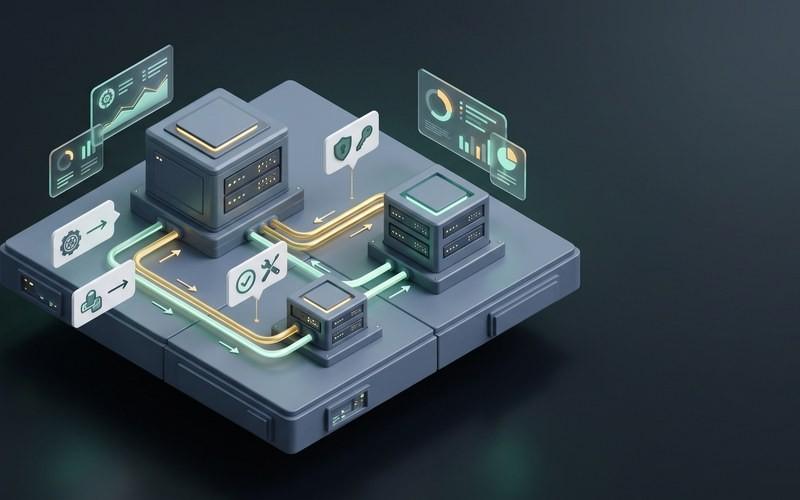
Accurately budgeting your Dynamics 365 development cost requires dissecting technical scope rather than relying on arbitrary hourly estimates. Enterprise implementations vary widely because custom business logic, Dataverse entity modeling, API rate ceilings, and legacy data migrations carry distinct engineering overheads.
Understanding these underlying architecture drivers allows technical leads and operations executives to scope integrations realistically, leverage modern AI acceleration responsibly, and preserve working capital before issuing a request for proposal.
What Actually Determines Your Dynamics 365 Development Cost?
Your total Dynamics 365 development cost is primarily governed by architectural surface area rather than simple user interface requirements. While standard Dynamics 365 modules provide foundational customer relationship management capabilities, adapting them to enterprise workflows demands targeted engineering across custom data models, middleware layers, and governance structures.
An experienced Dynamics 365 developer evaluates four primary cost drivers during technical discovery:
- Schema and business logic customization: Moving beyond standard out-of-the-box entities into relational Dataverse architectures, asynchronous event pipelines, and bespoke C# plugins.
- Integration topology and rate limits: Building resilient connections against Microsoft service protection thresholds using robust retry algorithms and message broker infrastructure.
- Data migration hygiene: Transforming unstructured or duplicate legacy records into strictly validated, normalized Dataverse schemas.
- Deployment governance and quality assurance: Establishing automated CI/CD pipelines, regression testing suites, and role-based security validation across distinct sandbox environments.
When organizations underestimate these engineering fundamentals, project scopes expand unexpectedly during user acceptance testing. Scrutinizing where workflows can rely on standard configurations versus bespoke code allows teams to direct engineering investment where operational differentiation actually justifies it.
Which Dataverse Layers and Custom Features Increase Scope?
Architecting a scalable dynamics 365 dataverse integration requires choosing the right extension layer. Development budgets inflate rapidly when teams construct custom code for processes that native platform tools already handle, or conversely, when low-code tools are forced into complex transactional domains where they fail under load.
Custom Business Logic vs. Native Power Platform Capabilities
A key scope determinant is deciding whether business rules should run via native Power Automate cloud flows or bespoke C# plugins executing on the Dataverse event execution pipeline. Standard cloud flows and low-code business rules reduce initial scaffolding effort for simple state changes and approval sequences. However, high-volume transactions, strict synchronous execution, or complex mathematical validations demand registered Dataverse plugins.
A skilled microsoft dynamics crm developer implements isolated plugins to avoid synchronous execution timeouts. Building and compiling custom plugins requires rigorous unit testing, sandboxed execution verification, and deployment packaging via solutions, which naturally commands more development hours than visual flow configuration.
Dataverse Entity Schema Design and Relationship Complexity
Dataverse data modeling directly dictates development complexity. Standard entities—such as Accounts, Contacts, and Opportunities—possess predefined relationships and behavioral constraints. When business workflows require custom tables, the relational structure drives implementation effort.
Designing many-to-many (N:N) relationships, deep hierarchical lookups, and polymorphic customer fields introduces schema overhead. Developers must configure cascading behaviors (such as parental delete or cascade-reparent rules) and implement alternate keys to support idempotent updates from external systems. Inadequate indexing or poorly structured table relationships degrade query performance, forcing subsequent database tuning cycles.
Legacy Data Cleansing, Transformation, and Migration Volume
Data migration consistently represents an underestimated line item in enterprise CRM initiatives. Moving historical records from legacy databases or disparate SaaS tools into Dataverse requires rigorous schema mapping, duplicate detection, and relational integrity enforcement.
Transforming denormalized legacy tables into normalized Dataverse entities requires automated ETL scripts, intermediate staging tables, and field-level validation routines. Complex data types—including multi-select option sets, currency lookups, and timezone-adjusted timestamps—require dedicated transformation logic. Handling data cleansing upstream prevents dirty data from breaking downstream transactional workflows, but it requires thorough dry-run staging environments before production cutover.
How Do API Integrations and Vendor Limits Impact Your Budget?
Connecting external applications to Dataverse requires robust network and protocol management. A successful dynamics 365 api integration must handle high transaction volumes without tripping vendor throttling thresholds or leaving transactions half-processed.
Authentication Architecture and Microsoft Entra ID Configuration
Secure integration with Dataverse Web API relies on OAuth 2.0 managed through Microsoft Entra ID. According to official Microsoft Entra ID documentation for Dataverse, server-to-server (S2S) integrations require registering a confidential client application and requesting the .default scope with a client secret or certificate.
Engineering costs increase when managing automated token lifecycles. Access tokens expire after approximately 60 minutes, requiring developers to implement token caching and silent refresh handlers—such as a custom DelegatingHandler using the Microsoft Authentication Library (MSAL). Configuring role assignments for the application user in the Power Platform Admin Center ensures strict principle-of-least-privilege access across Dataverse business units.
Navigating Microsoft Dataverse Service Protection API Limits
High-volume data synchronizations must respect Dataverse service protection API limits. According to official Microsoft Dataverse platform documentation, the service enforces protection limits per web server over a 5-minute (300-second) sliding window: a maximum of 6,000 requests, 1,200 seconds (20 minutes) of cumulative execution time, and a concurrency cap of 52 simultaneous requests.
Exceeding these limits triggers an HTTP 429 Too Many Requests response containing a Retry-After header indicating the required backoff duration. Designing middleware that parses this header and dynamically throttles requests demands structured engineering. Ignoring these limits causes dropped requests, thread starvation, and sync failure during peak enterprise usage.
Data Delivery Semantics, Dead-Letter Queues, and Retry Logic
When you hire dynamics 365 integration expert support, the core deliverable is architectural reliability. Naive integrations rely on simple synchronous HTTP POST requests, which fail irreversibly during network interruptions or upstream rate-limiting events.
Enterprise integrations require asynchronous message brokers—such as Azure Service Bus or RabbitMQ—to guarantee at-least-once delivery. Implementing dead-letter queues (DLQ) captures malformed payloads for administrative inspection without stalling subsequent queue consumers. Furthermore, developers must design idempotent processing mechanisms—often leveraging Dataverse alternate keys—so that automated retries never generate duplicate customer accounts or double-billed invoices.
Can Vibe Coding and AI Acceleration Safely Lower Engineering Costs?
The rise of AI-assisted scaffolding and generative software development has introduced Dynamics 365 vibe coding into enterprise conversations. While automated code generation significantly accelerates early delivery cycles, applying generative tools to mission-critical business systems requires rigorous architectural oversight.
Where AI Scaffolding Accelerates Repetitive Integration Code
AI coding agents excel at producing boilerplate code. Generating strongly typed C# entity wrappers, writing JSON serialization schemas, scaffolding Web API client calls, and mapping standard DTOs (Data Transfer Objects) can be completed in minutes rather than days. Development platforms like Antigravity and commercial tools like Claude Code or OpenAI Codex allow engineering teams to prototype integration endpoints rapidly.
At Canvas Developers, our engineers utilize directed AI harnesses to generate initial ETL scripts and boilerplate middleware. This rapid iteration compresses initial feedback loops, enabling teams to evaluate integration models against live sandbox endpoints without spending weeks writing repetitive plumbing code.
AI Blindspots: Role-Based Access, Concurrency, and Data Loss
Organizations that attempt to hire a vibe coder for Dynamics 365 without structured engineering leadership encounter severe vulnerabilities. Autonomous AI tools struggle with nuanced enterprise domain constraints. They frequently generate code that ignores Dataverse role-based security, runs administrative impersonations across all requests, or neglects optimistic concurrency checks.
In high-throughput environments, overlooking record versioning (RowVersion checks) leads to silent data overwrites when multiple external services update the same account simultaneously. Additionally, AI-generated queries often omit OData $select and $filter statements, retrieving full record schemas that waste network bandwidth and breach execution time limits.
The Engineering Layer: Review, Testing, and Release Decisions
Real cost efficiency emerges when AI speed is governed by experienced engineering discipline. At Canvas Developers, a software engineering company with an office in Dhaka, AI coding agents accelerate delivery while experienced engineers, QA, and DevOps specialists direct the work, own the architecture, review every change, and decide releases.
We provide two transparent delivery packages: Private / Local AI Engineering (hosting open-weight models within client-controlled infrastructure or agreed isolated environments) and Claude Code / OpenAI Codex Engineering (commercial AI coding tools with client-approved cloud settings). Every integration undergoes automated unit testing, end-to-end integration simulations, and Dataverse solution packaging before deployment. Explore our specialized workflows for Dynamics 365 development to see how disciplined engineering safeguards enterprise data.
What Dynamics 365 Features Can You Defer to Protect Your Budget?
Strategic phasing protects working capital during enterprise rollouts. Controlling your overall Dynamics 365 development cost involves defining a clear minimum viable integration that validates core business operations before expanding into complex secondary automations.
Separating Core Transactional Records from Secondary Syncs
An effective initial phase focuses exclusively on revenue-generating and operational master records. Real-time bi-directional synchronization for customer accounts, contacts, and active sales orders represents the foundational layer required for daily business continuity. Establishing transactional integrity across these core tables proves the integration architecture under live enterprise operating conditions.
Secondary data streams—such as historical audit logs, closed legacy leads, customer survey responses, and marketing interaction histories—can be deferred safely to subsequent project milestones. Postponing these auxiliary entities simplifies the initial Dataverse entity schema, reduces early migration friction, and minimizes the risk of service protection throttling during initial user onboarding.
Phasing Complex Automated Reporting and Background Workflows
Another area where a senior Dynamics 365 developer can reduce initial expenditure is analytical reporting and deep process automation. Project stakeholders frequently request real-time Power BI embedded dashboards, intricate multi-stage approval matrices, and automated background reconciliation routines during initial discovery.
During early adoption, organizations can rely on standard Dataverse views, native system charts, and straightforward platform notifications. Deferring Azure Synapse Link data lake pipelines and complex scheduled batch processes allows engineering teams to observe live transaction patterns first. Once business workflows stabilize in production, advanced analytics, custom background jobs, and event-driven automation pipelines can be scoped against demonstrated operational needs rather than speculative feature lists.
What Technical Details Should You Prepare Before Requesting an Estimate?
Arriving at technical scoping discussions with verified system specifications prevents cost inflation and ambiguous estimates. When preparing to hire dynamics 365 integration expert services, providing structured technical documentation accelerates architectural discovery.
Technical Readiness Checklist: Payloads, Access, and Endpoints
Before requesting a formal proposal, assemble the following engineering prerequisites:
- Target Dataverse environment details: Tenant ID, base API URL (such as
https://org.api.crm.dynamics.com), and existing custom solution publishers. - Sample data payloads: JSON or CSV samples for every entity requiring synchronization, noting required fields, unique external identifiers, and data types.
- Authentication parameters: Microsoft Entra ID app registration privileges, required API scopes, and certificate management policies.
- Integration specifications: Expected hourly and peak transaction volumes, batch processing windows, and target upstream endpoints for your dynamics 365 api integration.
Defining Clear Acceptance Criteria for a Scoped Assessment
Ambiguous deliverables inevitably cause scope creep. Define explicit operational benchmarks: maximum acceptable sync latency (such as updates reflected within 60 seconds), idempotent retry verification under simulated network failure, and zero duplicate record generation.
Clarify whether your team requires complete CI/CD solution pipelines, automated regression suites, or administrator training documentation. At Canvas Developers, every engagement begins with scoping, followed by agreed milestones, rigorous testing, and handover. If you are preparing an implementation, reach out through our contact page or via WhatsApp on our website with your current stack, workflow constraints, and target outcomes to initiate a scoped assessment.