The problem
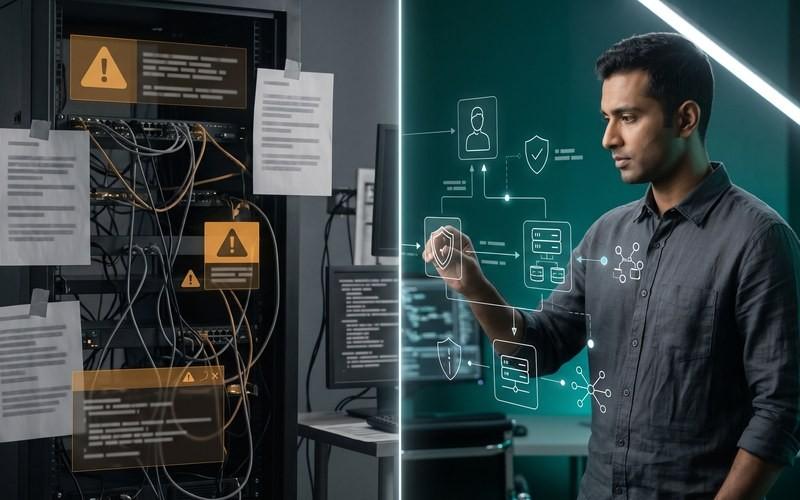
Shared staging servers frequently stall continuous delivery as engineering teams queue for access and resolve conflicting test states. Engineering teams facing shared staging bottlenecks struggle with persistent configuration drift and delayed QA cycles. Furthermore, self-service environments present security risks if ephemeral containers inherit elevated infrastructure permissions, while transient network failures or worker crashes can interrupt resource allocation, generating orphaned cloud resources and corrupted state.
Approach
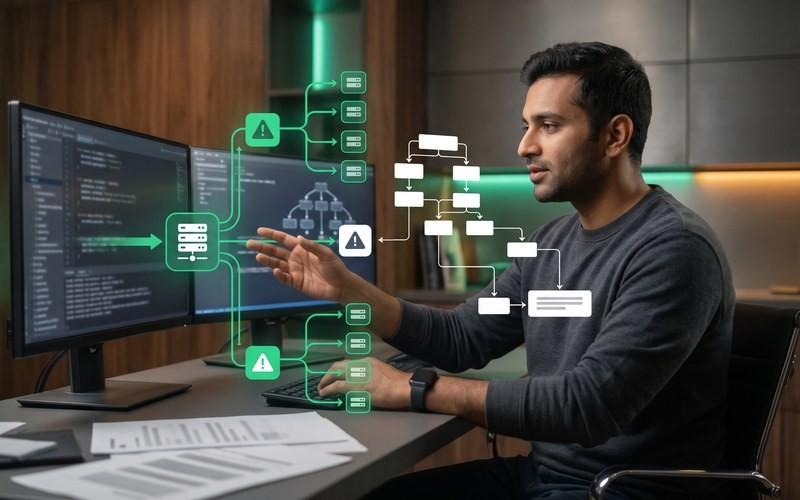
Canvas Developers establishes self-service automation through declarative pipeline blueprints, least-privilege credential scoping, and resilient state handling across entry, task detail, and confirmation views. The architecture decouples automated test suites from core infrastructure provisioners, allowing developers to initiate on-demand environments while operations engineers govern compliance rules, resource boundaries, and automated teardown schedules. Every change is managed through release task records featuring client-generated idempotency tokens and automated rollback routines to safely handle interrupted executions without duplicate records or data loss.
Outcome
The self-service setup isolates test execution and protects core production workloads while preventing resource sprawl through automated lifetime schedules. Automated acceptance test suites verify that interrupted release task submissions resume cleanly from persisted checkpoints without duplicate records or discarded input parameters.
Modern software delivery requires reliable, isolated verification before code reaches shared infrastructure. A robust Test Automation self-service environment setup helps engineering teams overcome testing bottlenecks by enabling developers, peer reviewers, and operations engineers to provision ephemeral environments on demand under strict boundary controls. Rather than competing for fragile staging instances, engineering teams initiate governed workflows that bind automated test suites directly to temporary cloud resources.
At Canvas Developers, our approach establishes self-service automation through declarative pipeline blueprints, least-privilege credential scoping, and resilient state handling, helping teams isolate test execution and protect core production workloads.
Why Do Engineering Teams Require Self-Service Environment Setup with Test Automation?
Aligning Developer Requests, Peer Review, and Operations Approvals in One Journey
Shared staging servers frequently stall continuous delivery as engineering teams queue for access and resolve conflicting test states. According to Harness environment management documentation, engineering teams facing shared staging bottlenecks struggle with persistent configuration drift and delayed QA cycles. A unified Test Automation self-service environment setup addresses these operational delays by bringing developers, peer reviewers, and operations engineers into a single governed provisioning journey.
In our approach, developers initiate on-demand environments directly from their feature branches. Peer reviewers inspect both application changes and automated test suites in a single workspace, ensuring code meets quality gates before deployment. Meanwhile, operations engineers establish global compliance rules, resource boundaries, and automated lifetime schedules without handling manual infrastructure tickets.
Managing the Release Task Lifecycle Across Entry, Detail, and Confirmation Views
Every operational transition centers on the release task, a durable record capturing configuration, authorization, and execution state. Structured self-service environment setup development organizes this lifecycle across three dedicated interface views:
- Entry Screen: Developers configure branch parameters, select targeted automated test suites, assign synthetic seed datasets, and submit the provisioning request under pre-configured quota boundaries.
- Task Detail Screen: Reviewers and operations engineers monitor real-time execution telemetry, inspecting container build events, network boundary checks, and automated regression test logs.
- Confirmation Screen: Stakeholders review validated endpoint routes, authorization proofs, and automated teardown countdowns once test assertions conclude successfully.
This progression enforces full transparency, ensuring no ephemeral environment runs without documented operational accountability.
What Constraints and Failure Modes Threaten Environment Isolation and State Safety?
Enforcing Least-Privilege Credentials and Strict Boundary Isolation Across Environments
Self-service environments present severe security risks if ephemeral containers inherit elevated infrastructure permissions. As detailed in the Northflank isolated sandbox preview guide, preview environments must separate application workloads from administrative provisioning authority, enforcing strict automated testing environment boundaries so branch-level scripts cannot compromise cluster control planes or peer workloads. In our architecture, every preview environment operates under scoped, non-production credentials segmented across build, runtime, and database migration tasks.
Network isolation rules block outbound egress toward internal production databases and corporate services. Databases run on isolated ephemeral instances seeded exclusively with synthetic test data rather than unsanitized production dumps. Micro-segmentation policies ensure that even if an untrusted dependency executes arbitrary code within a test container, it cannot traverse network perimeters, modify sibling namespaces, or leak sensitive system telemetry.
Handling Interrupted Requests and Execution Halts Without Duplicate Records or Data Loss
Transient network failures, worker pod crashes, or abrupt user disconnections can interrupt provisioning midway through resource allocation. Without defensive design, incomplete requests generate orphaned cloud resources, corrupted databases, and stalled pipelines. Our architecture integrates release task automation with idempotent state machine semantics to maintain consistent state handling and guard against execution failures.
Each release task submission carries a client-generated idempotency token. When a network connection drops during environment creation, the client can safely retry the request; the coordinator checks the existing token, resumes execution from the last persisted state checkpoint, and prevents duplicate records. Furthermore, if a provisioning step fails unrecoverably, automated rollback checks trigger: the system systematically purges partially provisioned containers, tears down ingress routes, releases reserved network subnets, and logs the precise failure event for engineering review without losing original request parameters.
How Is the End-to-End Release Task Architecture Implemented and Decoupled?
Tracing Request Data Flow: User Validation, State Persistence, and Idempotent Acknowledgement
Tracing a single release task illustrates how data integrity is maintained from user interaction to infrastructure confirmation. When an engineer configures environment parameters on the entry screen, the client issues a signed HTTP POST request accompanied by a cryptographic idempotency key. The API gateway verifies the caller's session token and forwards the payload to an intake validation service. This service enforces input validation against strict schemas, confirming that requested container images, branch names, and resource allocations remain within established organization quotas.
Once validated, the request commits atomically to a relational database within a transaction that initializes the release task record in a PENDING state. Only after transaction persistence does the system dispatch an event to the asynchronous task broker and return an HTTP 202 response to the client. The confirmation screen receives this acknowledgement and begins polling the task detail endpoint via WebSocket updates, establishing end-to-end traceability before asynchronous provisioning steps begin.
Separating Test Automation Framework Responsibilities from Core Infrastructure Provisioners
A frequent anti-pattern in platform engineering is burdening automated test suites with direct cloud infrastructure provisioning logic. Effective Test Automation development requires clear separation of concerns: test runners must execute assertions, whereas infrastructure engines manage cloud lifecycles. Coupling test code directly to Kubernetes APIs or cloud provider SDKs creates brittle test suites that fail unpredictably when network or IAM policies change.
In our architecture, specialized provisioners handle infrastructure lifecycle management—orchestrating namespaces, secret distribution, and database clones—before handing control to the testing engine. The Test Automation integration layer interacts exclusively through standardized endpoints, consuming environment configuration through environment variables. For comprehensive delivery, our engineering teams at Canvas Developers configure specialized test harness pipelines within our automated testing capabilities, ensuring automated suites validate application behavior while dedicated cloud runners govern resource lifecycles independently.
Which Acceptance Tests and Engineering Tradeoffs Verify Resilient Execution?
Validating Interruption Resumption, Rollback Triggers, and State Integrity Checks
Verifying a resilient Test Automation self-service environment setup requires automated acceptance test suites that actively evaluate failure boundaries rather than solely validating successful executions. In our approach, engineering verification focuses on three core acceptance criteria to ensure operational resilience across the release lifecycle:
- Interruption Resumption: The platform validates that an interrupted release task submission resumes cleanly from its last persisted checkpoint without creating duplicate database records or discarding original input parameters.
- Rollback Triggers: If synthetic database seeding or container initialization fails readiness probes, automated teardown routines immediately deprovision partial resources and release reserved network allocations.
- State Integrity Audits: Post-deployment checks ensure that relational database records, event broker state, and active container instances match expected configuration before marking the release task complete.
Balancing Test Rigor and Environment Isolation Against Provisioning Latency and Cost
Architecting self-service testing environments requires navigating continuous trade-offs between isolation fidelity, provisioning speed, and cloud infrastructure expenditure. Enforcing strict automated testing environment boundaries via namespace-level network policies and scoped service accounts provides robust runtime isolation without the prolonged spin-up latency and financial overhead of provisioning full ephemeral clusters.
Engineering leaders should establish clear criteria for when ephemeral environments are justified versus when simpler options suffice. Lightweight local container mocks or shared staging lanes offer rapid, low-cost feedback for routine unit, styling, and component testing. Dedicated ephemeral environments become essential when teams validate distributed schema migrations, cross-service API contracts, or complex asynchronous workflows. Coupling automated provisioning with strict time-to-live (TTL) expiration schedules ensures temporary infrastructure deprovisions automatically once test assertions conclude, preventing idle resource sprawl.
How Does Canvas Developers Deliver Hardened Test Automation via AI-Assisted Workflows?
Accelerating Scaffolding with AI Coding Agents Under Human Architectural Governance
At Canvas Developers, our engineering teams combine AI coding agents with rigorous human oversight. When implementing Test Automation vibe coding workflows, AI assistants rapidly scaffold boilerplate code, generate schema validation rules, and draft initial test suites. This accelerated iteration shortens initial feedback loops and reduces repetitive implementation effort during early development stages.
However, AI tools cannot evaluate organizational risk or architectural trade-offs. While AI generates code rapidly, it frequently struggles with subtle distributed race conditions, multi-tenant network isolation, and least-privilege security boundaries. Experienced software engineers direct every initiative, own system architecture, conduct manual peer reviews, and verify all automated test criteria before code deployment. Whether clients choose our Private / Local AI Engineering package or our Claude Code / OpenAI Codex Engineering workflows, human engineers make all release decisions.
Transitioning from Scoped Feasibility Assessment to Milestone-Driven Delivery
Robust Test Automation development requires disciplined project planning. We deliver systems through structured engagements that align business goals with engineering realities:
- Scoped Assessment: We evaluate your existing application architecture, CI/CD pipelines, container orchestration, and state isolation constraints.
- Milestone-Driven Execution: We construct infrastructure templates, implement idempotent task controllers, configure synthetic test datasets, and harden boundary security across transparent delivery milestones.
- Verification and Handover: Comprehensive acceptance tests validate interruption recovery and teardown automation before production handover.
If your team seeks to replace shared staging bottlenecks with resilient self-service environments, contact our engineering team through our contact form with your current stack, workflow bottlenecks, and target requirements to schedule a scoped assessment.