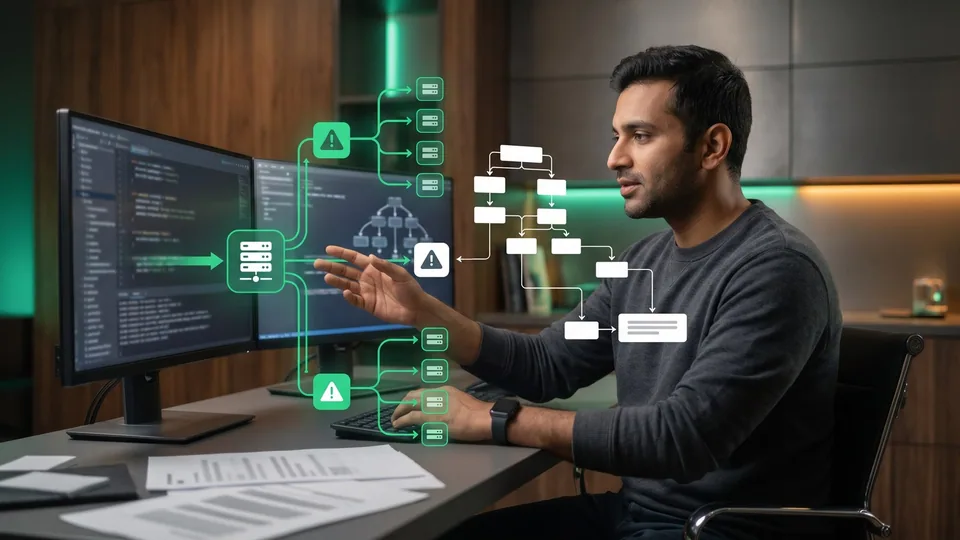
Executing programmatic trades across hundreds of managed client sub-accounts requires bespoke infrastructure when standard desktop interfaces reach their operational limits. Building custom trading software for Interactive Brokers allows registered investment advisors (RIAs), hedge funds, and multi-strategy desks to automate multi-account allocations, bypass manual Trader Workstation (TWS) bottlenecks, and enforce strict institutional risk parameters. By coupling direct API integration with deterministic execution logic, firms minimize manual rebalancing errors and improve trade velocity across complex account hierarchies.
Why Do Off-the-Shelf Tools Fail for Multi-Account Interactive Brokers Execution?
Commercial trading terminals and manual desktop tools like Interactive Brokers Trader Workstation (TWS) are designed primarily for discretionary, single-account traders or small-scale wealth managers. As a registered investment advisor (RIA) or multi-strategy fund scales past dozens of accounts, running a commercial terminal for high-volume execution introduces severe operational bottlenecks. Deploying bespoke custom trading software for Interactive Brokers becomes necessary when manual order generation through graphical interfaces creates execution lag, introduces keystroke latency, and exposes desks to trade execution delays during volatile market openings.
Furthermore, off-the-shelf platforms struggle with automated model portfolio drift detection and real-time reconciliation. When an advisor rebalances an investment model across diverse account sizes, standard desktop allocation tools cannot dynamically account for individual account cash buffers, tax-loss harvesting mandates, or legacy holdings without tedious manual overrides. Disconnected portfolio accounting systems force operators to export spreadsheets, calculate order sizes externally, and re-import basket files into TWS—a workflow vulnerable to manual data entry errors.
Multi-strategy desks running concurrent quantitative models require deterministic routing, instant sub-account splitting, and direct telemetry. Building a bespoke RIA custom trading platform for IBKR replaces fragmented spreadsheets with unified execution pipelines, allowing institutions to synchronize portfolio accounting with direct market execution.
How Does the Interactive Brokers Multi-Account Hierarchy Actually Work?
Master-Sub Account Topologies for Financial Advisors and Multi-Strategy Funds
Interactive Brokers organizes institutional structures under a master-sub account topology. A Financial Advisor (FA) or hedge fund master account maintains administrative and trading authority over individual client sub-accounts without commingling assets. In this architecture, sub-accounts maintain separate cash balances, margin requirements, and tax reporting, while the master account executes centralized basket orders. Implementing an enterprise multi-tenant architecture ensures trading systems maintain clean security boundaries between distinct client portfolios.
Protocols for connecting to this hierarchy differ significantly. While the Client Portal Web API offers REST-based management suitable for asynchronous reporting, high-frequency order placement requires socket-level connectivity through the TWS API or IB Gateway. For institutional firms executing thousands of orders daily, direct FIX protocol sessions via dedicated lines bypass gateway overhead entirely, offering sub-millisecond routing compared to desktop bridge limitations.
Native Allocation Profiles: Group Allocations, Account Aliases, and Pre-Allocated Orders
To streamline order entry across sub-accounts, IBKR provides native pre-trade allocation mechanisms. According to the official Interactive Brokers Financial Advisor API documentation, advisors can execute orders using Account Groups or Allocation Profiles. While Account Groups calculate dynamic share distributions based on portfolio metrics like Net Liquidation value (NetLiq) or AvailableEquity, Allocation Profiles enforce static user-defined percentages, financial ratios, or fixed share counts.
Through direct interactive brokers api integration, master accounts query account aliases using requestFA() and route orders by specifying the target group or profile directly in the order's FaGroup field. This enables seamless interactive brokers multi-account execution, eliminating manual sub-account order duplication.
How Do You Implement Group Trading Allocations via the IBKR API?
Constructing FA Group Profiles and Dynamic XML/JSON Allocation Strings
Configuring programmatic allocations requires transmitting structured configuration payloads to TWS or IB Gateway. In the TWS API, allocation profiles and groups are created or updated via the replaceFA() method, which accepts a comprehensive XML payload. As detailed in the IBKR Financial Advisor API documentation, modern TWS builds unify groups and profiles, allowing systems to transmit XML definitions that specify group names, default calculation methods (such as EqualQuantity, NetLiq, or PctChange), and member account identifiers.
When placing an order using the ibkr group trading allocation api, the client application sets the FaGroup and FaMethod fields directly on the Order object. For dynamic, on-the-fly allocations that vary per order, custom execution engines construct dynamic allocation XML strings directly within the order attributes, routing bulk basket trades across accounts without persistently overwriting existing TWS profiles.
Handling Fractional Shares, Rounding Residuals, and Cash-Weight Rebalancing
A major mathematical challenge in interactive brokers multi-account execution is handling fractional shares and rounding discrepancies during portfolio rebalancing. When a model trade allocates 1,000 shares across accounts with proportional cash weighting, fractional share calculations inevitably generate remainder shares due to exchange minimum increment constraints. Without deterministic rounding algorithms, the sum of sub-account allocations will mismatch the parent order quantity, causing TWS to reject the entire block order.
Production-grade trading engines solve this using the Largest Remainder Method (Hare-Niemeyer method). The algorithm calculates exact floating-point share targets per sub-account, truncates them to whole integers, and assigns residual whole shares sequentially to sub-accounts with the largest fractional remainders. Furthermore, systems must monitor post-trade execution reports. When the IBKR matching engine fills a block order, the API emits asynchronous executionDetails callbacks containing sub-account clearing allocations and average fill prices, which your internal ledger must reconcile against original targets to verify model adherence.
How Do You Prevent TWS API Pacing Violations and Rate Limits?
Understanding IBKR Pacing Constraints: The 50-Message-Per-Second Threshold
Interactive Brokers enforces strict rate limits to prevent trading software from overwhelming gateway endpoints. By default, client connections to TWS or IB Gateway are restricted to an outbound rate of 50 messages per second. Exceeding this threshold triggers immediate throttling, dropped messages, or socket disconnection. Managing tws api pacing violations and rate limits becomes even more acute when requesting historical market data bars.
As outlined in the Interactive Brokers official pacing documentation, IBKR imposes rigid restrictions on historical data requests: small bars of 30 seconds or less cannot be requested more than 60 times within any 10-minute window, identical requests must not be repeated within 15 seconds, and more than 6 requests for the same contract within 2 seconds trigger error code 162. Violating these rules results in severe pacing penalties that freeze historical data streams.
Implementing Token-Bucket Rate Limiters and Queued Request Workers
To maintain high throughput without tripping pacing thresholds, robust interactive brokers api integration architectures decouple trade generation from socket transmission using token-bucket rate limiters and queued background workers. When quantitative models emit batch rebalancing orders, requests enter an in-memory priority queue such as Redis. A dedicated sender process consumes messages according to a token-bucket algorithm configured strictly below the 50 msgs/sec threshold, maintaining compliance even during surge volatility.
Beyond message throttling, trading engines must gracefully manage the socket lifecycle. IBKR gateways enforce automated nightly server resets, which drop TCP socket connections without explicit client handshake termination. Production systems implement heartbeat monitoring, exponential backoff reconnect logic, and state reconciliation to verify open order statuses upon reconnection before resuming automated routing. By buffering burst traffic in worker queues and pacing transmission, trading engines avoid connection drops while dispatching orders as efficiently as the broker gateway permits.
How Does a Dedicated Custom Trading Engine Compare to Manual TWS Execution?
Execution Velocity and Slippage Control Across Hundreds of Client Sub-Accounts
For wealth managers overseeing substantial assets across hundreds of sub-accounts, execution latency directly translates into slippage costs. In manual Trader Workstation workflows, an advisor must manually select groups, verify allocations, and click through confirmation prompts. During fast-moving market regimes, a 30-second delay in transmitting basket orders creates adverse market impact and execution variance between early-filled and late-filled client accounts. Purpose-built custom trading software for Interactive Brokers significantly reduces this latency by executing block orders programmatically in milliseconds, synchronizing fills across all sub-accounts at uniform volume-weighted average prices (VWAP) and eliminating manual workstation drag.
Eliminating Fat-Finger Risks Through Programmatic Guardrails and Pre-Trade Rules
Manual order entry carries inherent operational risks, from transposition errors to incorrect multiplier selections. A specialized RIA custom trading platform for IBKR embeds programmatic pre-trade compliance checks that intercept erroneous orders before they reach the gateway socket. These guardrails enforce configurable limits on maximum single-order notional values, maximum percentage of average daily volume (ADV), cash-balance floors, and restricted ticker lists.
Additionally, dedicated trading engines provide multi-tenant security and automated compliance logging. Every model signal, risk check evaluation, order transmission, and fill acknowledgment is recorded with millisecond timestamps in a centralized audit database. This structured telemetry provides compliance officers with complete transparency, streamlining regulatory reporting and quarterly client performance attribution.
What Are the Critical Architectural Pitfalls When Building Trading Software with AI Tools?
Where AI Coding Accelerates Scaffolding vs. Where AI Generates Catastrophic Order Logic
Modern AI coding tools and assistants like Claude Code and OpenAI Codex significantly accelerate software development by scaffolding boilerplate API client wrappers, generating data transfer objects, and structuring basic database models. In an interactive brokers api integration project, AI agents can generate initial contract definition classes and parse XML schema responses in minutes rather than days. However, unvetted AI-generated code frequently produces catastrophic flaws in institutional trading logic.
AI models lack contextual understanding of live market microstructures and broker-specific idiosyncrasies. When prompted to generate order distribution algorithms, AI frequently hallucinates simplified floating-point math, fails to account for tws api pacing violations and rate limits, or implements naive blocking loops that choke the client socket when processing high-volume order books. Relying on unassisted AI output in financial systems risks severe financial and regulatory fallout.
Mandatory Human Engineering Oversight: Thread Safety, State Machines, and Decimal Precision
At Canvas Developers, senior software engineers direct AI coding agents to accelerate routine development while retaining strict human ownership over core architecture, security, and release decisions. Human engineers must rigorously inspect mission-critical components that AI tools reliably mishandle: multi-threaded socket safety, finite state machines for complex order lifecycles (such as partial fills, cancellations, and rejections), and fixed-point decimal arithmetic to prevent IEEE 754 floating-point precision errors.
Every trading component undergoes rigorous automated integration testing within the Interactive Brokers Paper Trading sandbox. By running automated regression suites against simulated market gateways, engineering teams stress-test failover mechanisms, pacing buffers, and allocation reconciliations before routing live client capital into production markets.
How Should You Scope and Build Your Custom Interactive Brokers Trading Platform?
Successfully deploying enterprise custom trading software for Interactive Brokers requires a disciplined, milestone-driven engineering roadmap. Rather than jumping directly into live code, firms must define architectural specifications first: mapping account topologies, establishing risk threshold policies, and benchmarking message throughput in the IBKR Paper Trading gateway. Developing dedicated test harnesses early ensures pacing limiters and allocation algorithms operate reliably under adverse market conditions.
For wealth managers, RIAs, and funds seeking to build or harden an RIA custom trading platform for IBKR, Canvas Developers delivers institutional-grade software engineering. With offices in Dhaka, our engineering teams combine AI-assisted scaffolding speed with seasoned engineering oversight across architecture, thread-safe execution, and DevOps. Whether deploying via Private / Local AI Engineering or commercial Claude Code / OpenAI Codex environments, every system is rigorously verified. To scope your trading infrastructure or evaluate your current architecture, reach out through our contact assessment form.