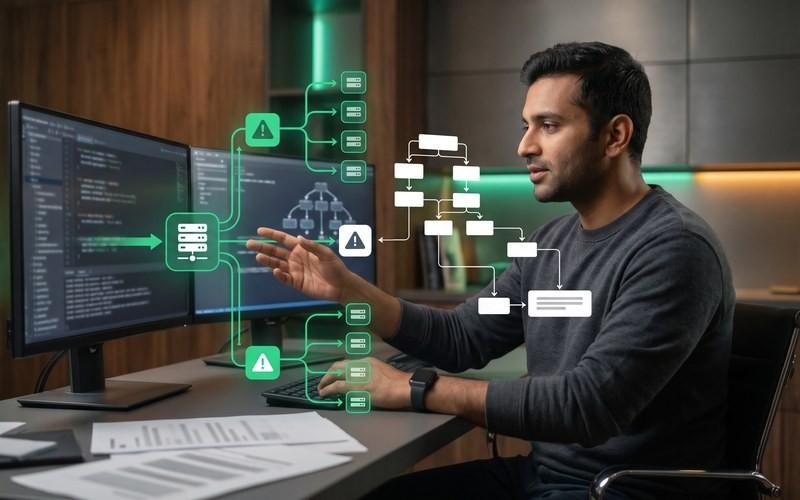
A resilient yardi accounting api integration bridges the gap between proprietary billing platforms and Yardi Voyager's general ledger by enforcing strict double-entry validation, deterministic idempotency, and automated reconciliation. Connecting bespoke property management or subscription billing systems directly to enterprise accounting ledgers eliminates manual spreadsheet imports while safeguarding multi-entity books against transaction drift and duplicate postings.
Achieving a compliant, production-grade sync requires navigating legacy SOAP interfaces, multi-property chart of accounts hierarchies, and asynchronous settlement cycles. This architectural guide outlines how engineering teams structure robust accounts payable payloads, prevent double-debit errors, and establish reliable audit pipelines across enterprise real estate portfolios.
Why Do Disconnected Billing Systems and Yardi GL Create High-Risk Audit Gaps?
Operating separate property billing engines alongside Yardi Voyager often forces finance and operations teams into brittle spreadsheet workflows. When proprietary platforms handle tenant billing, submeter utility allocations, or ancillary fee invoicing outside the core ERP, monthly closes depend on manual CSV batch exports and imports. This operational drag creates multi-day reconciliation lags, introduces human transcription errors, and leaves audit trails fragmented across disconnected systems.
Without an automated yardi accounting api integration, organizations encounter continuous data drift. Adjustments made in the billing application—such as tenant credit memos, payment reversals, or pro-rated charges—frequently fail to reflect immediately in the general ledger. Conversely, manual journal adjustments entered directly into Voyager do not flow back downstream, leading to unreconciled variances between operational ledgers and statutory financial statements.
Implementing a resilient custom yardi financial data sync replaces error-prone file dumps with continuous, transactional verification. By establishing a direct programmatic pipeline into Voyager, engineering teams can validate chart of accounts allocations at the point of invoice generation, ensuring that every debit and credit balances before records touch property-level balance sheets. For scaling real estate operators managing complex multi-entity portfolios via multi-tenant SaaS billing architectures, eliminating these manual touchpoints is essential for maintaining verifiable audit compliance.
How Should You Architect a Reliable Yardi Accounting API Integration?
Connecting bespoke software to Yardi requires an architecture that accommodates enterprise SOAP protocols while shielding core ledgers from malformed mutations. A production yardi accounting api integration decouples operational billing events from ERP ingestion through dedicated middleware.
Selecting the Ingestion Layer: Yardi Voyager Web Services vs. Custom Middleware
Yardi Voyager exposes programmatic accounting interfaces primarily through legacy SOAP web services (such as ItfVendorInvoice.asmx and ItfCommonData.asmx), which require partner licensing credentials and IP allowlisting as documented in Supergood's Yardi Voyager API report. Attempting to invoke these SOAP endpoints directly from distributed billing microservices introduces brittle service dependencies, exposes enterprise credentials across services, and struggles under high-volume billing bursts.
A dedicated middleware service bridges this operational gap. The middleware ingests lightweight JSON payloads from upstream applications, translates them into schema-compliant XML envelopes, and manages SOAP session state within a secure execution boundary. This layer buffers outbound requests to respect Voyager rate limits, manages token lifecycles, and provides unified telemetry for all accounting transmissions.
Enforcing Strict Double-Entry Ledger Validation Across Distributed Services
In an enterprise yardi general ledger integration, the middleware service operates as an authoritative gatekeeper enforcing fundamental double-entry bookkeeping rules. Disconnected billing engines frequently produce asynchronous financial events—including recurring rent charges, utility recovery fees, and concessions—that must balance before ledger submission.
The ingestion gateway executes automated pre-flight checks verifying that total debits equal total credits in integer cents, eliminating floating-point rounding errors. It also validates that target property entity IDs, sub-journals, and account segments are active and open for posting in Voyager, rejecting out-of-balance batches before they cause downstream financial reporting discrepancies.
How Do You Sync Accounts Payable and Automated Journal Entries with Yardi?
Synchronizing operational expenditures and accounting entries between bespoke billing engines and enterprise property management software requires rigorous data modeling. When organizations sync accounts payable with yardi voyager, payload structures must reflect the multi-entity hierarchies and ownership splits that govern commercial and residential portfolios.
Structuring Accounts Payable Payloads for Multi-Property Portfolios
Enterprise real estate portfolios rarely operate under a single legal structure. Instead, individual assets are compartmentalized into distinct ownership entities (such as separate LLCs or joint ventures), even when vendor procurement occurs centrally. When processing vendor invoices—such as portfolio-wide security contracts, capital repairs, or shared utility expenses—the integration payload must support header-level vendor attributes paired with granular, multi-property line-item distributions.
In a resilient ingestion pipeline, incoming payables map each invoice distribution line to a verified Yardi Property Code, Vendor ID, and General Ledger expense account. The middleware queries cached property registries to validate that the vendor is active and authorized for the specific property entity before dispatching the payload to Yardi's invoicing interfaces (such as ItfVendorInvoice.asmx). Attaching persistent external invoice identifiers and document metadata URIs allows property accountants to inspect supporting documentation directly within Voyager during approval routing, eliminating manual cross-referencing and invoice re-entry.
Automating Journal Entry Creation While Preserving Chart of Accounts Mapping
Beyond standard vendor payables, billing platforms generate operational events that require non-invoiced ledger adjustments, including revenue accruals, prepaid rent amortizations, and security deposit transfers. Deploying automated journal entries yardi api pipelines requires strict preservation of multi-segment Chart of Accounts (COA) hierarchies across diverse legal funds.
Because each entity within Voyager can maintain customized account configurations, the integration gateway translates upstream billing events into standardized general ledger distributions. When an accounting transaction bridges multiple properties, the engine automatically calculates and injects balancing inter-company due-to and due-from journal lines to maintain ledger equilibrium.
Handling adjustments, partial payments, and transaction reversals demands an immutable accounting approach. The integration pipeline avoids destructive updates or silent overwrites on posted ledger batches. When an upstream billing charge is disputed, credited, or voided, the sync engine generates an explicit reversing journal entry paired with a referencing reconciliation token. This design preserves historical financial integrity, guarantees complete auditability, and satisfies institutional reporting standards.
How Do You Prevent Duplicate Ledger Postings Using Idempotency and Audit Pipelines?
Transient network timeouts, server reboots, and distributed message replays present significant threats to financial consistency. In an automated custom yardi financial data sync, executing an unvalidated retry against an enterprise accounting endpoint risks double-posting accounts payable vouchers or duplicating general ledger debits, distorting month-end financial reporting.
Designing Idempotent Request Handlers to Prevent Double-Debit Errors
Idempotency ensures that processing the same transaction multiple times produces the identical ledger outcome as a single execution. Because legacy SOAP web services lack native idempotency headers, integration middleware must enforce deterministic deduplication before dispatching calls to Yardi.
The ingestion gateway computes a cryptographic hash based on immutable transaction attributes—such as the source invoice identifier, property code, line-item sequence, amount, and posting period. Before transmitting an XML envelope to Voyager, the handler checks a transactional store using an atomic lock. If the hash exists with a confirmed posting status, the gateway skips the remote invocation and returns the cached Yardi transaction reference number. If an identical transaction is in-flight, subsequent requests pause until resolution, eliminating concurrency race conditions and double-debit errors.
Asynchronous Queueing, Webhook Retry Backoffs, and Dead-Letter Handling
Coupling synchronous billing events directly to Yardi web services creates fragile bottlenecks during peak billing periods. A robust yardi financial reporting data integration relies on persistent message queues to decouple transaction generation from ledger ingestion.
Billing events enter durable message queues configured with rate-limiting controls to honor Voyager's ingestion thresholds. When transient network faults or maintenance windows trigger delivery failures, workers execute exponential retry backoffs with randomized jitter. If an error is permanent—such as a closed accounting period or an invalid vendor ID—the message routes to a dead-letter queue (DLQ) with contextual diagnostic telemetry, alerting engineers for triage rather than dropping records.
To ensure ledger parity across distributed systems, the architecture incorporates automated two-way reconciliation pipelines. Scheduled background workers execute daily cross-system audits comparing billing aggregates against Voyager's trial balance. Any variance between operational billing records and general ledger postings triggers automated anomaly detection alerts, allowing finance teams to resolve discrepancies before period-end closes.
What Critical Financial Data Integrity and Security Pitfalls Must You Avoid?
Financial data pipelines operate under stringent regulatory and security standards. In a mission-critical yardi accounting api integration, overlooking data governance and transport security risks silent posting failures, audit non-compliance, and exposure of sensitive financial records.
Managing Schema Drift Across Complex Multi-Entity Chart of Accounts
Real estate portfolios are rarely static: property operators frequently acquire assets, restructure legal entities, or reconfigure ledger accounts. When property accountants modify accounting segment rules directly inside Voyager, downstream pipelines experience severe schema drift.
A dependable yardi general ledger integration defends against drift through automated catalog synchronization. The middleware periodically queries Yardi configuration services to refresh local account definitions, department hierarchies, and entity posting statuses. When upstream systems attempt to submit charges against an inactive or restructured ledger code, schema interceptors block the payload before dispatch, preventing unallocated balances and corrupted trial balances.
Zero-Trust Payload Encryption, API Key Rotation, and Audit Log Compliance
Transmitting tenant billing data, payment histories, and corporate ledgers demands zero-trust security controls. Payloads moving between proprietary applications and Yardi must enforce TLS 1.3 in transit, with sensitive account numbers and identifiers secured via field-level AES-256 encryption at rest.
API keys, SOAP credentials, and database secrets should be managed through automated rotation policies rather than static configurations. Additionally, the integration layer must record immutable, append-only audit logs capturing request hashes, posting timestamps, and Voyager receipt IDs to satisfy SOC 1 standards. Engineering teams conducting a code audit and review can verify these safeguards to ensure end-to-end compliance.
Where Does AI Acceleration Help in API Integrations—and Where Must Engineers Step In?
Modern engineering teams increasingly leverage AI coding assistants and vibe coding practices to accelerate integration delivery. However, integrating complex enterprise ERPs requires understanding precisely where automated generation adds velocity and where human engineering rigor remains indispensable.
Where AI Tooling Accelerates: Boilerplate Connectors, DTOs, and Schema Parsing
In developing a custom yardi financial data sync, AI coding tools significantly reduce the time spent on repetitive boilerplate. Assisted coding agents rapidly parse complex XML WSDL schemas, generate strongly-typed Data Transfer Objects (DTOs), map data fields, and draft initial unit test suites. At Canvas Developers, engineers utilize AI delivery models—including Claude Code, OpenAI Codex, or isolated Private / Local AI Engineering environments—to scaffold boilerplate API connectors, synthesize mock SOAP responses, and shorten developer feedback loops.
This automated scaffolding significantly accelerates early development stages, enabling teams to validate data models and build transformation logic in days rather than weeks.
Where AI Falls Short: Financial Edge Cases, Concurrency Races, and Idempotency
Despite these productivity gains, unassisted AI tooling fails when handling nuanced accounting rules and distributed system edge cases. Generative models often overlook floating-point precision issues, miss distributed transaction race conditions, and neglect multi-entity isolation boundaries required for automated journal entries yardi api pipelines.
AI cannot independently verify that an idempotency key reliably prevents duplicate postings under network partitions or that multi-currency rounding conforms to statutory accounting rules. This is why experienced software engineers at Canvas Developers direct the system architecture, write deterministic integration tests, conduct rigorous security reviews, and approve every production release. Combining AI-driven scaffolding with senior engineering governance provides both development speed and absolute financial data integrity.
What Is the Next Step to Deploy a Compliant, Production-Ready Yardi Sync?
Maintaining fragile in-house scripts and periodic CSV patches often incurs higher long-term operational costs than investing in a resilient, production-grade integration. While quick scripts might seem adequate initially, organizations that need to sync accounts payable with yardi voyager alongside high-volume tenant billing quickly hit scaling limits, reconciliation drift, and audit friction.
Building a robust yardi accounting api integration requires end-to-end engineering: decoupled middleware, strict double-entry validation, deterministic idempotency, and automated anomaly detection. Where reporting-only feeds might suffice for static analytics, two-way transactional sync demands rigorous engineering discipline.
At Canvas Developers, experienced engineers direct the architecture, conduct security reviews, and verify ledger consistency while using AI coding workflows to accelerate connector scaffolding and test generation. To move beyond brittle exports and protect your financial operations, explore our Yardi developer integration platform and submit your workflow requirements through our contact form to request a scoped architecture assessment.