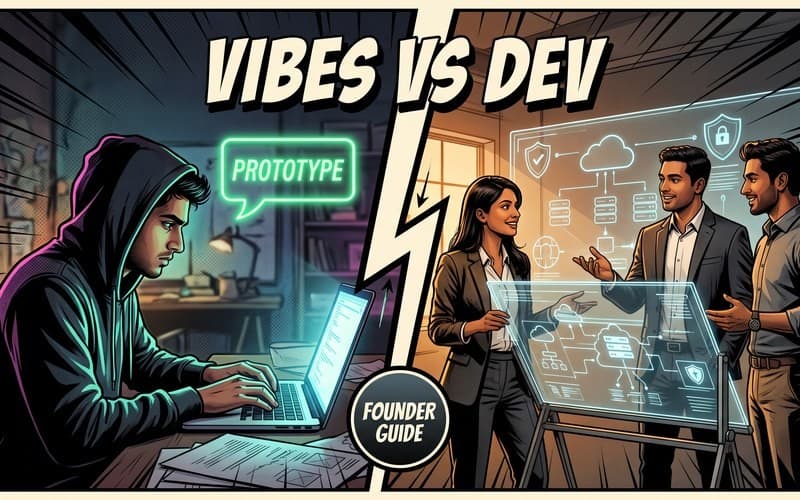
An organization evaluating an AI chatbot development cost must look beyond raw token billing to understand total system architecture. The true investment is determined by three interdependent engineering layers: contextual retrieval depth through vector data stores, custom middleware connecting business APIs, and ongoing governance required to keep model responses compliant. While simple interface wrappers require modest upfront effort, resilient enterprise conversational assistants demand dedicated data pipelines, robust security safeguards, and systematic human code review to prevent operational failures at scale.
What Really Drives AI Chatbot Development Cost in 2025?
Estimating an AI chatbot development cost begins by distinguishing between superficial AI wrappers and production-grade conversational architectures. A basic wrapper relies on a third-party hosted model endpoint with minimal static system prompting. While cheap to prototype, it fails quickly in enterprise environments where data isolation, state persistence, and predictable transaction handling are required. In contrast, an enterprise conversational system operates as an orchestrated application layer integrating structured business logic, identity verification, and dynamic context retrieval.
The total cost to build an AI chatbot is primarily governed by three technical variables:
- Retrieval Depth and Freshness: Integrating real-time company knowledge requires ingestion pipelines, chunking strategies, and vector indexing that consume compute, storage, and embedding generation resources.
- Integration Scope: A chatbot that simply answers static documentation questions costs far less to engineer than an agentic system executing authenticated read-write operations against ERPs, CRMs, or core transactional databases.
- Concurrency and Throughput Requirements: Supporting hundreds of concurrent user sessions requires resilient asynchronous message queues, rate-limiting guards, and caching layers to prevent spiraling inference expenses.
Understanding these drivers allows technical leaders to allocate engineering capital effectively rather than treating artificial intelligence deployment as an unpredictable operational liability.
Core Architectural Layers and Their Implementation Expenses
An accurate enterprise AI chatbot cost breakdown requires deconstructing the software into its foundational functional layers. Rather than treating an intelligent assistant as a monolithic expenditure, development teams evaluate costs across model inference, contextual knowledge storage, and backend middleware integration.
LLM Inference and Context Window Token Economics
The variable operating budget of any conversational assistant centers on model inference. As documented across foundation model API benchmarks, commercial providers bill separately for input, cached input, and output tokens, with output generation billed at a steep multiple over standard input. In multi-turn chat applications, context windows expand rapidly as message histories, retrieval chunks, and system prompts accumulate. Without prompt caching or context truncation strategies, each follow-up query resends historical context, multiplying token consumption exponentially. When calculating LLM chatbot implementation cost, engineering teams must evaluate whether to deploy advanced frontier models for complex multi-step reasoning, smaller distilled models for narrow classification tasks, or hybrid routing layers that direct routine questions to lightweight models.
Vector Retrieval Infrastructure and Embedding Index Management
Retrieval-Augmented Generation (RAG) grounds conversational responses in internal enterprise records. Implementation budgets must account for both embedding generation and vector database operations. As highlighted in Pinecone's indexing documentation, vector search pricing structures differ fundamentally between dedicated provisioned pods—which charge fixed hourly rates regardless of query traffic—and serverless architectures billed on storage volume and active read/write query units. Indexing expenses also scale with document update frequencies; real-time synchronization of fast-changing catalogs or CRM records triggers continuous re-embedding calls. For most organizations, advanced RAG with hybrid semantic and keyword search proves far more cost-effective than custom model fine-tuning, which introduces substantial upfront data labeling expenses, compute clustering overhead, and rapid obsolescence whenever base foundation models upgrade.
Data Connectors, Sanitization Pipelines, and Middleware Engineering
The largest portion of initial engineering effort lies in middleware development. Raw enterprise data residing in SQL databases, ticketing platforms, and document management systems must pass through automated sanitization pipelines to scrub sensitive personal identifiers, validate schema formats, and strip formatting artifacts before indexing. Production architectures require resilient LLM integration services that manage connection pooling, enforce role-based access control, and handle API rate-limit backoffs. Orchestration middleware also hosts validation guardrails, inspecting outgoing payloads to ensure generated responses comply with structured JSON schemas before reaching customer-facing clients.
Turnkey SaaS Subscriptions vs. Custom Engineering: Total Cost Analysis
When architecting a conversational solution, decision-makers face a critical fork: subscribing to an off-the-shelf chatbot platform or investing in proprietary engineering. Analyzing custom AI chatbot pricing against commercial subscription models reveals substantial divergence over extended operational horizons.
When Ready-Made Chatbot SaaS Introduces High Scale Penalties
Turnkey chatbot platforms provide rapid setup, offering visual flow builders and hosted connectors suitable for basic customer support. However, their pricing models often penalize business growth. Most turnkey providers charge layered platform fees, seat licenses for human agents, and significant per-resolution or per-message surcharges on top of underlying LLM usage. At low conversation volumes, this bundled approach appears economical. Yet, as user engagement scales into tens of thousands of monthly sessions, these per-message premiums accumulate rapidly. Furthermore, turnkey vendors restrict access to raw vector embeddings, impose rigid prompt configurations, and retain proprietary control over conversation telemetry, leaving enterprises vulnerable to vendor lock-in and unexpected pricing tier revisions.
Capitalizing Bespoke Software for Control, IP, and Tailored Workflows
Investing in bespoke software transforms software expenditure from ongoing operational rent into capitalized enterprise assets. By engineering custom AI chatbot solutions, organizations directly manage their AI chatbot infrastructure pricing, paying only wholesale provider rates for raw token consumption and cloud compute.
| Evaluation Dimension | Turnkey SaaS Platform | Bespoke Custom Build |
|---|---|---|
| Marginal Cost per Query | High retail markup per message or resolved ticket | Direct wholesale token and vector compute rates |
| Data Governance & IP | Shared vendor cloud; limited telemetry access | Full source code, private deployment, proprietary data ownership |
| Integration Depth | Constrained to pre-built marketplace connectors | Arbitrary integration with private ERPs, CRMs, and internal APIs |
Determining the break-even threshold between SaaS subscriptions and bespoke development depends on user engagement volume and workflow complexity. For organizations handling high interaction volumes or complex private workflows, bespoke development establishes predictable long-term economics while preserving full technical flexibility.
How Modern Engineering Workflows Rationalize Development Budgets
The economics of conversational software engineering have evolved beyond traditional hourly billing models. Historically, chatbot development agency rates heavily factored in dozens of manual engineering hours spent writing boilerplate connectors, UI wrappers, and repetitive data schemas. Today, agentic engineering workflows streamline initial code generation, redirecting specialized technical effort toward high-value architecture, security validation, and system integration.
Accelerating Initial Builds with AI Coding Harnesses and Agentic Tooling
At Canvas Developers, our approach pairs AI coding agents and advanced harnesses like Antigravity with senior software engineers to accelerate design, scaffolding, and test generation. Shorter feedback loops allow developers to stand up functional prototypes rapidly, whether building from scratch or finishing and hardening an early AI-built, vibe-coded MVP. Depending on data governance requirements, organizations choose between two structured delivery models: Private / Local AI Engineering, which runs privately hosted open-weight models within client-controlled infrastructure, or Claude Code / OpenAI Codex Engineering, utilizing approved commercial cloud environments. These targeted automation mechanisms compress initial turnaround schedules and reduce the aggregate cost to build an AI chatbot without compromising architectural integrity.
Why Senior Engineers Must Direct Architecture, Code Review, and Deployment
While AI coding tools excel at generating syntactical scaffolds and boilerplate handlers, they fail at contextual risk assessment and deep system design. Automated code generators frequently introduce subtle concurrency flaws, improper error handling around rate-limited APIs, and vulnerable database access patterns. In our engineering workflow, experienced engineers own the architecture, conduct rigorous code reviews on every commit, and maintain final authority over release decisions. Senior engineers design role-based access boundaries, isolate payment flows, and ensure complex integrations—such as custom intelligent automation agents and backend webhooks—behave deterministically under enterprise workloads.
Post-Deployment Operating Expenses and Hidden Engineering Overhead
A complete enterprise AI chatbot cost breakdown must account for post-deployment operational expenditure. Launching a conversational system into production marks the beginning of continuous lifecycle maintenance rather than a completed capital expense. Ongoing operations require automated quality monitoring, infrastructure tuning, and proactive data governance to maintain reliable performance.
Continuous Quality Assurance: Hallucination Mitigation and Latency Tuning
Production conversational agents interact with unstructured user inputs that inevitably test system boundaries. Without active monitoring, foundation models can hallucinate incorrect business facts or drift from defined behavioral policies. Maintaining response accuracy requires establishing automated evaluation pipelines that run regression tests against curated test suites whenever prompts or underlying foundation models are updated. Concurrently, technical teams optimize runtime latency. Because slow response generation directly degrades user adoption, engineers implement semantic caching layers to intercept recurrent questions, structure asynchronous tool calls, and deploy streaming output protocols. These tuning efforts directly stabilize AI chatbot infrastructure pricing by avoiding unnecessary re-computation and minimizing peak compute utilization.
Enterprise Data Governance, RBAC Constraints, and Payment Security
Enterprise deployments demand strict boundaries around proprietary data access. Conversational interfaces querying enterprise knowledge bases must enforce Role-Based Access Control (RBAC) at the retrieval tier, guaranteeing that authenticated users only receive information matching their permission clearance. Furthermore, production pipelines must incorporate data sanitization routines to redact personally identifiable information (PII) before queries reach third-party inference endpoints.
To ensure long-term stability and compliance, engineering teams rely on a production operational checklist:
- Permission Boundary Validation: Validate that metadata filters in vector queries strictly mirror user authentication scopes.
- Data Sanitization and Redaction: Strip sensitive payment details and personal identifiers prior to external model transmission.
- Index and Schema Maintenance: Schedule periodic vector re-indexing and monitor for embedding drift across evolving product documentation.
- Model Deprecation Lifecycles: Track upstream vendor deprecation roadmaps to transition API versions without service interruptions.
By addressing these operational disciplines during initial architecture planning, organizations avoid unbudgeted maintenance overhead and ensure sustainable conversational reliability.
Scoping Your Chatbot Project: Milestone Planning and Next Steps
Successfully controlling an AI chatbot development cost requires structured project delivery rather than open-ended experimentation. Transparent software initiatives translate functional requirements into discrete, sequential milestones: architectural scoping, data sanitization and indexing pipelines, middleware and API connector engineering, user acceptance testing with human evaluation, and production deployment.
Each phase provides an opportunity to evaluate technical viability before committing additional engineering capital. When structuring custom AI chatbot pricing, defining clear boundary criteria between initial prototypes and production-hardened systems prevents scope creep. For workflows with modest complexity, a simpler static knowledge base or existing turnkey tool may suffice; however, when your product requires proprietary database interactions, custom business rules, or private cloud isolation, bespoke engineering provides the necessary control and longevity.
At Canvas Developers, our software engineering team partners with founders, agencies, and enterprise leaders to plan and execute conversational software architectures. Engagements begin with a thorough technical scoping phase to assess your existing software stack, workflow dependencies, data security constraints, and target operational outcomes. From there, experienced engineers establish agreed project milestones, implement rigorous automated testing, and guide systems through release assurance and handover. To evaluate your architectural requirements or request a technical scoping assessment, reach out through our contact form or connect via WhatsApp on our website.