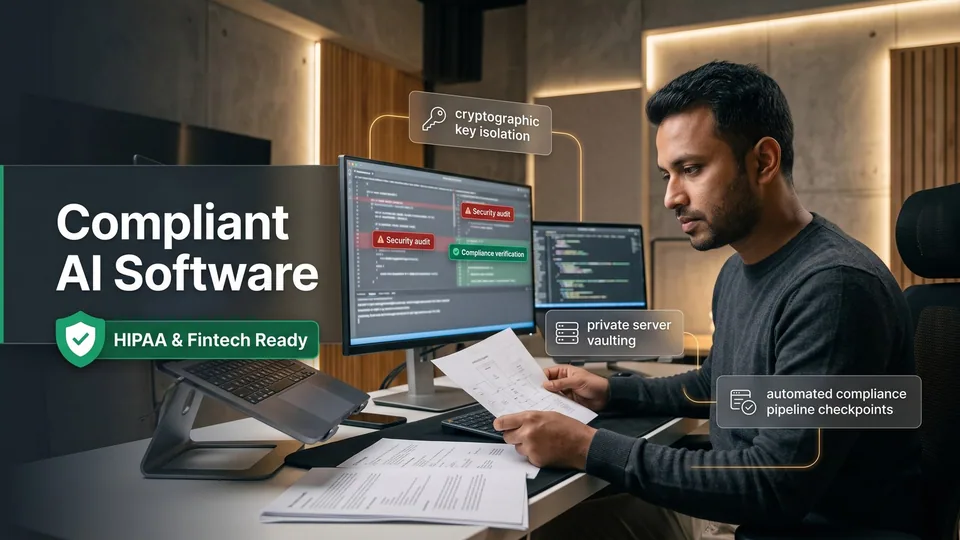
Deploying AI coding assistants inside fintech and healthcare engineering workflows introduces a fundamental operational conflict: developer velocity versus strict regulatory compliance. While autonomous code generation can accelerate routine development cycles, financial and medical systems demand rigorous governance across data handling, cryptographic integrity, and statutory audit trails. Achieving compliant AI software development requires continuous engineering supervision rather than unmonitored automation.
For organizations operating under HIPAA, PCI-DSS, and GDPR, adopting generative engineering tools cannot come at the expense of verified security postures. Maintaining compliance requires structured architectural boundaries, isolated model execution, and deterministic validation at every stage of the software delivery lifecycle.
Can Regulated Teams Safely Use AI Coding Tools Without Violating Compliance?
The Tension Between Rapid Delivery and Strict Regulatory Scrutiny
Engineering teams in financial technology and digital healthcare face relentless pressure to ship features quickly. Generative AI coding assistants offer significant speed advantages for boilerplate generation, scaffolding, and test suite creation. However, adopting these tools inside regulated software development environments introduces non-trivial compliance risks.
Regulatory frameworks such as HIPAA for protected health information (PHI) and PCI-DSS for payment card data enforce strict standards regarding data governance, system access, and system maintainability. When developers paste proprietary code into public models or deploy unvetted generative output directly to production branches, they risk exposing sensitive endpoints, introducing insecure defaults, and violating statutory privacy standards. Acceleration cannot override regulatory mandates.
Why Autonomous AI Coding Cannot Own Regulatory Accountability
An algorithm cannot sign an audit attestation or assume fiduciary responsibility. Machine learning models generate code based on statistical probability rather than deterministic comprehension of regulatory controls. They lack operational awareness of organizational data perimeters, cryptographic key management policies, or specific jurisdictional data sovereignty rules.
Achieving compliant AI software development requires a clear separation of concerns: AI coding agents can draft code and accelerate repetitive implementation tasks, but experienced human engineers must direct the architecture, review every diff, and approve production releases. Accountability resides strictly with human engineers who understand the regulatory consequences of every deployed line of code.
Where Do Commercial AI Coding Agents Fail Under HIPAA, PCI-DSS, and GDPR?
Data Leakage Risks from Uncontrolled Third-Party Model Telemetry
Commercial AI coding platforms frequently transmit context windows—including code snippets, database schemas, and local configuration files—back to remote inference endpoints. In healthcare and financial settings, this background telemetry can inadvertently expose Protected Health Information (PHI) or sensitive customer data to third-party infrastructure. Without explicit Business Associate Agreements (BAAs) under HIPAA or formal Data Processing Agreements under GDPR, routing proprietary context through external cloud services creates direct regulatory violations. Furthermore, external model providers may retain prompt data for evaluation unless zero-retention enterprise agreements are enforced at the network gateway.
Cryptographic Flaws, Secret Mismanagement, and Insecure Defaults
Generative coding tools optimize for plausible syntax rather than verified security postures. In payment processing systems, achieving AI coding PCI DSS compliance requires adherence to stringent cryptographic standards, including authenticated ciphers (such as AES-256-GCM), secure key derivation, and automated secret rotation. Automated assistants frequently generate code featuring deprecated algorithms, weak initialization vectors, or hardcoded sandbox credentials when writing boilerplate logic. In regulated software development, engineers must actively inspect every data pathway to ensure tokenization protocols and secret vaults supersede unvetted code suggestions.
Audit Trail Gaps: Why Unreviewed Code Fails Compliance Inspections
Compliance frameworks require complete, demonstrable provenance for every production commit. Standards such as PCI-DSS Requirement 6, SOC 2 Type II, and the HIPAA Security Rule demand traceable change management, documented peer review records, and reproducible test results. Merging autonomous synthetic output directly into production repositories creates unverified code provenance that collapses under regulatory audit scrutiny. Regulatory examiners require documented engineering rationale for access control decisions and cryptographic configurations—accountability that automated generation utilities cannot articulate or defend.
How Does Human-Directed Architecture Keep AI-Generated Code Compliant?
Pairing Fast AI Drafts with Experienced Architectural Ownership
AI coding agents excel at producing boilerplate interfaces, scaffolding schema migrations, and generating initial unit tests at high velocity. However, system architecture must be defined and owned exclusively by experienced human engineers before any automated code generation begins. In regulated domains, engineers deliberately design architectural boundaries: isolating database access behind strict repository abstractions, decoupling cardholder data environments from general application logic, and enforcing domain-driven encapsulation. Under this model of compliant AI software development, automated tooling serves as an accelerated implementation assistant, while seasoned engineers maintain full ownership over system topologies, cross-service contracts, and long-term maintainability.
Mandatory Manual Code Reviews for Security, Payments, and Data Flows
Automated linter checks and static analysis tools are foundational, but they cannot substitute for thorough manual code reviews conducted by senior engineers. When engineering fintech transaction processing engines or healthtech patient record workflows, human reviewers specifically inspect data flow paths, boundary validations, and race conditions that automated tools routinely miss. Reviews scrutinize database queries for accidental data leaks, verify that no raw account numbers or protected health metrics enter unencrypted application logs, and ensure all cryptographic operations employ verified, standard libraries. Experienced engineers review every diff line by line to guarantee that payment integrations and patient data handlers satisfy every operational security requirement.
Enforcing Release Decisions and Deterministic QA Verification
Production release decisions in regulated environments require authoritative human sign-off backed by deterministic quality assurance. Test suites drafted by automated assistants must be expanded and verified by dedicated QA engineers against regulatory edge cases, concurrency anomalies, and disaster recovery scenarios. Automated agents cannot possess permission to merge pull requests or trigger production deployments autonomously. Comprehensive automated test runs, static application security testing (SAST), and dual-engineer approvals are assembled into tamper-evident audit trails AI code pipelines require for compliance verification. This deterministic gate ensures that every production deployment adheres strictly to statutory mandates while keeping delivery cycles fast.
When Should You Choose Private Local AI Engineering Over Cloud Models?
Operating Open-Weight Models Inside Client-Controlled Infrastructure
When organizations handle sensitive medical records, proprietary payment routing algorithms, or banking credentials, routing source code through public multi-tenant cloud platforms introduces unacceptable risk. To address these exposure vectors, organizations deploy Private / Local AI Engineering packages, hosting open-weight models directly within private data centers or dedicated Virtual Private Clouds (VPCs) under the client's direct administrative control.
In high-consequence healthcare settings, utilizing private AI engineering healthcare infrastructure ensures inference computations happen entirely behind company firewalls. This air-gapped topology prevents unauthorized data transit, keeps proprietary codebases isolated, and eliminates dependency on external third-party model hosts.
Configuring Commercial Tooling with Strict Cloud Governance Controls
When engineering teams choose commercial developer tooling—such as Claude Code / OpenAI Codex Engineering workflows—cloud configurations must be explicitly reviewed and approved before developer onboarding. Regulated engineering leaders implement tenant-level enterprise configurations that disable background telemetry, restrict automated workspace indexing, and enforce strict zero-data-retention agreements across all provider endpoints.
Additionally, technical managers mandate Single Sign-On (SSO) authentication, role-based tool access, and outbound network filtering. These guardrails ensure that commercial assistants operate within clearly defined perimeters without transmitting proprietary financial algorithms or configuration secrets outside approved enterprise boundaries.
Guaranteeing Data Sovereignty and Zero-Retention for Protected Data
Data sovereignty regulations, including GDPR residency mandates, the HIPAA Security Rule, and national banking directives, govern where protected records reside and who retains custody. Enforcing verified zero-retention policies guarantees that proprietary code context, mock payloads, and schema definitions are discarded immediately following inference without being cached or evaluated externally.
Aligning private infrastructure with fintech AI development compliance standards assures risk officers and regulatory examiners that modern engineering tooling honors statutory confidentiality obligations. Organizations achieve high development velocity while preserving complete jurisdictional control over their intellectual property and customer records.
What Does Compliant AI Engineering Look Like in Practice? A Digital Health Scenario
Building a HIPAA-Compliant Symptom Tracking and Telehealth Portal
Consider a digital health organization developing a patient-facing symptom intake tool and video telehealth consultation portal. In this scenario, developers leverage AI coding assistants to accelerate responsive front-end component creation, state management scaffolding, and FHIR (Fast Healthcare Interoperability Resources) data models. However, practicing rigorous healthtech software engineering HIPAA standards requires senior engineers to define and isolate every data pathway that touches electronic Protected Health Information (ePHI).
Engineers ensure that patient questionnaire inputs, clinical notes, and diagnostic records never interface directly with automated external pipelines. Strict input validation, sanitized schema serialization, and dedicated backend middleware isolate confidential patient interactions from external developer tools.
Isolating Patient Data Using Air-Gapped Local Model Environments
To support real-time clinical triage or natural language symptom categorization without risking statutory breaches, the engineering team deploys dedicated private AI engineering healthcare infrastructure. Open-weight inference engines operate inside an isolated, air-gapped VPC with zero outbound public internet connectivity.
Clinicians and staff benefit from automated clinical intake drafting and structured record formatting, while compliance officers maintain verifiable certainty that sensitive medical histories remain confined to hardened, customer-owned infrastructure. Local model hosting eliminates exposure to third-party data collection policies, ensuring full alignment with organizational privacy controls.
Implementing End-to-End Encryption, Strict RBAC, and Complete Audit Logs
Human engineers construct the defensive security architecture surrounding the entire telehealth pipeline: enforcing TLS 1.3 for data in transit and AES-256 for database volumes and document archives. Granular Role-Based Access Control (RBAC) ensures only credentialed healthcare practitioners access specific patient charts, preventing background services from inheriting excessive system privileges.
Furthermore, every patient record mutation, clinical access event, and code deployment generates an immutable, write-once audit log. Senior engineers verify that all access attempts and data export routines adhere to HIPAA Security Rule audit specifications before certifying the platform for production staging.
What Security and Governance Controls Must Engineers Verify Before Release?
Verifying Encryption Standards, Tokenization, and Key Management
Before any release enters staging or production, security engineers must validate all cryptographic configurations. Automated coding tools often default to basic hashing or unauthenticated encryption ciphers unless strictly constrained. To achieve AI coding PCI DSS compliance and protect cardholder or patient records, engineers ensure data at rest uses AES-256-GCM and data in transit adheres to TLS 1.3 with forward secrecy.
Sensitive data elements, such as Primary Account Numbers (PANs) or government identifiers, must be replaced with opaque tokens before persisting to application databases. Furthermore, cryptographic keys must reside in dedicated Hardware Security Modules (HSMs) or cloud Key Management Services (KMS) with automated rotation schedules, never within code repositories or environment variables.
Hardening APIs and Enforcing Least-Privilege Role-Based Access Control
API endpoints generated during accelerated development sprints require rigorous perimeter verification. Human engineers verify that every endpoint enforces strict input validation, rate limiting, and parameter sanitization to prevent injection vulnerabilities and broken object-level authorization (BOLA). Access boundaries must reflect least-privilege principles, ensuring that microservices and background workers access only the specific database tables and cloud storage buckets necessary for their designated functions.
Documenting Changes and Maintaining Immutable Audit Trails for Regulators
Regulatory authorities such as banking supervisors, healthcare regulators, and data protection commissions require comprehensive proof of system integrity. Technical teams must preserve comprehensive audit trails AI code pipelines generate, cataloging every pull request, automated security scan result, human review approval, and container digest. Storing deployment artifacts in write-once, tamper-evident audit repositories ensures that engineering organizations can demonstrate complete governance during formal regulatory examinations.
How Can You Modernize Your Regulated Engineering Stack Securely?
Starting with a Scoped Architecture and Compliance Assessment
Modernizing engineering workflows in fintech and healthcare begins with an objective evaluation of existing infrastructure and regulatory boundaries. A structured architectural audit maps data flows, identifies sensitive data perimeters, and defines concrete isolation requirements. This initial scoping process ensures that regulated software development practices align with organizational compliance obligations from day one while establishing clear verification protocols.
Engaging Canvas Developers for Private or Governed AI Engineering via https://www.canvasdevelopers.com/contact
Canvas Developers delivers high-velocity, compliant AI software development across fintech, healthtech, and enterprise systems. Experienced engineers direct architecture, conduct manual code reviews, and own release decisions while AI coding agents speed up implementation and testing. Whether your organization requires Private / Local AI Engineering in isolated environments or governed commercial tooling, engagements begin with structured scoping followed by agreed milestones. Contact the engineering team through https://www.canvasdevelopers.com/contact to discuss your requirements.