Modern engineering teams increasingly rely on automated coding agents to accelerate product delivery, but adopting external machine models without strict controls creates severe security and legal liabilities. Establishing robust enterprise AI code governance ensures that proprietary source code, internal logic, and sensitive business data remain protected against unauthorized telemetry retention and intellectual property exposure.
For technology leaders, balancing developer velocity with enterprise-grade compliance requires clear operational boundaries, air-gapped or privately hosted model infrastructure, and disciplined human oversight over every automated pull request.
What Risks Does Ungoverned AI Coding Introduce to Enterprise Software?
Data Exfiltration Risks via Commercial Prompt History and Telemetry
When software developers paste proprietary code snippets into public cloud assistants, they transmit internal application logic, database schemas, and API endpoints across external networks. Commercial providers frequently retain prompt history, session context buffers, and system telemetry for debugging or evaluation. Without formal enterprise AI code governance, organizations inadvertently expose critical intellectual assets and sensitive operational configurations to third-party infrastructure.
Intellectual Property Ownership Ambiguities in Cloud-Trained Code
Cloud-based AI models often ingest developer interactions into continuous training datasets unless explicit enterprise data-handling contracts prevent it. This pipeline blurs source code provenance, raising legal disputes regarding license contamination and derivative works. Maintaining strict AI development IP protection demands verifiable controls ensuring proprietary business logic never trains external foundation models or leaks into competitor prompts.
The Expansion of Unvetted Shadow AI Across Engineering Teams
Without clear corporate guardrails, individual engineers frequently adopt unvetted IDE extensions and automated agents to meet aggressive sprint deadlines. This unmanaged shadow usage bypasses internal security audits, leaves repositories vulnerable to unauthorized telemetry extraction, and injects undocumented external dependencies into production applications. Consequently, organizations lose visibility into where machine-generated logic enters the codebase.
How Do Public Cloud AI Tools Differ from Private AI Engineering?
Data Isolation in Self-Hosted Open-Weight Models vs. Public APIs
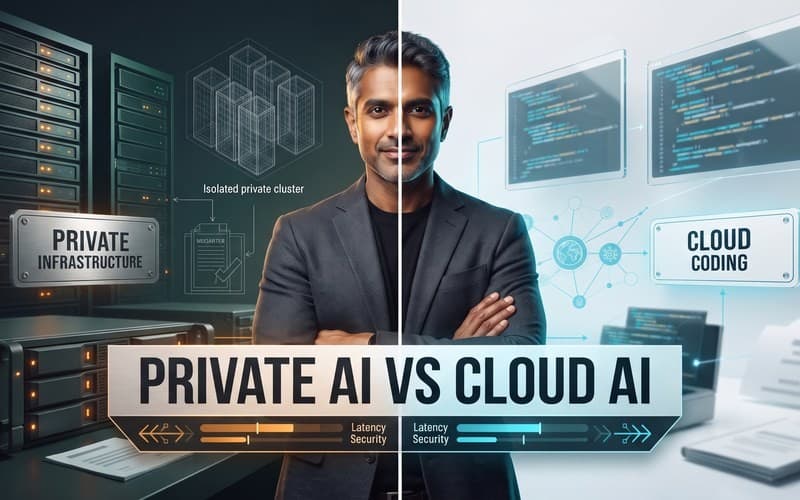
Commercial cloud APIs process code requests across distributed multi-tenant infrastructure where prompt payloads, context buffers, and system metadata leave the corporate network. Even when enterprise vendors provide contractual zero-retention assurances, data traverses public routing layers and remains subject to third-party infrastructure vulnerabilities. In contrast, private AI engineering establishes absolute data isolation by running open-weight foundation models exclusively inside infrastructure the organization owns and administers. Proprietary algorithms, business logic, and configuration secrets never exit approved perimeters, preventing external data ingestion and unauthorized model training. This architectural boundary eliminates third-party supply chain exposure at the inference tier.
Network Perimeter Security and Air-Gapped Code Processing
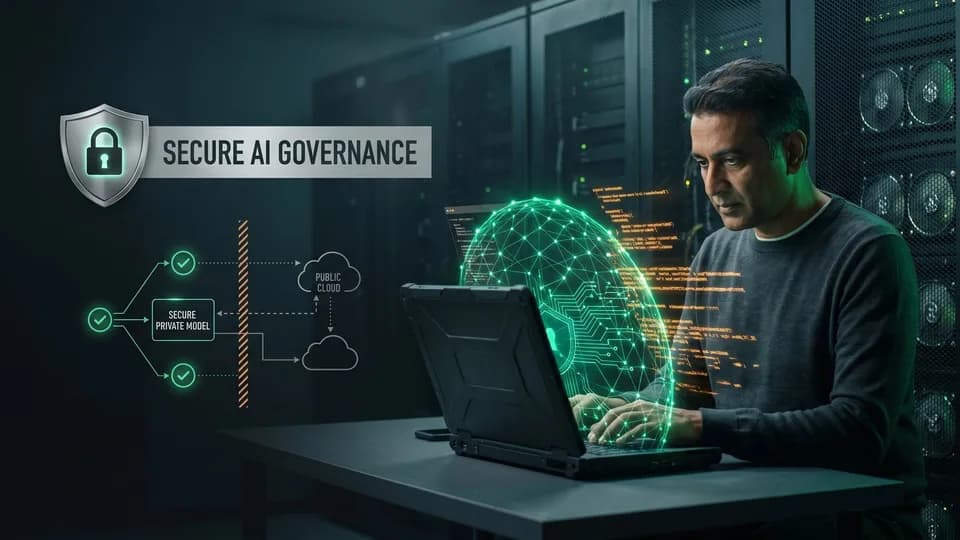
Enterprises operating in regulated sectors such as finance, healthcare, and critical infrastructure must enforce rigorous network segmentation. Implementing self hosted AI coding models within private subnets or fully air-gapped internal environments eliminates outbound data leakage vectors entirely. Security teams can establish strict ingress controls, mutual TLS communication, and isolated container runtimes that completely block external internet egress. Because inference hardware resides within the corporate perimeter, security analysts monitor all network traffic through existing intrusion detection systems and centralized firewall logs.
Balancing Developer Velocity with Enterprise Infrastructure Control
Prohibiting engineering teams from utilizing automated assistance often degrades productivity and inadvertently drives unmanaged shadow AI adoption. Providing controlled internal inference clusters balances developer velocity with rigorous enterprise governance. Software engineers retain rapid code generation, scaffolding acceleration, and unit test synthesis directly within approved development workflows. Concurrently, IT leadership enforces enterprise access policies, hardware quotas, and network isolation, ensuring that engineering acceleration aligns with operational security requirements. This dual approach delivers modern development tooling without sacrificing institutional governance standards.
What Does an Enterprise AI Code Governance Architecture Look Like?
Deploying Open-Weight Models Within Client-Controlled Virtual Private Clouds
Enterprise security architectures prevent data leakage by isolating inference execution inside a dedicated Virtual Private Cloud (VPC) or on-premises data center. In this model, high-performing open-weight foundation models run on dedicated GPU compute instances provisioned, secured, and maintained directly by enterprise infrastructure teams. By hosting models within client-controlled network boundaries, infrastructure policies restrict traffic to internal private endpoints. This setup guarantees that proprietary source code repositories, staging databases, and internal API schemas never communicate with external public clusters over the open internet. This isolated infrastructure forms the technical baseline for modern enterprise AI code governance, granting organizations complete sovereignty over memory persistence, network interfaces, and model execution environments.
Configuring Role-Based Access Controls and Ephemeral Context Windows
Controlling how engineering personnel interface with internal inference engines requires granular access policies and strictly regulated prompt contexts. Identity and access management (IAM) systems must enforce role-based permissions, restricting model queries to authorized engineers based on project scope, repository classification, and branch clearance levels. Furthermore, inference harnesses must implement ephemeral context windows that process prompt data strictly in volatile memory without writing intermediate tokens to persistent storage disks. When an engineering session terminates or a task concludes, prompt tokens and generated code suggestions purge completely from memory buffers. This architectural discipline prevents unintended cross-project data leakage and ensures that sensitive domain logic remains strictly compartmentalized within authorized development boundaries.
Automating Audit Logging and Model Telemetry Monitoring
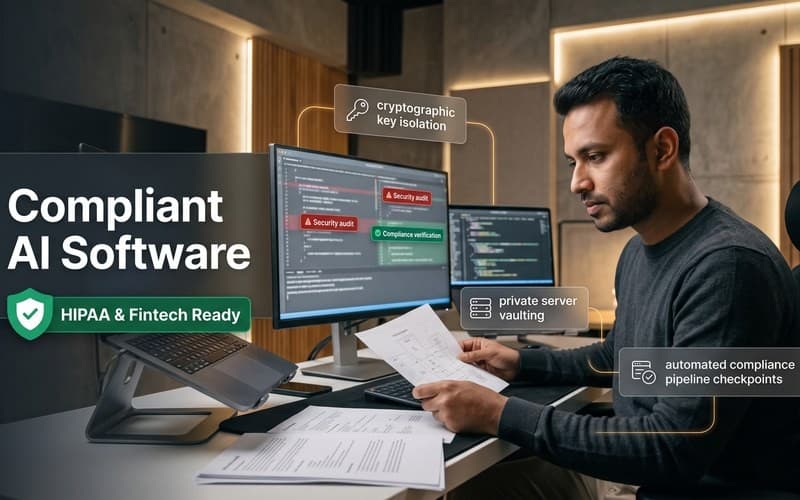
Operational oversight demands continuous visibility into every machine-assisted development interaction across the organization. When implementing local LLM coding enterprise infrastructure, engineering leaders deploy automated telemetry collectors that record prompt metadata, model versioning, execution timestamps, and user identities. Instead of recording raw source code containing proprietary trade secrets, audit pipelines log cryptographic hashes, token consumption metrics, and latency performance across the inference cluster. Centralized security information and event management (SIEM) dashboards analyze these telemetry streams against compliance baselines, instantly flagging anomalous query patterns, unauthorized access attempts, or bulk extraction activities. Comprehensive audit trails provide verifiable compliance evidence for industry frameworks while preserving developer velocity.
Why Must Senior Engineers Direct AI-Assisted Development?
Where AI Models Excel: Accelerating Scaffolding, Repetitive Logic, and QA Tests
Modern AI coding agents deliver significant productivity gains when assigned well-bounded, mechanical software engineering tasks. Automated models excel at generating boilerplate project scaffolding, synthesizing standard CRUD interfaces, converting data formats, and drafting comprehensive unit and regression test suites. By handling repetitive coding patterns, automated assistants free engineering teams from routine syntax generation and accelerate baseline development cycles. When integrated into structured development workflows, these capabilities allow organizations to prototype features and expand test coverage rapidly without sacrificing baseline velocity.
Where AI Models Fail: Architectural Cohesion, Payment Flows, and Scale Bottlenecks
Despite their code generation speed, machine models lack holistic comprehension of complex enterprise systems and long-term architectural cohesion. Automated tools frequently struggle with subtle state management, transactional concurrency, database indexing, and high-volume scalability bottlenecks. In critical domains such as payment processing, authentication workflows, and sensitive data pipelines, machine-generated code often introduces latent security vulnerabilities, unhandled exception paths, or insecure default configurations. Maintaining rigorous enterprise AI code security requires recognizing that statistical models cannot evaluate operational risk, leaving critical financial transactions and system resilience vulnerable if left unchecked.
Enforcing Human Ownership Over Architecture, Deep Code Review, and Releases
Deploying automated coding tools effectively requires seasoned software engineers to direct, evaluate, and govern every output. Human architects must own foundational system design, define interface boundaries, and determine how new components interact with existing enterprise systems. A disciplined CIO AI software policy mandates that senior developers conduct thorough code reviews on all machine-assisted pull requests, verifying data sanitization, security controls, and architectural integrity. Release decisions must remain strictly under human control, ensuring that machine-generated suggestions never bypass manual verification before entering production environments.
How Do Self-Hosted AI Models Compare to Commercial SaaS Solutions?
Regulatory Compliance and Data Residency Across Hosting Models
Organizations governed by stringent regulatory frameworks, such as GDPR, HIPAA, or regional data sovereignty mandates, face substantial compliance challenges when using commercial multi-tenant AI services. Cloud providers frequently route inference payloads across globally distributed server clusters, making verifiable data residency difficult to confirm. By utilizing self hosted AI coding models, enterprises anchor code processing and repository analysis to specific geographic regions or private on-premises facilities. Infrastructure teams maintain direct physical and logical control over storage volumes and processing nodes, satisfying statutory audit requirements without ambiguity.
Long-Term Codebase Integrity and Protection Against Upstream API Changes
Relying on external commercial AI APIs introduces operational volatility whenever upstream providers deprecate endpoints, modify model weights, or adjust internal safety filters without notice. These unannounced adjustments can alter code synthesis behavior, disrupt custom engineering harnesses, or degrade output consistency across development cycles. Self-hosted deployments insulate internal teams from unexpected vendor modifications. By freezing model versions and validating updates through controlled internal release cadences, organizations preserve deterministic code generation standards and maintain long-term codebase integrity.
Infrastructure Maintenance Overhead vs. External Vendor Dependencies
While commercial SaaS tools offer immediate turnkey convenience, they exchange operational simplicity for systemic vendor lock-in and persistent telemetry exposure. Operating internal models requires capital allocation for GPU compute instances, model orchestration, and specialized maintenance oversight. However, this engineering investment establishes sovereign enterprise AI code security, complete network perimeter defense, and continuous availability during public cloud outages. Enterprises can weigh these operational trade-offs by identifying which sensitive codebases require absolute infrastructure isolation.
What Practical Policies Should CIOs Enforce for AI-Assisted Teams?
Classifying Approved vs. Restricted Tasks for AI Agent Workflows
An actionable CIO AI software policy begins with transparent task classification across the engineering lifecycle. Technology leadership should explicitly designate which development activities may leverage automated coding agents and which require exclusive human authoring. While automated assistants are well suited for generating routine boilerplate, drafting integration tests, and synthesizing schema transformations, they should be prohibited from independently modifying cryptographic keys, authentication flows, payment gateway integrations, and proprietary business logic. Restricting model involvement in high-risk modules prevents accidental security misconfigurations while maintaining developer velocity across low-risk engineering tasks.
Mandating Security and Static Analysis Gates for Machine-Generated PRs
Because automated agents can hallucinate non-existent package dependencies or introduce subtle vulnerabilities, automated pull requests require mandatory verification gates. CI/CD pipelines must integrate static application security testing (SAST), software composition analysis (SCA), and automated dependency validation on all machine-assisted code submissions. Tagging pull requests with model attribution ensures reviewers scrutinize generated logic with appropriate rigor. Enforcing these automated gates strengthens AI development IP protection by validating code provenance and preventing unvetted external libraries from entering production branches.
Formalizing Vendor Approval Criteria for Cloud and Local AI Harnesses
Procuring AI engineering harnesses requires clear corporate standards that address data privacy, intellectual property retention, and network boundaries. Procurement policies must mandate verified zero-retention contracts and strict non-training clauses before any cloud-based development tool is approved. For mission-critical repositories, enterprise guidelines should establish explicit thresholds where teams must transition from commercial APIs to self-hosted or isolated deployment models. Formalizing these evaluation criteria protects proprietary assets and ensures consistent compliance across all engineering units.
How Can Enterprises Safely Adopt Governed AI Engineering Today?
Conducting a Scoped Governance Assessment for Internal Workflows
To adopt automated development securely, organizations should begin with a structured engineering audit. Evaluating existing repository permissions, developer workflows, and compliance requirements identifies where machine assistance accelerates delivery and where strict isolation is necessary. Establishing an actionable framework for enterprise AI code governance ensures that automated tools align with internal data protection policies before broader deployment across product teams.
Implementing Isolated Infrastructure with Canvas Developers
For organizations seeking secure engineering velocity, Canvas Developers provides dedicated delivery models for private AI engineering that combine AI acceleration with rigorous human oversight. Through its Private / Local AI Engineering package, Canvas Developers deploys open-weight models within client-controlled infrastructure, ensuring proprietary source code never leaves private perimeters. Experienced software engineers, QA specialists, and DevOps architects direct every automated workflow, own foundational system architecture, and review all code changes before release. To evaluate your engineering workflows or establish an isolated deployment harness, request a scoped assessment through the contact form at Canvas Developers Contact.