Engineering leaders evaluating modern automated workflows face a strategic tension between developer velocity and data governance. When weighing private AI vs cloud AI coding, technical executives must reconcile the rapid synthesis of hosted commercial assistants with the strict isolation demanded by intellectual property policies and compliance standards.
While AI coding tools significantly accelerate implementation, engineering rigor remains essential. At Canvas Developers, specialized AI agents speed up software design, testing, and implementation, while experienced engineers direct the architecture, conduct peer code reviews, and govern all production release decisions.
Why Is Choosing Between Private AI and Cloud AI Coding Critical for Engineering Leaders?
Balancing Developer Velocity with IP Protection and Data Sovereignty
Modern engineering teams face unrelenting pressure to deliver software rapidly, and generative coding assistants provide undeniable gains in routine scaffolding and interface prototyping. However, adopting these tools forces leadership to evaluate the structural trade-offs in private AI vs cloud AI coding. While individual developer throughput accelerates, enterprise organizations must protect proprietary intellectual property, trade secrets, and core business algorithms from inadvertent exposure.
In regulated sectors such as financial services, healthcare, and critical infrastructure, statutory data sovereignty mandates dictate that proprietary codebases remain strictly within audited boundaries. Deploying automated engineering workflows without compromising enterprise governance requires establishing clear demarcations around where code resides, how tokens are processed, and whether external platforms retain contextual telemetry.
The Technical and Compliance Risks of Sending Codebases to External APIs
Transmitting entire enterprise codebases across external networks introduces distinct security concerns. The primary issue regarding commercial AI coding tools security centers on data ingestion, contextual caching, and potential retention for downstream model training. When proprietary code passes through multi-tenant external endpoints, companies risk exposing internal microservice schemas, proprietary business rules, and hidden architectural vulnerabilities to third-party infrastructure.
Compliance frameworks such as SOC 2, ISO 27001, and HIPAA frequently restrict multi-tenant data processing without explicit vendor agreements and strict cryptographic guarantees. Engineering leaders must determine whether developer convenience warrants external dependencies, or whether enterprise risk profiles require isolated environments where zero source code leaves designated infrastructure.
How Do Commercial Cloud AI Tools Like Claude Code and OpenAI Codex Perform in Production?
Strengths in Complex Multi-File Reasoning and Fast Scaffold Generation
Commercial cloud systems such as Claude Code and OpenAI Codex excel at synthesizing broad contextual surfaces across interconnected, multi-file codebases. When engineering teams construct full-stack web applications, cross-platform mobile apps, or enterprise business systems, these frontier models rapidly trace complex dependencies across user interfaces, backend API routes, and database abstraction layers. Their core technical strength lies in accelerating structural boilerplate creation, automated unit and integration test generation, and multi-file refactoring tasks that demand high-capacity reasoning.
In practice, these automated capabilities dramatically compress the initial phase of software delivery. When evaluating local LLM coding vs Claude Code, commercial cloud models frequently show greater out-of-the-box consistency when managing cross-module type definitions, asynchronous data flows, and third-party library integrations. Because these commercial platforms operate on massive centralized compute clusters, they ingest extensive repository context without requiring local hardware provisioning, giving developers immediate leverage during early architecture scaffolding and proof-of-concept assembly.
Operational Boundaries: Rate Limits, Vendor Dependencies, and Cloud Settings
Despite their technical strengths, relying solely on commercial cloud endpoints introduces unavoidable operational vulnerabilities. High-throughput development environments regularly encounter strict API concurrency thresholds, unpredictable token latencies during peak hours, and external platform outages that can halt automated continuous integration pipelines. Furthermore, upstream vendor updates, shifting token pricing, or model deprecations can silently alter code generation patterns, introducing unexpected regressions or breaking syntactic changes into production build systems without advance notice.
Governance and data isolation present equally pressing challenges for technical leadership. Maintaining enterprise-grade commercial AI coding tools security requires meticulous implementation of approved cloud settings, including verified zero-data-retention agreements, disabled telemetry ingestion, and strictly isolated tenant environments. Because commercial services operate across shared multi-tenant infrastructure, technical leaders must ensure that sensitive microservice schemas, proprietary business rules, and internal access tokens are never transmitted or stored in external caches. Experienced engineering oversight is indispensable to configure, monitor, and enforce these boundaries continuously.
What Are the Real Infrastructure Requirements for Private Open-Weight AI Engineering?
Deploying Open-Weight Coding Models Within Client-Controlled Infrastructure
Establishing a dependable private AI engineering infrastructure requires provisioning dedicated compute resources, optimized inference runtimes, and secure serving stacks inside client-controlled environments. Rather than routing sensitive token streams through external public endpoints, organizations deploy modern open weight coding models enterprise teams can run on private virtual private clouds (VPCs) or dedicated on-premises hardware clusters. Production deployments utilize high-efficiency serving engines such as vLLM, TensorRT-LLM, or Ollama alongside structured quantization schemes—such as FP8, AWQ, or INT4—to achieve sustained token throughput while managing memory footprints efficiently.
Hosting models on internal infrastructure grants engineering leaders absolute administrative control and predictable operational characteristics. Technical architects can bind model endpoints to internal developer networks, enforce mutual TLS authentication, and deploy custom retrieval-augmented generation (RAG) pipelines over internal code documentation without external exposure. This self-contained setup provides complete visibility into GPU memory saturation, context caching strategies, and concurrency thresholds, eliminating arbitrary third-party API throttling during intensive development cycles across distributed engineering teams.
Air-Gapped Development Workflows and Strict Regulatory Compliance
For organizations operating in defense, public sector governance, healthcare systems, and tier-one banking, statutory security mandates frequently prohibit outbound internet traffic from development workstations. In these high-security environments, air gapped AI development workflows allow software engineers to harness automated assistance without compromising isolation protocols. The entire development toolchain—including source code repositories, self-hosted coding weights, local package mirrors, and build pipelines—operates completely isolated from public network connectivity.
Operating inside isolated boundaries guarantees that source code, database schemas, internal network topologies, and algorithmic assets never leave sovereign control. Updates to model weights and base dependencies are executed through audited offline staging, secure artifact repositories, and cryptographic checksum verification. This architectural rigor ensures full compliance with stringent data protection standards—including ISO 27001, SOC 2 Type II, and regional data protection regulations—while supporting productive day-to-day engineering workflows and robust intellectual property protection.
How Do Private Open-Weight Models Compare Directly to Cloud AI Coding Services?
Architectural Comparison: Privacy, Latency, and Context Window Capabilities
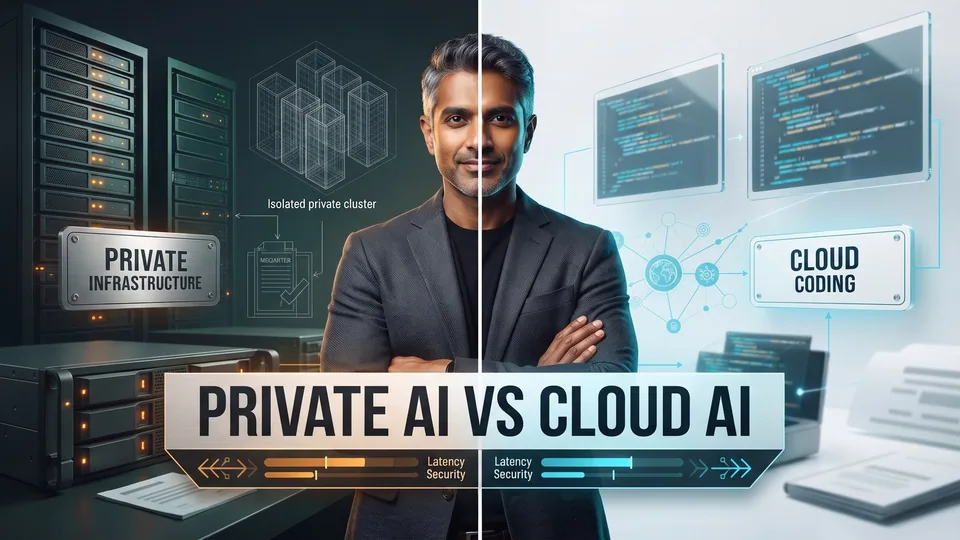
Comparing commercial cloud coding services with self-hosted alternatives requires evaluating architectural trade-offs across privacy guarantees, execution latency, and context window scale. When analyzing OpenAI Codex vs self hosted models, commercial cloud offerings deliver expansive context windows spanning hundreds of thousands of tokens. This vast context capacity enables commercial platforms to ingest multi-tier repositories, third-party framework definitions, and extensive dependency trees in a single inference pass, facilitating comprehensive architectural refactoring.
Conversely, self-hosted open-weight architectures provide unparalleled data privacy and deterministic latency. In a comparative evaluation of local LLM coding vs Claude Code, self-hosted deployments keep every token, syntax tree, and proprietary data schema completely on-premises or within a private VPC. While private infrastructure typically operates with more focused context budgets to conserve hardware memory, co-locating inference servers on internal high-speed networks eliminates public internet routing delays. This delivers predictable token streaming speeds and rapid response times for inline code completion, automated unit test generation, and focused file refactoring.
Resource Realities: Dedicated GPU Compute vs. Cloud Tool Subscriptions
The financial and operational profiles of these two paradigms diverge sharply. Commercial cloud tools operate on flexible per-seat or consumption-based subscription pricing, requiring minimal upfront capital expenditure. Engineering teams can onboard developers immediately without provisioning physical hardware or managing specialized infrastructure. However, as development volume scales across large engineering divisions, ongoing subscription fees, token overages, and proprietary platform lock-in can create compounding operational expenditures.
Deploying private open-weight solutions introduces significant capital commitments for dedicated GPU hardware—such as enterprise-grade accelerators with high-bandwidth memory—or ongoing hourly reservations in private cloud environments. Organizations must also allocate engineering bandwidth for GPU driver maintenance, model quantization, container orchestration, and continuous inference optimization. For enterprises prioritizing proprietary intellectual property, trade secret protection, and predictable long-term compute costs, this dedicated infrastructure investment delivers total governance and immunity from external vendor pricing shifts.
Where Does AI Coding Fail and Why Must Experienced Engineers Direct Delivery?
Critical Vulnerabilities in System Architecture, Database Schema, and Payment Flows
Automated coding assistants synthesize syntactically plausible code at remarkable speed, yet they lack holistic awareness of distributed production systems. When tasked with designing database schemas, generative models often overlook transactional isolation boundaries, high-concurrency race conditions, index optimization, and backward-compatible migration safety. In financial workflows and payment integrations, an unverified automated script can introduce critical flaws, such as missing idempotency keys, unvalidated webhook signatures, improper decimal precision, or subtle rounding errors in multi-currency settlements.
These failure modes illustrate why the strategic deliberation surrounding private AI vs cloud AI coding extends far beyond token transmission. Regardless of whether an engineering team deploys self-hosted open-weight weights or external cloud APIs, automated tools lack contextual awareness of real-world operational constraints. Left unsupervised, automated code synthesis can introduce severe architectural anti-patterns, inefficient object-relational queries, and hidden security vulnerabilities that routine automated tests easily miss.
The Indispensable Role of Human Code Review and Release Assurance
Mitigating these structural risks demands rigorous human governance across every stage of delivery. At Canvas Developers, AI coding agents and an advanced harness accelerate software design, engineering, QA, and DevOps workflows, while experienced engineers, designers, QA specialists, and DevOps architects actively direct the implementation. Seasoned engineers establish the foundational system architecture, scrutinize every diff through peer code reviews, and maintain exclusive authority over production release decisions.
Human release assurance is indispensable for upholding commercial AI coding tools security, enterprise data governance, and scalable infrastructure performance. Experienced engineers rigorously audit external dependencies, verify cryptographic protocols, enforce strict data validation, and execute end-to-end regression testing. Combining AI-driven development velocity with veteran engineering oversight guarantees that modern software remains scalable, secure, and resilient under production workloads.
How Should Your Organization Select and Implement the Right AI Delivery Package?
Decision Matrix: Assessing Regulatory Mandates Against Model Reasoning Needs
Selecting the optimal engineering setup requires aligning organizational risk profiles with technical requirements. When choosing between private AI vs cloud AI coding, engineering leaders should evaluate four fundamental criteria: regulatory compliance obligations, intellectual property sensitivity, codebase complexity, and operational budget. Organizations bound by strict data residency rules or handling classified source code must prioritize dedicated private AI engineering infrastructure or isolated on-premises environments, ensuring complete code sovereignty.
Conversely, development teams building public-facing MVPs, standard SaaS platforms, or internal tools without sensitive trade secrets can leverage commercial cloud coding tools under verified enterprise cloud configurations. This approach maximizes reasoning depth and speed while maintaining appropriate commercial data protections. Many growing enterprises adopt a hybrid model, deploying commercial cloud tools for routine interface scaffolding while isolating core algorithmic logic within private open-weight environments.
Initiating a Scoped AI Infrastructure Assessment via Canvas Developers
Canvas Developers provides structured AI delivery packages tailored to enterprise governance and technical requirements. Through two specialized offerings—Private / Local AI Engineering using privately hosted open-weight models within client-controlled infrastructure, and Claude Code / OpenAI Codex Engineering utilizing commercial tools under approved cloud configurations—teams achieve rapid delivery backed by architectural discipline. Canvas Developers builds startup MVPs, SaaS platforms, mobile applications, web portals, enterprise systems, and custom e-commerce stores, while also stabilizing and hardening vibe-coded software.
Every client engagement begins with comprehensive technical scoping, followed by agreed milestones, rigorous QA testing, and orderly handover. To evaluate your organization's technical needs and determine the right infrastructure architecture, schedule a scoped assessment through the contact form at https://www.canvasdevelopers.com/contact.