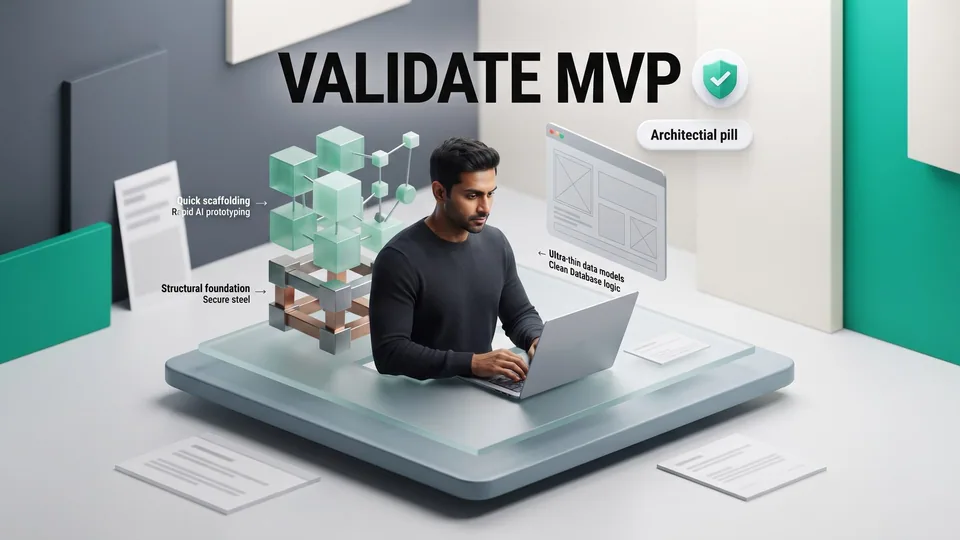
Founders building software products now use generative coding assistants to assemble clickable web applications in hours rather than months. However, the ability to generate user interfaces rapidly does not guarantee that a product can handle real customer workloads. When founders seek to validate MVP with AI without accumulating technical debt, visual proof of concept must be distinguished from production-ready software.
Validating early demand requires reliable data persistence, resilient business logic, and sound system architecture. Without disciplined technical oversight, fast prototypes risk collapsing during initial user trials, creating costly rewrites that delay market traction.
Why Does Vibe Coding Alone Fail When You Validate MVP with AI?
The Prototype Illusion: Why Visual Polish Masks Fragile Logic
Modern generative tools allow non-technical founders to assemble reactive interfaces in minutes. A founder can prompt a model to produce an attractive dashboard with interactive charts and fluid navigation. However, visual polish frequently obscures structural deficiencies beneath the surface. When teams attempt to validate MVP with AI, frontend presentation often masks absent error boundaries, brittle client state, and hardcoded logic that cannot function in dynamic production environments.
AI models generate code optimized for immediate syntactic coherence rather than distributed system integrity. An interface may appear functional during a single-user walkthrough on a local browser, yet collapse when handling unexpected network latency or complex data structures. Without rigorous state management and resilient API contracts, minor modifications to one view can trigger cascading failures across the application.
The Real Risk of Unverified Code When Pilot Users Onboard
The primary purpose of an early trial is gathering behavioral data from genuine commercial customers. In any practical vibe coding MVP guide, founders must recognize the operational risks that emerge when unvetted code meets live traffic. Prototype scripts assembled without human architectural oversight routinely omit concurrency controls, robust input sanitization, and standardized session persistence.
When pilot cohorts access the platform simultaneously, unverified logic can trigger dropped database connections, inconsistent authentication states, or corrupted user records. Instead of evaluating product-market fit, founders spend critical early momentum triaging avoidable outages and explaining security vulnerabilities to pilot partners. True validation requires architectural stability alongside interface speed.
What Can AI Coding Accelerate—and What Must Engineers Architect?
Where AI Coding Excels: Rapid UI Scaffolding and Interactive Mockups
Modern engineering workflows leverage generative assistants to compress the time required for early interface exploration. When teams build MVP with AI agents, autonomous models generate boilerplate components, standard layout structures, and responsive CSS styling with remarkable efficiency. Non-technical founders can quickly visualize operational workflows, test user navigation paths, and gather immediate feedback on UI layouts.
By automating repetitive frontend scaffolding, AI tools allow technical teams to evaluate feature feasibility without expending weeks on mechanical implementation. This rapid iteration clarifies product requirements early, enabling stakeholders to refine customer journeys before committing significant development resources.
Where AI Models Fail: Data Schemas, Authentication, and Transactional Integrity
Despite rapid frontend output, automated code generators exhibit fundamental blind spots across critical system layers. AI models struggle to maintain sound software MVP architecture across normalized database schemas, role-based access control, and asynchronous transaction pipelines. When prompts dictate database structures, models frequently produce redundant table schemas, unindexed queries, and flawed foreign key relationships that degrade performance under real database loads.
Furthermore, authentication and payment processing require precise compliance, token rotation, and race-condition prevention. AI assistants lack contextual understanding of state management across distributed sessions, often leaving security boundaries vulnerable. Experienced systems engineers must establish these foundations manually to ensure transactional consistency and regulatory compliance.
Choosing Infrastructure: Private Local AI vs Approved Commercial AI Tools
Selecting the right development toolchain directly impacts intellectual property protection and regulatory governance. Teams typically choose between two operational setups based on security constraints:
- Private Local AI Engineering: Open-weight models deployed within client-managed infrastructure or agreed isolated environments. This approach ensures sensitive business logic and proprietary data remain strictly within private perimeters.
- Approved Commercial AI Tools: Managed developer platforms such as Claude Code or OpenAI Codex, configured with explicit cloud policies and enterprise data safeguards vetted by engineering leadership.
Balancing these deployment models ensures development velocity never compromises compliance or code security.
How Do Non-Technical Founders Build an MVP with AI Without Technical Debt?
Step 1: Scoping Core Validation Metrics Before Writing Prompts
Before generating a single line of interface code, founders must define the precise business signals required to confirm product viability. Successful AI MVP development begins with clear functional boundaries rather than open-ended prompting sessions. Leaders should establish whether customer validation hinges on recurring daily transactions, automated data exports, or specific workflow completion rates.
Documenting these customer interaction paths prevents feature creep and prompt drift. When software requirements focus on measurable business hypotheses, engineering efforts remain dedicated to proving value rather than accumulating superficial UI widgets that confuse pilot users.
Step 2: Leveraging AI Coding Agents Under Human Architectural Direction
For any non technical founder AI app, code generation platforms deliver durable value only under seasoned engineering governance. Rather than allowing generative assistants to dictate system structure unmonitored, experienced software architects establish core database topologies, asynchronous workers, and secure API gateways before automated code generation begins.
Within this governed structure, AI coding agents and harness pipelines handle routine tasks such as generating responsive interface components, standard CRUD controllers, and unit test scaffolds. Senior engineers direct the automated agents, validating every implementation against modular system design patterns. This disciplined collaboration combines rapid prototyping speed with proven architectural resilience, ensuring that the codebase scales smoothly as user volume expands.
Step 3: Enforcing Senior Code Reviews and Release Assurance
A functional prototype running on a local workstation does not constitute a deployable commercial asset. Deploying software into staging and production environments requires rigorous code review protocols, automated regression suites, and comprehensive release assurance pipelines. Senior engineers must scrutinize every pull request to identify memory leaks, unoptimized queries, missing error handlers, and privilege escalation vulnerabilities.
At Canvas Developers, specialized QA and release assurance teams oversee staging deployments to verify that AI-generated modules align with production benchmarks. Formal gatekeeping ensures that release candidates meet enterprise reliability standards before real customers interact with the platform, eliminating technical debt at the point of creation.
How Does a Logistics Startup Validate an Automated Dispatch Tool with AI?
The Challenge: Testing Automated Dispatch with 50 Commercial Carriers
Consider an early-stage logistics platform seeking to automate load matching and rate confirmation across regional freight corridors. To establish commercial viability, the founding team needs rapid MVP validation with a pilot cohort of 50 commercial carriers. Each carrier requires immediate load status updates, location tracking, and confirmed vehicle availability across variable transport routes.
If the dispatch system fails during operational peak hours or drops rate quotes, transport partners abandon the software immediately. The core testing objective is validating whether carriers actively accept automated dispatch assignments, without exposing operational logistics to manual coordination breakdowns.
AI Speed in Action: Rapid Booking Interfaces and Real-Time Feeds
Generative coding tools allow engineers to construct carrier-facing interfaces with exceptional velocity. Development teams can use automated agents to scaffold responsive mobile booking screens, visual fleet tracking maps, and live status feeds in days. These interactive interfaces give dispatchers and drivers functional screens to test booking actions, view shipment details, and submit status changes.
By accelerating frontend assembly, the startup gathers direct qualitative feedback on driver usability and workflow friction before committing months of engineering effort. The team can test alternative trip acceptance flows, simplify rate confirmation buttons, and observe how carrier operators interact with automated notifications under live dispatch schedules.
Human Engineering Guardrails: Designing Robust Data Schemas to Prevent Database Corruption
While generative models deliver rapid UI components, autonomous code generation fails to establish resilient backend pipelines for concurrent logistics events. If multiple freight operators bid on identical shipments simultaneously, unvetted database logic risks creating duplicate load assignments, race conditions, and corrupted booking tables.
To preserve data integrity, experienced engineers must establish proper software MVP architecture. Human architects design ACID-compliant database transactions, idempotent event queues, and optimistic locking mechanisms on freight records. Senior engineers implement secure webhooks and strict input validation across external telematics endpoints, ensuring the operational database maintains transactional consistency when real shipments move across the network.
What Mistakes Must Founders Avoid When Hardening an AI-Built App?
Overlooking Security, Payment Gateways, and Data Scalability
When founders transition from prototype generation to commercial operations, foundational security practices are frequently neglected. Automated code generators produce code that prioritizes instant visual gratification over secure transaction flows. As a result, AI-built prototypes often omit authentication token rotation, fail to verify payment gateway webhook signatures, and store sensitive credentials directly within client-side code repositories.
Furthermore, early prototypes struggle with data scalability when pilot usage accelerates. Automated prompts routinely produce naive database queries that execute unindexed scans across tables, quickly exhausting server memory. Without defensive engineering practices, including connection pooling, background worker queues, and strict access controls, user growth immediately destabilizes core application workflows.
The Danger of Untracked Dependencies and Architectural Drift
A recurring hazard detailed in any comprehensive vibe coding MVP guide is architectural drift caused by fragmented prompting. Over successive development iterations, generative assistants introduce disparate libraries, conflicting package versions, and redundant utility scripts to solve localized errors. This uncoordinated dependency creep bloats bundle sizes and introduces unvetted third-party vulnerabilities into the application core.
Without unified architectural governance, separate views adopt conflicting state management patterns and divergent API conventions. The resulting structural friction complicates subsequent feature additions and makes systematic debugging nearly impossible once live customers encounter edge cases.
A 6-Point Technical Debt Prevention Checklist Before Pilot Launch
To achieve rapid MVP validation while safeguarding system integrity, founders must audit their software against six fundamental engineering benchmarks before onboarding pilot cohorts:
- Database Schema Normalization: Enforce strict primary and foreign key constraints, index high-traffic lookup columns, and isolate transactional entities.
- Authentication and Access Governance: Secure session handling, validate permissions on server endpoints, and eliminate client-side role checks.
- Financial and Webhook Verification: Verify cryptographic signatures for payment callbacks and enforce idempotency on financial events.
- Dependency and License Auditing: Prune unused packages, eliminate redundant utility frameworks, and patch known library vulnerabilities.
- Centralized Logging and Observability: Deploy structured error tracking and performance monitoring across critical user pathways.
- Automated Test Coverage and Staging Gates: Establish integration test suites and automated deployment checks to verify that every pull request meets production standards.
How Do You Move from an AI Prototype to a Scoped Engineering Engagement?
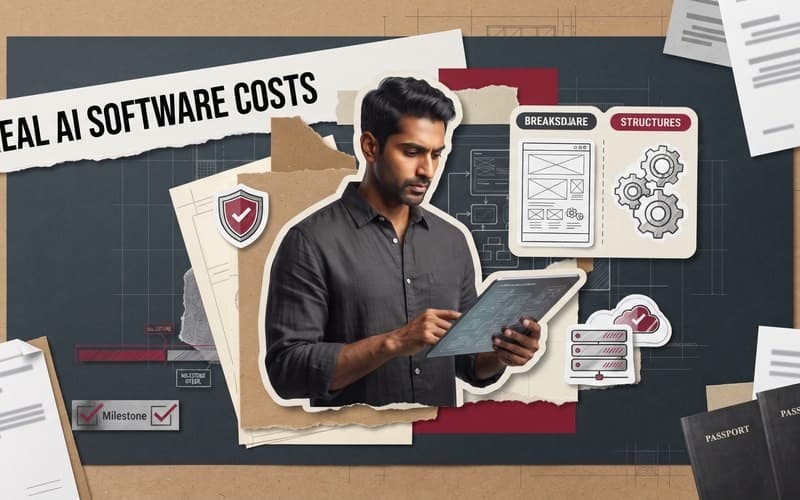
Why Milestone-Based Scoping and Testing Protect Founder Capital
Founders transitioning from experimental prototypes to commercial software risk capital when unvetted code meets live traffic. Moving to a structured engineering framework protects capital by replacing open-ended prompting with defined technical deliverables. A disciplined engagement begins with formal technical scoping, establishing system architecture, data models, and integration boundaries before code is written.
Structuring development around agreed milestones ensures that each phase—such as relational database schemas, secure API endpoints, and automated regression suites—is validated before moving forward. This phased progression allows founders to validate MVP with AI efficiently, ensuring that development spend builds reliable, scalable infrastructure rather than disposable scripts.
Book a Scoped MVP Assessment with Canvas Developers via https://www.canvasdevelopers.com/contact
Transforming an early build into a dependable commercial product requires experienced engineering leadership. Canvas Developers is a software engineering company with an office in Dhaka, Bangladesh, building startup MVPs, SaaS platforms, mobile and web applications, business systems, e-commerce, and custom AI features. The team also finishes, stabilizes, and hardens AI-built applications.
For sustainable AI MVP development, Canvas Developers uses AI coding agents and advanced harnesses to accelerate delivery, while senior engineers, designers, QA, and DevOps specialists own the architecture, review all code, and govern releases. Engagements begin with scoping, followed by agreed milestones, testing, and handover. Request a scoped technical assessment through the contact form at https://www.canvasdevelopers.com/contact.