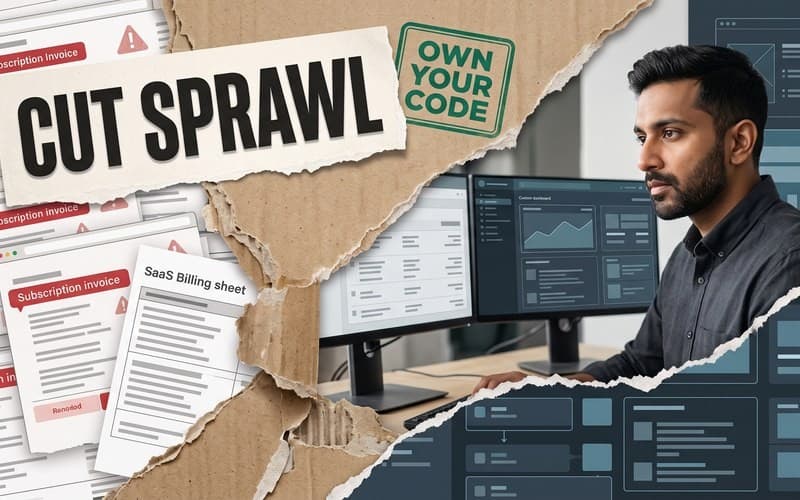
Scaling technical capacity presents digital agencies with an acute operational trade-off. Expanding an internal engineering department introduces substantial fixed overhead, prolonged recruitment cycles, and margin volatility during client lulls. Conversely, declining complex technical engagements caps agency revenue and compromises strategic accounts.
A modern approach to white label software development resolves this friction. By partnering with dedicated engineering teams that combine AI coding workflows with rigorous senior oversight, agencies expand their production capacity on demand. This model protects project margins, preserves architectural standards, and delivers custom web and mobile applications under the agency's own brand without internal balance-sheet expansion.
Why Is In-House Engineering Bottlenecking Your Agency's Delivery?
The Overhead and Margin Risks of Maintaining Internal Tech Teams
Maintaining a dedicated in-house technical department burdens creative and marketing agencies with heavy fixed payroll, recruiting expenses, and continuous overhead. When client pipeline volume fluctuates across quarterly cycles, carrying underutilised software engineers rapidly degrades operational margins. Partnering with a structured outsource software development agency converts rigid balance-sheet payroll into variable, project-aligned expenditure, safeguarding profitability across shifting demand cycles.
Turning Down High-Value Software Contracts Due to Capacity Limits
Agencies routinely walk away from lucrative custom web builds, mobile portals, or SaaS platforms when their current developers reach maximum capacity. Rejecting these complex opportunities caps firm revenue and frequently forces strategic clients to source engineering elsewhere. Working alongside a trusted agency development partner unlocks elastic technical bandwidth, allowing leadership to capture high-value contracts and scale output without adding internal management overhead.
What Is White-Label AI Engineering and How Does Senior Oversight Guide It?
Accelerating Delivery with AI Coding Agents and Structured Harnesses
Modern white label software development increasingly integrates agentic AI workflows to compress repetitive engineering cycles without lowering delivery standards. By deploying purpose-built AI coding agents within a structured agent harness, development teams rapidly generate boilerplate scaffolding, translate data schemas, and draft unit testing suites. This systematic acceleration eliminates days of manual typing across frontend layouts, routine API routing, and backend integrations. Instead of spending costly hours on routine syntax and component setup, technical teams allocate their focus toward core business logic, enabling partner agencies to ship complex client milestones with enhanced turnaround speeds.
Why Senior Engineers Must Direct Architecture, Code Review, and QA
Raw velocity generated by AI coding tools creates substantial operational risk if detached from experienced governance. Autonomous code generation cannot anticipate distributed system bottlenecks, subtle edge cases, or multi-tenant database vulnerability patterns. Within professional white label AI engineering, seasoned software engineers, product designers, and QA specialists actively command every stage of the development pipeline. Senior architects define database models and interface boundaries upfront, conduct rigorous line-by-line manual code reviews on every pull request, and maintain absolute discretion over staging and production deployments. While AI coding tools accelerate implementation, senior human engineers ensure that code quality, maintainability, and architectural standards remain uncompromising.
Choosing Between Private Isolated AI and Commercial Cloud Tooling
Enterprise clients operate under diverse compliance frameworks, confidentiality agreements, and data sovereignty mandates. A mature technical partner supports flexible execution models aligned directly with these operational constraints:
- Private / Local AI Engineering: Workflows deploy privately hosted, open-weight models operating within client-controlled cloud infrastructure or an agreed isolated on-premise perimeter, guaranteeing that proprietary codebases and sensitive data never transit external vendor networks.
- Claude Code / OpenAI Codex Engineering: Teams leverage industry-leading commercial AI coding engines governed by enterprise cloud agreements, zero-data-retention parameters, and privacy configurations explicitly vetted and approved by agency leadership.
Offering these two distinct delivery pathways ensures agencies can confidently satisfy stringent enterprise security standards while equipping their development pipeline with state-of-the-art computational speed.
How Can Agencies Deliver Custom Web and Mobile Apps Under Their Own Brand?
Translating UI/UX Prototypes into Production-Grade Web Applications
Agencies frequently excel at digital brand strategy, user research, and UI/UX design, yet face operational friction when translating complex Figma prototypes into production-grade digital platforms. Dedicated white label web app development bridges this transition by converting approved interface specifications into responsive, enterprise-ready frontends and resilient backend architectures. Experienced frontend engineers implement modular component systems and reactive frameworks—such as React, Next.js, or Vue—to deliver pixel-perfect visual fidelity, accessibility compliance, and swift page load performance.
Behind the user interface, senior backend developers establish robust API contracts, structured database schemas, and caching layers that prevent technical debt before launch. Rather than retrofitting basic content management systems to handle dynamic business requirements, white-label engineering teams construct comprehensive SaaS platforms, custom client portals, and administrative dashboards tailored to complex client workflows.
Building Native and Cross-Platform Mobile Apps for Client Portals
Client requirements increasingly extend beyond desktop browsers to dedicated mobile ecosystems, including self-service portals, field workforce tools, and on-demand services. Delivering white label mobile app development enables agencies to offer native iOS and Android solutions or cross-platform Flutter and React Native applications without recruiting in-house mobile developers. Technical teams manage end-to-end device integration, including offline data persistence, push notification architecture, biometric authentication, and secure local storage.
Navigating the stringent submission criteria of Apple's App Store and Google Play presents another operational hurdle for creative teams. An established engineering partner directs the entire build preparation and release verification process, testing across physical device matrices to prevent rejection. Finished builds deploy seamlessly under agency or end-client publisher accounts, expanding service offerings without operational drag.
White-Label Governance: Code Repositories, Documentation, and Client Ownership
True white-label execution demands disciplined technical governance to ensure agency custom software delivery remains entirely anonymous to end clients. All development workflows proceed inside agency-managed source control repositories—whether on GitHub, GitLab, or Bitbucket—using designated white-label commit profiles or direct client workspaces. Engineering partners never insert vendor signatures, marketing links, or external branding into deliverable assets.
Engineering partners provide exhaustive documentation, including API references, architectural diagrams, environment setup guides, and clean inline code annotations. Upon formal milestone acceptance, complete intellectual property rights, compiled assets, and repository ownership transfer cleanly to the agency. This structural transparency protects agency equity, ensures long-term codebase maintainability, and cements lasting client trust.
Where Does AI Coding Excel, and Where Must Senior Engineers Step In?
Tasks AI Speeds Up: Boilerplate Code, Scaffolding, and Automated Testing
In modern white label software development, AI coding tools demonstrate immense utility across structured, repetitive implementation tasks. Generating boilerplate directory scaffolding, standard CRUD endpoints, TypeScript type definitions, and standard unit testing fixtures typically consumes substantial engineering hours. Directed AI coding agents compress these tasks into minutes, assembling reliable foundational code that conforms to project conventions.
Automated test generation represents another area of high efficiency. When instructed by technical leads, AI tools can rapidly draft comprehensive test cases across standard validation boundaries, HTTP status codes, and input parsing errors. This baseline generation provides comprehensive test coverage early in the development lifecycle, accelerating velocity while allowing human developers to focus on higher-level system logic.
Non-Negotiable Human Checks: Security Architecture, Payment Logic, and Scalability
Despite its efficiency, automated code generation introduces severe hazards when unmonitored. Automated tools lack contextual understanding of threat models, regulatory boundaries, and systemic performance constraints. In production-grade white label AI engineering, experienced senior engineers must rigorously inspect and validate critical technical domains:
- Security and Authentication: Senior engineers audit session handling, token expiration, role-based access control, and sanitisation routines to prevent injection attacks, data leaks, and broken object-level authorization vulnerabilities.
- Financial and Payment Workflows: Idempotency keys, webhook verification, dispute flows, and double-entry accounting reconciliation require absolute precision where automated generation frequently overlooks race conditions.
- Scalability and Database Performance: Query execution plans, connection pooling, cache invalidation, and indexing strategies demand architectural expertise to ensure stability under heavy concurrent traffic.
Stabilising and Hardening Prototype or Vibe-Coded Applications
Founders and internal agency teams frequently create proof-of-concept builds or vibe-coded prototypes using rapid AI generation tools. While these applications validate initial market concepts or client demonstrations, their underlying architectures often suffer from fragile state management, circular dependencies, unhandled edge cases, and missing security safeguards.
A professional engineering partner takes these unstable prototypes and systematically hardens them for enterprise production. Senior developers refactor fragile code paths, establish modular domain architectures, secure third-party API keys, and enforce rigorous automated integration testing. This remediation transforms experimental software into resilient, maintainable assets that agencies can confidently launch under their brand name.
How Do You Evaluate and Structure a Reliable White-Label Engineering Partnership?
Scoping Clear Milestones to Protect Agency Margins
Engaging an outsource software development agency succeeds or fails based on commercial scoping discipline. Ambiguous project requirements and unstructured hourly billing create scope creep, eroding project margins and triggering friction with clients. A mature technical partnership establishes clear, phase-based milestones before development begins. Each milestone outlines specific deliverables, acceptance criteria, technical dependencies, and verification sign-offs.
This milestone-driven structure provides agency leadership with complete visibility into delivery timelines and financial expenditure. By anchoring commercial agreements to verifiable technical outcomes—such as database schema approval, API integration completion, and staging deployment—agencies maintain predictable delivery schedules and protect client profitability.
Enforcing Strict Non-Disclosure and IP Protection Agreements
Confidentiality and proprietary rights remain paramount when choosing a white-label agency development partner. Agency reputation relies upon strict non-disclosure agreements that forbid the external development team from claiming client work, displaying portfolio credentials, or communicating directly with end clients without explicit authorization. Furthermore, contracts must explicitly assign full intellectual property ownership, source code, and design assets directly to the agency upon payment.
In practice, enforceable agreements also mandate secure repository access controls, multi-factor authentication, and encrypted credential management across every stage of the engagement. By establishing comprehensive non-disclosure frameworks and clean legal chains of custody, agencies eliminate operational liability and confidently present custom platforms under their own brand.
DevOps Infrastructure, Release Assurance, and Post-Launch Handover
High-performing software delivery requires mature deployment pipelines and release assurance. Dependable engineering partners configure automated continuous integration and continuous deployment (CI/CD) pipelines inside agency or client cloud environments. Automated testing suites execute alongside manual QA protocols on staging branches, validating security, performance benchmarks, and functional stability prior to production rollout.
Following launch, the partnership ensures structured operational continuity rather than abrupt disengagement. Senior engineers provide clean documentation, infrastructure configurations, and dedicated post-release monitoring to resolve any immediate production anomalies. This structured handover equips agencies with operational confidence and sustainable technical support for ongoing client retainers.
How Can Your Agency Start Delivering Scalable Software Without Adding Overhead?
Conducting a Scoped Technical Assessment for Upcoming Projects
Scaling agency technical bandwidth does not require unvetted commitments or upfront departmental expansion. When evaluating upcoming client proposals or struggling with overextended internal teams, agencies begin by conducting a scoped technical assessment. In this scoping phase, senior software engineers review client requirements, interface designs, user stories, and third-party API dependencies. This rigorous technical discovery clarifies architectural feasibility, defines technology stacks, and flags potential security, integration, or database bottlenecks before any code is generated.
Initiating White-Label Collaboration Through Milestone-Based Delivery
Following technical scoping, agencies initiate collaboration through phased, milestone-based delivery. An experienced engineering partner operates seamlessly behind the scenes, accelerating foundational implementation with AI coding agents while senior engineers maintain strict ownership over system architecture, line-by-line code review, and release decisions. This disciplined workflow empowers creative and digital firms to expand their white label software development services, executing complex agency custom software delivery across web portals, SaaS platforms, and mobile apps without balance-sheet strain.
By establishing transparent milestone acceptance criteria and complete IP handover at every phase, agency leadership protects project margins and builds enduring client equity. To evaluate an upcoming build, explore dedicated private or commercial AI engineering workflows, or request a scoped technical assessment, agency teams can connect directly via the contact form at https://www.canvasdevelopers.com/contact.