The problem
In mobile environments with compact viewports and network drops, standard component libraries often couple design tokens directly to remote endpoints, creating brittle handoffs. Multi-step mobile quote flows frequently drop critical marketing attribution and privacy consent metadata during client-side navigation. Furthermore, typical design systems treat network transport as a binary outcome, surfacing modal alerts that lock the viewport or discard user progress.
Approach
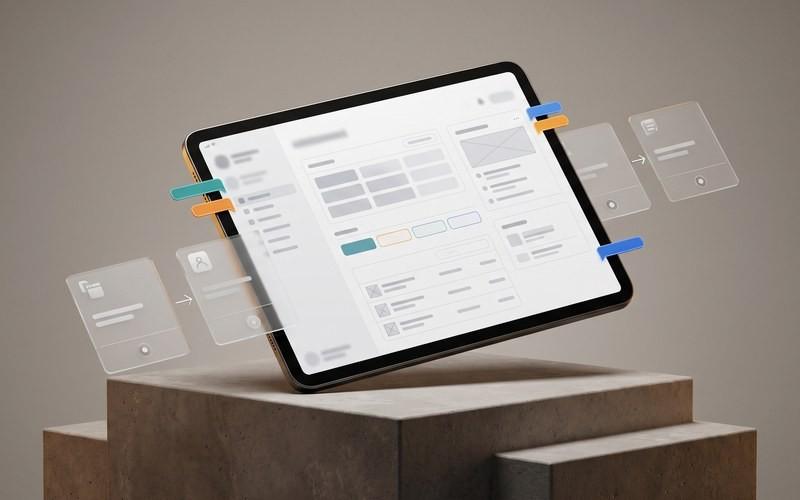
Canvas Developers decouples accessible interface components into a Task List, Focused Action Screen, and Sync Status component backed by an isolated transactional coordinator. Consent and attribution parameters serialize into persistent session storage before screen transitions, maintaining accessibility through ARIA standards. Client interactions write immediately to a durable local storage queue before HTTP dispatch, using idempotent client tokens and an explicit pending sync state to ensure safe recovery after network drops.
Outcome
The decoupled architecture and automated acceptance testing validate that enquiries remain intact without silent submission loss or duplicate records during network interruptions. This approach enables reliable role-based mobile quote workflows while shortening initial feedback loops through engineering-guided scaffolding.
A resilient Design Systems mobile quote request workflow coordinates qualified enquiries across prospective clients, sales operators, and content administrators without compromising form usability or data integrity. In mobile environments where compact viewports and network drops are common, standard component libraries often couple design tokens directly to remote endpoints, creating brittle handoffs. Our engineering approach at Canvas Developers decouples accessible interface components from underlying transactional queues, preserving user consent, campaign attribution, and submission state under real-world connectivity constraints.
How Does a Design System Structure Mobile Quote Requests Across Roles?
Managing Qualified Enquiries Across Prospects, Operators, and Admins
Coordinating an enterprise Design Systems mobile quote request workflow requires clear boundaries across three primary user roles: prospects seeking commercial proposals, sales operators evaluating submissions, and content administrators maintaining form schemas. The primary record in this flow is the qualified enquiry. Rather than treating a quote request as a static form submission, our architecture models it as a stateful entity that moves from client-side capture to operator triage.
Prospects need frictionless input mechanisms on compact devices, requiring concise forms with minimal visual friction. Sales operators require immediate visibility into enquiry metadata, budget tiers, and routing flags through condensed queues. Content administrators require configuration levers to alter required qualification fields without introducing breaking schema changes. By unifying field definitions and status indicators within a shared design system, each role interacts with consistent data models tailored to their operational context.
Adapting Task Lists and Focused Action Screens for Compact Viewports
Effective mobile quote request development depends on specialized viewports that preserve operational velocity without cluttering handheld displays. For sales operators, the design system implements a compact task list utilizing dense list items, priority badges, and scannable timestamp tokens to support rapid triage. Touch targets maintain expanded interactive dimensions and generous hit areas to prevent selection errors during high-volume reviews.
For prospective buyers, the interface switches to a focused action screen. This screen isolates the qualification inputs into a single-column layout, grouping project scopes, timeline pickers, and contact details into sequential sections. Presenting complex qualification inputs as focused, stepped actions prevents cognitive overload on narrow viewports, ensuring high completion fidelity before an enquiry enters the operator queue.
Where Do Mobile Quote Flows Break During Network Interruptions and Handoffs?
Preserving Consent, Attribution, and Accessibility Across Screen Transitions
Multi-step quote flows on mobile devices frequently drop critical metadata during client-side navigation. When a prospect moves between qualification steps, marketing attribution parameters and explicit privacy consent flags can be lost if state is stored only in ephemeral component trees. In an accessible mobile form architecture, our approach serializes consent checkboxes, referral source tags, and campaign tokens into persistent session storage before every view transition.
Form accessibility must remain intact across these state changes. Following the W3C WCAG Technique ARIA21, our input controls dynamically set aria-invalid="true" only after active validation, pairing each error with an aria-describedby pointer to visible corrective instructions. When a validation failure occurs during a screen handoff, focus moves to the first invalid field, and assistive technologies receive immediate announcements via live regions without wiping previously entered consent or attribution data.
Handling Connectivity Drops with Explicit Pending and Sync States
Mobile networks are inherently volatile, suffering from intermittent radio drops, tunnel transit latency, and captive portal dead ends. Typical design systems fail here by treating network transport as a binary success-or-failure outcome, surfacing abrupt modal alerts that lock the viewport or discard user progress. In an effective offline sync design systems architecture, client interactions write immediately to a durable local storage queue before initiating any HTTP transport.
If network connectivity drops during quote submission, the interface transitions to an explicit pending sync state. A dedicated status indicator displays persistent progress tokens indicating that the enquiry is securely saved on the device and queued for background dispatch. Once connectivity resumes, the queue dispatches idempotent payloads with unique client-generated request tokens, preventing duplicate enquiry creation while providing the user with unambiguous visual confirmation.
What Architecture Separates Design System Components from Transactional State?
Structuring Task List, Action Screen, and Sync Status Components
A maintainable frontend architecture separates pure presentational components from transactional logic. In our Design Systems development workflow, we divide the quote experience into three distinct component packages: the Task List, the Focused Action Screen, and the Sync Status component. Each component consumes design tokens while remaining decoupled from remote transport layers.
The Task List renders inbound enquiry records using standardized spacing, typography, and status badges. The Focused Action Screen encapsulates mobile form controls—scope selectors, budget inputs, and contact fields—validating inputs locally against field schemas. The Sync Status component renders current queue health, presenting idle, pending, syncing, and synced visual indicators based purely on received props.
Data flows unidirectionally across these modules. When a prospect submits an enquiry on a compact screen, the Action Screen executes immediate client validation, emits a structured event, and signals visual acknowledgement. The interface updates the Sync Status component to pending, allowing the prospect or operator to navigate freely while the background coordinator manages transport.
Decoupling Network Transport and Offline Queues from Design Tokens
Embedding network requests, storage drivers, or retry loops into UI components produces tight coupling and fragile tests. Under the W3C Design Tokens Community Group format specification, design tokens formally express design decisions such as color, typography, dimensions, and motion. Because token standards do not manage transport state, transactional logic must be kept in dedicated architectural layers.
In our Design Systems integration architecture, we pair stateless components with an isolated transactional coordinator. A client-side queue backed by persistent storage captures validated enquiries and attaches an idempotent client UUID. An independent sync manager coordinates HTTP transport, handles exponential backoff, and resolves network retries. The design system provides only the semantic tokens and UI primitives needed to represent connection states, keeping presentation cleanly insulated from operational failures.
How Do You Verify Recovery Paths and Navigate System Tradeoffs?
Acceptance Testing for Interrupted Submissions and Data Recovery
Verifying recovery resilience in mobile quote request development requires deterministic acceptance tests simulating adverse radio conditions. In our quality assurance pipeline, we would evaluate offline queue behavior against a strict acceptance checklist:
- Offline Interception: Cutting network connectivity mid-submission must leave form inputs intact and transition the UI to an unambiguous pending state.
- Persistent Storage: Terminating or restarting the mobile browser process must restore queued enquiries upon re-initialization.
- Idempotent Replay: Reconnecting to cellular data must trigger background dispatch with matching client tokens, preventing duplicate records on the server.
- Visible Reconciliation: Successful upstream acknowledgement must clear the pending queue and update the status badge without full-screen reloads.
This automated verification is designed to validate that prospects do not encounter silent submission loss or ambiguous error prompts when travelling through degraded coverage zones.
Balancing Reusable Component Constraints Against Mobile Latency
Engineering an enterprise-grade offline sync design systems architecture introduces structural tradeoffs. Comprehensive component libraries with rich token hierarchies and local database abstractions increase initial bundle weight and cold-start parsing times on low-powered mobile devices. Teams must balance the architectural rigor of decoupled state queues against immediate rendering speed.
When an organization operates basic, low-volume contact forms without multi-role triage, a simpler option fits best: native HTML forms with standard server-side rendering eliminate the overhead of local storage engines and synchronization workers. However, when qualified enquiries drive high-value sales pipelines requiring role-based handoffs, the engineering investment in decoupled queues, deterministic acceptance tests, and resilient design tokens provides essential reliability.
How Does Canvas Developers Deliver Resilient Design Systems Using Vibe Coding?
Accelerating Scaffolding with AI While Engineers Direct Architecture and QA
At Canvas Developers, our engineering team uses Design Systems vibe coding workflows to accelerate frontend scaffolding while maintaining strict engineering governance. AI coding agents and our harness rapidly generate repetitive boilerplate, map tokens across themes, and translate design file components into clean React or Vue primitives. This automation is structured to shorten initial feedback loops and reduce repetitive setup overhead.
However, AI code generation cannot replace architectural ownership. AI models often struggle with complex transactional edge cases, race conditions in offline storage synchronization, and nuanced accessibility compliance. In our delivery model, experienced software engineers direct the system architecture, conduct rigorous line-by-line code reviews, and verify cryptographic security, data validation, and automated test coverage. Clients choose between two flexible delivery models: Private / Local AI Engineering within isolated infrastructure, or commercial AI coding tool environments configured to organizational security policies.
Defining Your Integration Requirements for a Scoped Assessment
Implementing a dependable Design Systems development project requires defining technical constraints before writing production code. While reusable token libraries and rapid scaffolding can reduce initial implementation cycles, critical engineering responsibilities—such as CRM integrations, schema migration, and cross-browser regression testing—require seasoned technical guidance.
If your team is modernizing mobile quote workflows or decoupling frontend components from legacy backends, we invite you to request a scoped assessment. Share your existing tech stack, target mobile viewports, network resilience requirements, and enterprise integration goals. Connect with our engineering team in Dhaka through the contact form at https://www.canvasdevelopers.com/contact to scope your architecture, agreed milestones, and release strategy.