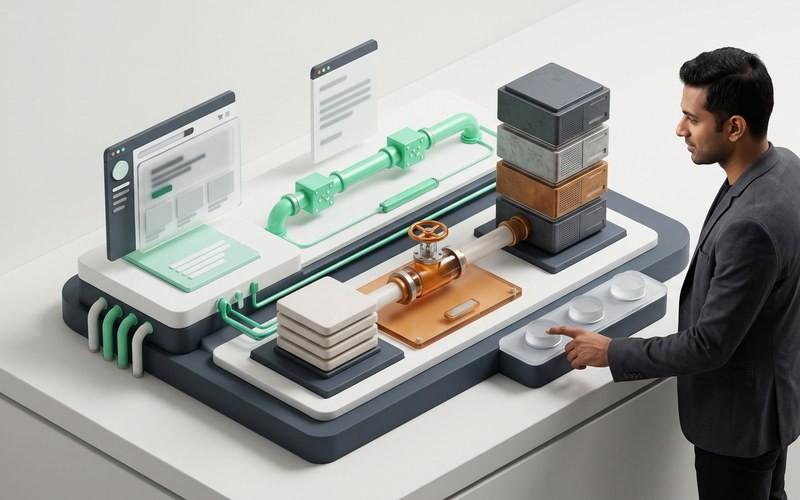
Maintaining continuous business operations while upgrading fragile enterprise software is one of the most demanding operational challenges engineering leaders navigate. A disciplined application modernization and stabilization initiative allows engineering teams to systematically eliminate legacy vulnerabilities, resolve architectural debt, and improve platform throughput while protecting service level objectives (SLOs) within defined error budgets.
By shifting from high-risk rewrites to structured, incremental architectural upgrades, organizations safeguard recurring revenue, protect mission-critical workflows, and restore engineering velocity across complex production environments.
Why Is Your Legacy Codebase Becoming an Operational Liability?
Legacy codebases rarely fail overnight; instead, they gradually accumulate structural friction that degrades engineering throughput and platform stability. Over years of rapid feature delivery, undocumented hotfixes, unmaintained third-party dependencies, and tightly coupled relational schemas create compounding operational risk. Development teams experience monolithic fragility when a routine patch in a secondary reporting module inadvertently breaks checkout workflows, session management, or background job queues. Without a proactive application modernization and stabilization initiative, routine maintenance consumes the majority of engineering bandwidth, stalling strategic product roadmaps.
This compounding decay also creates severe organizational bottlenecks. Knowledge silos emerge around legacy modules that only original authors understand, while newer engineers struggle with opaque side effects and fragile build scripts. Onboarding velocity slows down dramatically, and even simple UI adjustments or database migrations require exhaustive cross-team reviews to avoid unintended system regressions.
The tangible cost of this technical debt is acute deployment anxiety. When teams lack automated regression suites and reliable staging environments, software releases become stressful manual rituals. Organizations frequently defer deployments, mandate disruptive off-hours maintenance windows, and endure costly production regressions that threaten customer retention. Executing a structured technical debt remediation roadmap systematically untangles these fragile dependencies, restoring deployment frequency while protecting continuous business operations within established error budgets.
What Is an Application Modernization and Stabilization Strategy?
An effective legacy application stabilization strategy does not treat modernization as an all-or-nothing proposition. Modernizing complex production systems requires selecting the appropriate architectural intervention for each service boundary based on operational risk, technical complexity, and strategic business value.
Refactoring vs. Replatforming vs. Re-architecting Core Workflows
Engineering leaders typically evaluate three distinct paths when addressing technical debt:
- Refactoring: Restructuring internal code and eliminating anti-patterns without altering external runtime behavior or public API contracts. Refactoring delivers rapid stabilization for business logic bottlenecks while preserving existing deployment infrastructure.
- Replatforming: Migrating applications to modern cloud primitives or containerized orchestration environments (such as Kubernetes) with minimal code modification, unlocking autoscaling and managed persistence.
- Re-architecting: Decomposing tightly coupled domains into modular microservices or event-driven components. This approach is reserved for mission-critical core workflows that demand independent scalability and frequent deployment cycles.
Establishing Baselines: Telemetry, End-to-End Test Harnesses, and CI/CD
Stabilization cannot occur without visibility. Before modifying legacy code, engineering teams must establish comprehensive operational baselines. This begins with distributed tracing and application performance monitoring (APM) using tools like OpenTelemetry to map synchronous request flows, latency bottlenecks, and error rates.
Concurrently, engineers construct automated end-to-end regression suites and characterization tests around legacy boundaries. Integrating these safeguards into an automated CI/CD pipeline ensures that any behavioral drift or contract regression is intercepted immediately, providing the safety harness needed for continuous application modernization and stabilization without risking customer-facing outages.
How Do You Decouple Monoliths Without Incurring Downtime?
Decoupling an enterprise monolith while serving live customer requests requires an incremental migration boundary. Understanding how to modernize legacy web applications without triggering service interruptions starts with isolating distinct functional domains and routing traffic gradually rather than attempting a high-risk cutover.
Implementing the Strangler Fig Pattern at the API Gateway Layer
The most reliable architectural blueprint for incremental decoupling is Martin Fowler's Strangler Fig pattern. Rather than rewriting an entire monolith from scratch, engineers place an interception layer—such as a modern reverse proxy or API gateway—in front of the legacy application. Initially, all client traffic passes directly through to the legacy monolith.
When modernizing a specific domain, such as user authentication or invoicing, engineering teams implement the new service independently and expose matching endpoints behind the gateway. Teams implementing API development and gateway routing configure rules to intercept requests matching those specific endpoints. This architectural seam allows the new service to expand gradually around the legacy system until the legacy implementation can be safely retired.
Managing Database Decoupling with Dual-Writes and Change Data Capture
While rerouting stateless HTTP requests is straightforward, stateful data persistence represents the primary point of failure in monolithic refactoring. Adhering to application stabilization best practices requires keeping data stores synchronized across architectural boundaries during transitional phases.
Engineering teams manage this synchronization through a structured persistence workflow:
- Dual-Write Failure Modes: Application-level dual-writes introduce severe operational hazards. A primary database write may succeed while the secondary write fails due to network latency, schema mismatches, or transient infrastructure partitions. Without complex distributed two-phase commit protocols—which introduce latency bottlenecks—concurrent dual-writes inevitably trigger write-ordering race conditions and silent state drift when updates commit out of sequence.
- Change Data Capture (CDC): To eliminate dual-write vulnerabilities, engineering teams implement Change Data Capture to tail database transaction logs (such as PostgreSQL write-ahead logs or MySQL binary logs) asynchronously. Streaming committed transactions into distributed event pipelines guarantees eventual consistency across database boundaries without adding latency to customer requests or risking partial writes.
- Reconciliation and Canary Routing: Background reconciliation workers continuously audit row checksums between legacy and target databases to catch drift early. Production traffic transitions incrementally via dynamic feature flags and weighted canary releases, maintaining strict error budgets and enabling instant fallback to the legacy path if anomalies emerge.
How Can AI Accelerate Refactoring While Keeping Systems Secure?
Modern AI coding agents and autonomous developer harnesses have transformed legacy refactoring from a purely manual slog into an accelerated, semi-automated process. When incorporated into a disciplined legacy application stabilization strategy, AI assistance compresses early discovery and migration cycles while preserving architectural integrity.
Where AI Coding Harnesses Excel: Regression Test Scaffolding and Boilerplate Translation
AI coding harnesses, including Google Antigravity and automated agent workflows, excel at repetitive, syntax-heavy engineering tasks that traditionally bottleneck senior staff. When analyzing legacy codebases, AI models rapidly parse undocumented methods, map control flows, and generate extensive characterization test suites to establish baseline assertions.
Furthermore, AI tools accelerate data transfer object (DTO) translation, boilerplate API client generation, and schema conversions across language boundaries, such as translating outdated PHP or Java models into modern TypeScript or Go. By automating test scaffolding and repetitive pattern replication, development cycles benefit from significantly shorter feedback loops, allowing teams to prototype modular interfaces in hours rather than weeks.
Where AI Fails: Security Vulnerabilities, Payment Workflows, and Data Integrity Risks
Despite their speed, generative AI models cannot be trusted with autonomous architectural governance. AI-generated code frequently introduces subtle vulnerabilities, including improper authorization checks, unvalidated input parsing, and hallucinated dependency packages. In sensitive domains such as payment processing, cryptographic operations, and complex multi-table transactional workflows, AI tools lack the deep contextual awareness required to anticipate race conditions and deadlocks.
Core application stabilization best practices dictate that AI acts as an accelerator, not an autonomous architect. At Canvas Developers, engineering teams utilize AI delivery models—whether Private / Local AI Engineering using isolated open-weight models or enterprise Claude Code and OpenAI Codex setups—under strict human supervision. Senior software engineers, QA specialists, and DevOps architects direct the system design, enforce rigorous multi-stage code reviews, audit security perimeters, and retain final release authority. This balanced structure captures the speed of AI-assisted scaffolding while ensuring production reliability.
What Belongs on Your Production Stabilization Checklist?
Executing modernization while protecting system uptime requires a structured, phase-based execution framework. A comprehensive application modernization and stabilization checklist provides engineering leaders with the operational guardrails needed to stabilize volatile workloads while remediating architectural bottlenecks.
Phase 1: Zero-State Audit, Dependency Mapping, and APM Instrumentation
Before modifying production code, teams must document the current technical perimeter. Phase 1 focuses on eliminating blind spots across the legacy environment:
- Static Analysis and Security Scanning: Run automated dependency checkers and static code analysis to catalog CVEs, deprecated runtimes, and vulnerable third-party packages.
- Dynamic Dependency Mapping: Deploy Application Performance Monitoring (APM) and distributed request tracing to observe actual traffic patterns, synchronous blocking calls, and unindexed database queries.
- Domain Boundary Definition: Identify bounded contexts and database table ownership, establishing clear target seams for eventual extraction.
Phase 2: Automated Regression Safeguards and Staging Parity Setup
Stabilization initiatives fail when developers lack instant feedback on runtime anomalies. Phase 2 establishes automated safety harnesses across delivery pipelines:
- End-to-End Characterization Testing: Author black-box regression tests around mission-critical user journeys to ensure refactored logic preserves existing business behavior under production-scale loads.
- Staging Environment Parity: Configure containerized staging environments that mirror production database topology, message queues, and caching layers with sanitized, representative data sets.
- Contract Testing and Rollback Procedures: Implement consumer-driven contract tests to validate API schema compatibility between legacy services and modernized modules. Every deployment must feature automated health checks, blue-green deployment mechanisms, and automated traffic draining to revert traffic at the gateway if error budgets are breached.
Integrating these operational checkpoints into an overarching technical debt remediation roadmap ensures engineering teams systematically de-risk production releases, validate contract integrity, and preserve continuous platform availability.
How Do You Plan Refactoring Timelines and Engineering Budgets?
Estimating a realistic legacy software refactoring cost and timeline is notoriously difficult when organizations attempt monolithic rewrites. Big-bang overhauls routinely suffer from scope expansion, shifting commercial requirements, and extended freezes on new feature development that frustrate business stakeholders.
Why Iterative Milestones Outperform Risky Big-Bang Rebuilds
An incremental approach mitigates financial and operational risk by delivering continuous, measurable value. Instead of committing multi-quarter budgets to an unverified future release, engineering leadership breaks refactoring initiatives into discrete, milestone-driven phases. Each phase tackles an isolated bottleneck—such as modernizing an authentication service, upgrading database connection pooling, or decoupling an asynchronous job worker. This milestone model preserves capital, validates architectural assumptions in production early, and ensures the core business continues generating revenue without disruption.
Balancing Internal Engineering Bandwidth with Specialized Delivery Teams
Core product engineers already face intense pressure to ship revenue-generating features, maintain sprint velocity, and support daily operations. Forcing an internal team to simultaneously execute deep architectural stabilization often results in developer burnout, context switching, and delayed roadmap deliverables.
A proven legacy application stabilization strategy involves augmenting core teams with dedicated modernization specialists. Engaging external engineering teams or leveraging fractional CTO leadership provides focused capacity to audit architecture, establish test scaffolding, and execute transitional migrations. This clear division of labor allows in-house engineers to focus on customer-facing features while specialized partners systematically harden underlying infrastructure, keeping refactoring budgets predictable and aligned with business outcomes.
How Do You Begin Modernizing Your Mission-Critical Software?
Modernizing legacy software while safeguarding system uptime does not require an immediate, high-stakes overhaul. Sustainable application modernization and stabilization begins with an objective discovery phase that isolates your system's critical vulnerabilities and operational bottlenecks.
Canvas Developers partners with founders, tech leaders, and agencies to deliver structured application modernization services. Our engineering teams combine AI-assisted scaffolding and test generation with rigorous senior oversight, robust test suites, and transparent milestone governance. To establish a practical technical debt remediation roadmap tailored to your architecture, reach out through our contact form with your current tech stack, operational constraints, and target outcomes to schedule a scoped assessment.
Step by step
Zero-State Audit and Dependency Mapping
Catalog technical debt, security CVEs, and runtime dependencies using static analysis and APM distributed tracing.
Automated Regression Safeguards
Construct end-to-end characterization test suites and establish containerized staging environments mirroring production topology.
API Gateway and Strangler Fig Interception
Deploy an API gateway in front of the legacy monolith to intercept and reroute specific domain endpoints.
Database Decoupling with Change Data Capture
Synchronize legacy and modern data stores using transaction log replication (CDC) or application-level dual writes.
Canary Releases and Traffic Transition
Route production traffic incrementally using dynamic feature flags and weighted canary releases while monitoring latency and error budgets.