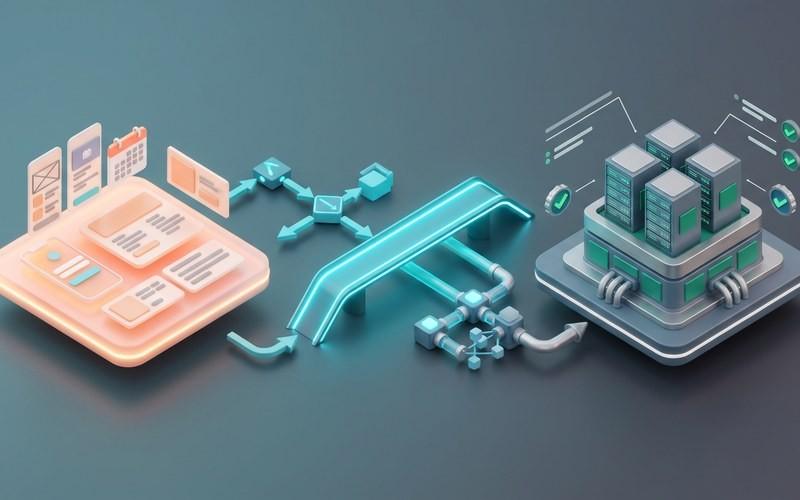
Taking a prototype built with Bolt.new to production requires transitioning from an in-browser development sandbox to a secure, maintainable cloud architecture. Bolt.new enables rapid full-stack scaffolding inside WebContainers, but its browser-generated code inherently couples client presentation with sensitive logic, leaving databases and third-party integrations vulnerable.
To successfully productionize a prototype without exposing infrastructure secrets or accumulating debilitating technical debt, engineering teams must decouple client-side views from backend services, enforce server-side data validation, and establish automated deployment pipelines.
Why Does Moving a Bolt.new Prototype Directly to Production Fail?
A working prototype built in an AI workspace creates a compelling illusion of completion. When a web application renders cleanly, queries sample records, and updates interactive components in the browser, stakeholders frequently assume it is ready for deployment. However, migrating a prototype from bolt.new to production without structural remediation regularly fails because browser-based execution environments bypass the core operational requirements of production systems.
Bolt.new operates within WebContainers, executing Node.js processes directly inside the user's browser. While this provides instant feedback during prototyping, the resulting codebase lacks the separation of concerns required for scalable infrastructure. In a typical vibe coding production deployment, the generated application treats the client bundle as the host for business logic, direct database connections, and third-party API orchestrations. It has no server boundary to enforce rate limiting, validate inputs against strict business schemas, or manage connection pooling under concurrent traffic.
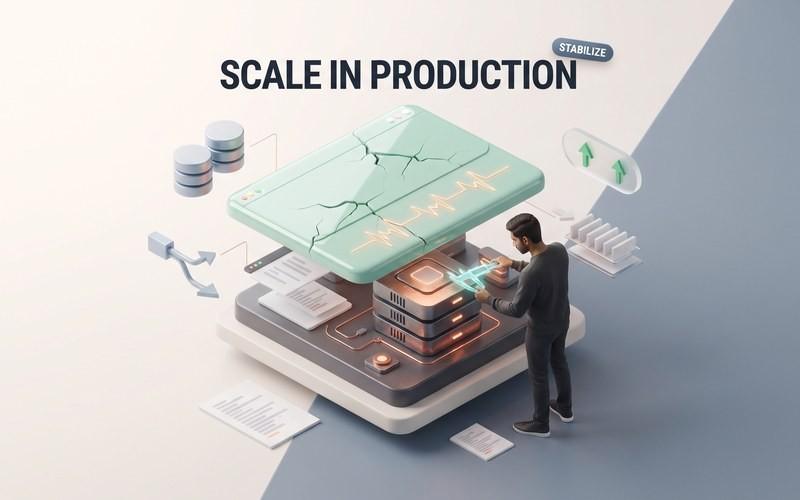
Deploying this output straight to static hosting or a serverless platform transforms design-time conveniences into severe reliability failures. Without dedicated backend boundaries, monitoring telemetry, and automated error recovery, initial user traffic quickly triggers race conditions, unhandled promise rejections, and uncontrolled compute exhaustion.
What Are the Critical Security and Architecture Risks in Bolt.new Code?
Understanding the primary bolt new security risks begins with inspecting how browser-first development scaffolds client assets. In an unhardened prototype, security boundaries are regularly collapsed into the browser bundle.
Exposed API Keys and Client-Side Secret Leaks
Bolt.new relies on Vite to bundle client applications. According to the official Vite environment variable documentation, any variable prefixed with VITE_ is statically inlined into client-side JavaScript during build time. When developers connect backend services like Supabase directly from the prompt, AI generators frequently assign administrative credentials—such as service role keys—to VITE_ variables. As outlined in Supabase's official documentation, secret keys bypass Row Level Security entirely because they carry the Postgres BYPASSRLS attribute. Placing these credentials in client files exposes full database read and write access to anyone inspecting network traffic or minified scripts.
In addition to database credentials, payment gateway secret tokens and generative AI vendor keys are often wired directly into browser fetch calls. Because the prototype runs in an isolated client runtime, it lacks an intermediate API proxy to sign requests, authenticate sessions, or throttle abuse. Consequently, malicious actors can extract raw keys to trigger unauthorized API consumption and drain vendor credits.
Bloated Bundle Sizes and Missing Code Splitting
Beyond credential exposure, the bolt new tech stack limitations manifest as severe frontend performance bottlenecks. Prompt-driven iteration prioritizes immediate visual rendering over dependency hygiene. The generator frequently pulls entire component libraries, heavy charting suites, and unoptimized icon sets for single-use elements without route-based dynamic imports. Furthermore, fragile client-side state synchronization—often relying on unmemoized React context providers without server cache invalidation—triggers cascading re-renders, race conditions, and unresponsive interfaces when users interact with live data streams.
Without explicit tree-shaking and vendor chunking configured in vite.config.ts, initial bundle sizes often exceed several megabytes. This creates poor Largest Contentful Paint (LCP) metrics, high mobile bounce rates, and memory leaks that degrade performance during prolonged user sessions.
How Do You Successfully Productionize a Bolt.new Web Application?
To systematically productionize bolt.new app codebases, engineering teams must transition the prototype from an unstructured single-tier model into a production-grade multi-tier architecture. This process preserves the rapid frontend layout while rebuilding the underlying operational foundation to ensure long-term stability.
Isolating Frontend UI from Secure Backend and Database Logic
The first prerequisite is extracting all data operations and business rules out of client components. In prototype code, UI buttons often invoke direct database queries via client libraries. Production hardening requires establishing an authoritative backend service, such as a dedicated Node.js, Go, or serverless API gateway. All database queries must run behind authenticated API routes that enforce strict input validation using schemas like Zod.
For teams utilizing backend-as-a-service platforms, database tables must have granular Row Level Security policies defined in SQL migrations, ensuring users can only read and mutate authorized records. Server-side session tokens, stored in secure HTTP-only cookies, must replace local-storage JWT persistence to eliminate token extraction and cross-site scripting risks. Furthermore, all egress requests to external third-party services must be proxied through backend controllers to enforce egress rate limiting and protect private API credentials.
Refactoring Monolithic Components into Modular Architectural Layers
Next, developers must refactor bolt new code to eliminate massive single-file components. AI generators routinely output five-hundred-line React files containing styling, UI rendering, local state management, and network calls in a single block. Engineers should decompose these monoliths into a clean directory structure: presentational UI components, custom hooks for business logic, dedicated API clients, and centralized state stores.
Introducing structured data caching with tools such as TanStack Query ensures robust error boundaries, background data revalidation, and optimistic updates without race conditions. Implementing defensive error handling—such as component-level error boundaries, structured HTTP status handling, and graceful degradation during network drops—prevents the entire interface from crashing when an unexpected payload arrives. Teams undertaking this transition often evaluate specialized engineering workflows, such as those provided by Canvas Developers for hardening Bolt and Lovable applications for production, to ensure architectural durability before launch.
What Does It Actually Cost to Harden a Bolt.new App vs. Rebuilding?
Estimating the engineering cost to productionize bolt prototype builds requires evaluating whether salvaging the generated codebase is more economical than conducting a clean architectural rewrite. While the prototype proves market demand and visual workflow, technical debt dictates the true engineering investment.
Evaluating Technical Debt: When Hardening Makes Sense vs. Clean Rebuilding
A hardening path is sensible when the prototype features complex, polished UI layouts, responsive dashboards, and interactive component states that would require substantial design and frontend time to recreate from scratch. In this scenario, engineers preserve the Tailwind styling, JSX layouts, and client flow while discarding the prototype's data access layer, authentication mocks, and direct integrations.
Conversely, if the generated codebase suffers from convoluted spaghetti dependencies, hallucinated utility packages, or unstructured database schemas, attempting to patch the codebase introduces compounding regression risks. Unrefactored AI code carries severe long-term maintenance overhead: every subsequent feature requires navigating tangled state trees and resolving subtle race conditions that automated tools introduced. In such cases, executing a clean rebuild using the prototype purely as an interactive product specification often yields lower long-term maintenance overhead, particularly when modernizing legacy systems through structured application modernization services.
Realistic Engineering Timelines and Resource Commitments
Transitioning from bolt.new to production involves dedicated engineering phases rather than one-click deployments. The workload typically spans three core milestones:
- Phase 1: Architecture Audit and Extraction – Identifying client-side secrets, mapping database relationships, profiling bundle bloat, and segregating reusable UI views from backend logic.
- Phase 2: Backend and Security Hardening – Implementing robust authentication, setting up relational database schemas with strict foreign keys, configuring RLS, and securing API routes behind input validation.
- Phase 3: QA, Telemetry, and CI/CD – Establishing automated unit tests, rate limiting, centralized error logging, and automated containerized deployment pipelines.
Engineering effort varies based on product scope and existing technical debt, but treating productionization as a disciplined engineering project ensures software stability and avoids catastrophic production outages.
Where Does AI Coding Excel, and Where Must Senior Engineers Step In?
Effectively leveraging AI in software engineering requires a clear operational division between automated scaffolding and senior technical governance.
Where AI Accelerates Velocity: Boilerplate, UI Shells, and Rapid Prototyping
AI coding assistants and specialized harnesses like Antigravity accelerate engineering velocity by eliminating repetitive foundational setup. They instantly generate standard CRUD forms, translate Figma specifications into responsive Tailwind layouts, generate TypeScript schemas, and assemble client state hooks. By compressing feedback loops and automating component scaffolding, engineering teams can explore interface ergonomics, validate user journeys, and iterate on UI shells in a fraction of traditional development cycles.
Where AI Fails: Payments, Critical Data Integrity, and Horizontal Scaling
However, relying solely on unassisted model generation for a vibe coding production deployment introduces acute risks across core operational layers. AI generators regularly fail at guaranteeing ACID-compliant database transactions, implementing idempotent payment webhooks, preventing race conditions under high concurrency, and architecting horizontal scale. They cannot autonomously anticipate edge cases such as distributed cache invalidation, dead-letter queue recovery, or zero-downtime database migrations.
When a payment gateway webhook drops or times out, an unreviewed AI implementation rarely provides automatic retry queues or reconciliation logging, risking corrupted customer balances. To reliably productionize bolt.new app prototypes, human software engineers must maintain complete architectural ownership. Experienced engineers, QA specialists, and DevOps architects must direct the build, conduct line-by-line code reviews, enforce rigorous data validation, and make final release decisions.
Which Technical Vulnerabilities Must You Audit Before Launching?
Before moving any generated codebase to live traffic, engineering teams must complete a rigorous pre-launch technical audit to resolve systemic bolt new security risks and overcome fundamental bolt new tech stack limitations.
Teams should execute this verified pre-launch acceptance checklist across infrastructure, database, and application layers:
- Zero-Trust Secrets Audit: Remove all service role keys, master credentials, and third-party tokens from client-accessible directories. Move private keys into cloud secret managers, ensuring build artifacts contain only public publishable identifiers.
- Database Integrity & Constraints: Replace loosely typed tables with relational schemas that enforce non-null constraints, unique indexes, foreign keys, and strict Row Level Security (RLS) policies.
- Transactional & Server-Side Validation: Sanitize every inbound payload using schema validation tools like Zod, and wrap multi-step data mutations in ACID-compliant transactions.
- Automated CI/CD & DevOps: Implement continuous integration pipelines with automated type checking, unit test coverage, containerization, and centralized telemetry for uptime alerts.
Recognizing architectural boundaries is equally vital: if an application merely displays static product catalogs or marketing documentation without authenticated user states, attempting to harden a complex full-stack web application is unnecessary overhead; migrating to a headless CMS or static framework offers a simpler, more resilient solution.
How Should You Scope and Execute Your Production Migration?
Successfully moving a prototype to market requires a disciplined engineering migration to properly productionize bolt.new app code. The process begins with a scoped architecture and code quality audit. This assessment identifies client-side credential leaks, benchmarks bundle overhead, and maps the exact decoupling needed to refactor bolt new code into scalable tiers.
At Canvas Developers, our engineering team in Dhaka helps founders, agencies, and technical leaders harden AI-generated prototypes through structured SaaS MVP development and production migration workflows. Experienced software engineers, QA specialists, and DevOps architects direct the build, own system architecture, and verify every release. Delivery options include Private / Local AI Engineering within client-controlled infrastructure or commercial Claude Code and Codex tooling.
Engagements follow agreed milestones, rigorous testing, and complete handover. We invite you to initiate a scoped technical enquiry with your current stack, workflow constraints, and target launch objectives through the Canvas Developers contact form or via WhatsApp on our site.