A resilient Bolt & Lovable to Production mobile inspection workflow translates rapid interface prototypes into enterprise-grade field software without compromising data integrity or security. While browser-based AI generators produce responsive frontends in hours, field operations demand deterministic offline state management, strict concurrency controls, and role-based access that visual scaffolding cannot deliver on its own.
At Canvas Developers, our engineering team bridges this divide by turning browser-generated UI components into production-hardened web and mobile inspection applications. This product and architecture walkthrough details how we structure the service request lifecycle, isolate field interactions, and harden cloud backends for enterprise release.
What Is the Mobile Inspection Workflow and Who Are Its Core Roles?
The primary objective of a Bolt & Lovable to Production mobile inspection workflow is maintaining absolute auditability across distributed field environments. The entire system centers on a single transactional entity: the service request record. Every dispatch, field measurement, photo upload, and sign-off operates as a governed transition on this record rather than an unverified client-side mutation.
In our architecture, three distinct operational roles govern this lifecycle:
- Customers: Submit initial inspection requests, provide site access parameters, track dispatch progress in real time, and verify completed inspection reports.
- Service Operators: Receive assigned requests on mobile devices, execute checklist verifications, capture diagnostic telemetry, record photographic proof, and log customer signatures even while disconnected.
- Organization Administrators: Oversee dispatch queues, manage territory assignments, resolve data conflicts, enforce compliance rules, and audit status histories.
Effective mobile inspection workflow development requires isolating these role permissions at the database level. While rapid prototypes often rely on client-side route guards, production systems must enforce ownership and role checks on every database mutation and API invocation.
How Are Mobile Inspection Screens Structured for Field Reliability?
Field technicians operate in environments where screen real estate is constrained and ambient lighting varies drastically. In our Bolt & Lovable to Production development methodology, the user interface follows a strict three-screen hierarchy designed to minimize cognitive load and eliminate ambiguity during data entry.
Task List, Focused Action Screen, and Explicit Sync Indicators
The field interface prioritizes clarity across three core mobile views:
- Task List: Displays scheduled service requests sorted by priority, scheduled arrival window, and proximity. High-contrast status badges indicate whether an inspection is pending, in progress, or flagged for review.
- Focused Action Screen: Isolates a single active inspection step. Instead of presenting sprawling forms, the interface guides the operator through sequential inputs: serial number verification, required photo capture, and tolerance readings.
- Explicit Sync Indicators: A persistent status element communicates connectivity and persistence states: Synced (cloud confirmed), Syncing (transmission active), or Pending Sync (stored securely in local storage).
When an operator records a measurement on a narrow mobile viewport, the interface provides immediate tactile validation, registers local persistence with an acknowledgement banner, and updates the sync indicator to reflect pending transmission.
Handling Empty States, Validation Errors, and Offline Interruptions
Robust mobile inspection workflow development demands comprehensive fault tolerance across every field view:
- Empty States: Provide actionable context rather than blank screens, offering clear prompts such as "No assigned inspections in your current territory" along with a manual pull-to-refresh trigger.
- Inline Validation: Validates inputs immediately against field rules (such as numerical bounds or mandatory photo metadata) before the operator advances to subsequent steps.
- Offline Interruption Resilience: When network connectivity drops, the application queues outgoing mutations in IndexedDB. Input fields remain editable, queued changes display unambiguous pending markers, and the UI prevents destructive actions until connectivity resumes.
How Does Data Flow from Rapid UI Scaffolding to a Production Architecture?
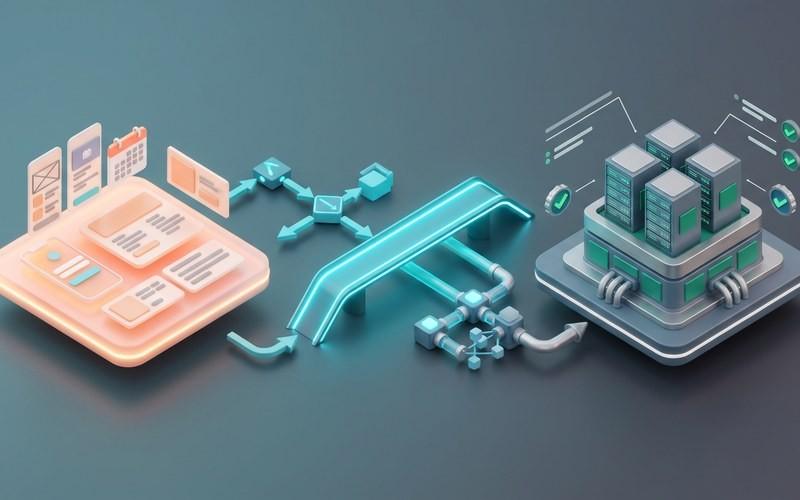
Modern AI scaffolding platforms accelerate frontend creation, but enterprise durability depends on how seamlessly client-side code connects to resilient backend infrastructure. A production-ready Bolt & Lovable to Production integration replaces ephemeral browser mockups with strict data contracts and isolated cloud services.
Tracing Service Request State Transitions and Concurrent Edit Controls
Every service request progresses through explicit, irreversible states: Draft → Assigned → In_Progress → Pending_Review → Completed. To prevent race conditions when multiple dispatchers or field technicians interact with the same record, our architecture implements optimistic concurrency control:
- Version Tokens: Each service request update carries an incrementing version integer and timestamp.
- Conflict Detection: If a sync payload arrives with a stale version token, the backend rejects the blind overwrite and flags the record for manual reconciliation.
- Explicit State Machine: Database-level check constraints enforce valid transitions, preventing illegitimate shortcuts such as moving directly from
DrafttoCompleted.
Separating Vibe-Coded Prototypes from Hardened Backend Logic
During early prototyping, Bolt & Lovable to Production vibe coding speeds up UI exploration by generating responsive components in browser environments. According to the Vultr deployment guide for Bolt.new, browser-based WebContainers execute full-stack mockups locally and export source trees to GitHub, but production requires dedicated containerization, managed reverse proxies, and isolated database networks.
Furthermore, analysis from Lumiasoft's Lovable export breakdown demonstrates that while UI components and client modules export cleanly to Git, database rows, authentication credentials, deployed edge functions, and Row-Level Security (RLS) policies stay behind in hosted environments. Canvas Developers hardens this boundary by extracting exported UI components into a clean frontend layer while provisioning dedicated PostgreSQL schemas, server-enforced RLS policies, and encrypted environment secrets in customer-controlled infrastructure.
How Are Acceptance Testing and Safe Network Recovery Verified Before Release?
Rigorous verification ensures that speed gained during visual prototyping is preserved through deployment. In professional Bolt & Lovable to Production development, engineering teams subject client applications to systematic resilience tests before release.
Our release assurance methodology validates the following critical criteria:
- Deterministic Network Interruption: Simulating mid-transaction connection drops during photo and form submission must leave the local record in an unambiguous Pending Sync state without data corruption.
- Idempotent Replay: Reconnecting to cellular or Wi-Fi networks triggers automatic replay of queued requests. Server-side idempotency keys guarantee that duplicate transmission attempts do not create duplicate service request records.
- Offline Cache Integrity: Encrypted local cache stores allow technicians to review active work orders across device reboots while disconnected.
- Authorization Boundary Verification: Automated regression suites verify that non-admin sessions cannot bypass Row-Level Security policies to inspect adjacent tenant data.
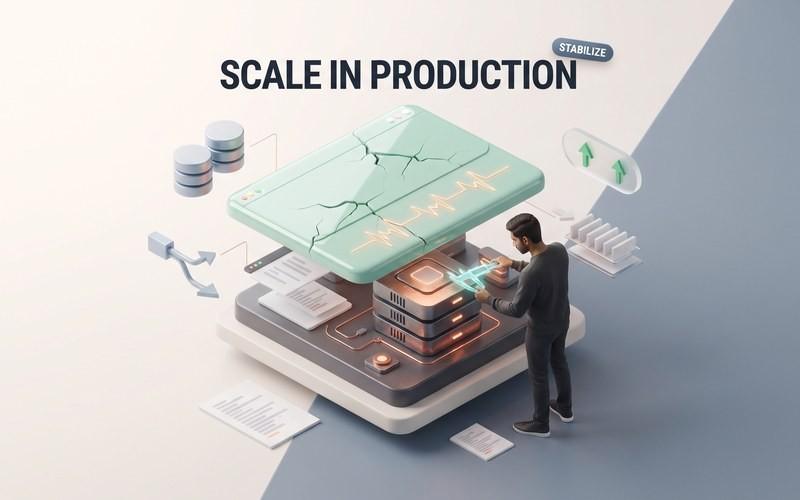
By pairing Bolt & Lovable to Production vibe coding scaffolding with engineer-supervised harness reviews, Canvas Developers identifies concurrency gaps and unhandled promise rejections early, turning fragile client scripts into fault-tolerant business software.
How Should You Scope and Harden a Bolt and Lovable Workflow for Production?
Deciding when to transition from a prototype to a fully engineered platform depends on operational complexity. A lightweight field tool managing non-critical logs may function adequately on standard hosted serverless tiers. However, when operations demand strict regulatory compliance, multi-tenant data isolation, and guaranteed offline recovery, investing in a robust Bolt & Lovable to Production mobile inspection workflow becomes essential.
Canvas Developers assists organizations by auditing AI-generated prototypes, structuring scalable backend services, and securing field operations. Learn more about our engineering approach through our Bolt & Lovable to production service, or reach out through our contact page to schedule a scoped technical assessment detailing your current stack, workflow requirements, and target timeline.
Outcome
By pairing vibe-coding scaffolding with engineer-supervised harness reviews, Canvas Developers identifies concurrency gaps and unhandled promise rejections early, turning fragile client scripts into fault-tolerant business software.