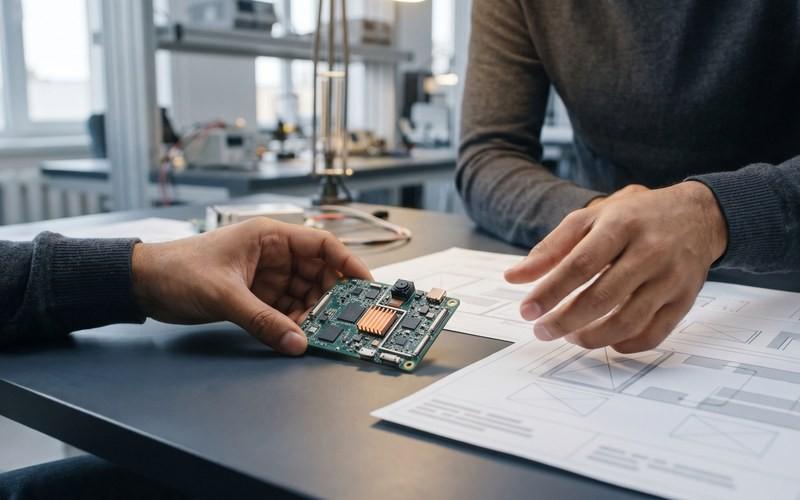
Determining your Computer Vision development cost requires evaluating architectural scope, data readiness, and ongoing inference requirements before committing to engineering resources. Instead of treating vision systems as uniform machine learning builds, technical leaders must separate exploratory experimentation from production-grade pipelines that process live image or video feeds reliably.
Understanding these engineering trade-offs enables engineering teams and founders to budget realistically for hardware, dataset preparation, and backend integration. At Canvas Developers, our software engineering team pairs AI coding assistance with senior engineering oversight to scaffold computer vision solutions, establish rigorous validation pipelines, and prevent costly architectural rework.
What Determines Your Computer Vision Development Cost?
Task Complexity: Pre-Trained Foundation APIs vs. Custom Architectures
The primary driver of your Computer Vision development cost is whether your core visual task can be solved using managed foundation APIs or requires training a proprietary architecture. Standard image classification, common optical character recognition (OCR), and general object detection frequently operate effectively on existing commercial foundation endpoints. Adopting these services eliminates initial training compute and model development time, restricting early financial commitments to API call volume and lightweight application integration.
Conversely, specialized industrial defect detection, medical image segmentation, or high-speed video tracking demand domain-specific neural network topologies. Building custom models introduces substantial model exploration overhead, custom loss function design, and rigorous validation cycles. When off-the-shelf APIs cannot generalize to your camera angles, lighting conditions, or unique object classes, the scope shifts from standard software integration to full-cycle Computer Vision research and machine learning engineering.
Data Readiness: Annotation Volume, Quality, and Synthetic Augmentation
Data preparation frequently represents a substantial portion of the overall investment. A custom model requires curated, balanced, and verified training sets. If your team starts with raw, unorganized imagery, budgets must account for establishing labeling taxonomies, multi-annotator consensus workflows, and programmatic quality auditing. Bounding box annotations require less operational labor than pixel-level instance segmentation masks or dense keypoint annotations.
Teams often integrate synthetic data generation and geometric augmentations to expand sparse edge-case datasets without manual collection overhead. While synthetic generation reduces field capture logistics, engineering realistic simulation environments requires dedicated graphics pipeline development. Addressing data readiness early ensures engineering hours are spent training valid models rather than diagnosing noisy labeling artifacts.
Which Pipeline Stages Add the Most Engineering and Compute Expense?
Data Ingestion, Camera Calibration, and Preprocessing Pipelines
Production vision systems begin long before tensors hit a neural network. Real-world sensor inputs require robust ingestion layers capable of handling variable frame rates, network drops, and format decoding. In industrial, robotics, or spatial tracking applications, geometric consistency is paramount. An experienced Computer Vision developer must implement camera intrinsic calibration, lens distortion correction, and rectification matrices to ensure pixel coordinates map accurately to physical spatial planes.
As detailed in OpenCV camera calibration and 3D reconstruction standards, computing intrinsic parameters and rectifying radial and tangential lens distortion requires solving non-linear optimization problems across known calibration grids. Preprocessing stages—including resizing, color space conversions, normalization, and perspective transforms—must execute within strict latency budgets. When video feeds scale across dozens of cameras, preprocessing pipelines demand multi-threaded CPU or hardware-accelerated decoding to prevent ingestion bottlenecks.
Training Compute, Hyperparameter Tuning, and Evaluation Benchmarks
Iterative training compute constitutes another major component of your total Computer Vision development cost. Modern vision architectures demand dedicated GPU clusters for distributed backpropagation, hyperparameter sweeps, and architectural search. Training expenses scale quadratically with dataset resolution and batch size, requiring systematic experiment tracking to prevent wasted compute runs.
Engineering discipline at this stage centers on automated evaluation harnesses. Teams benchmark models against holdout test sets using strict intersection-over-union (IoU) thresholds, mean average precision (mAP), and confusion matrices across rare edge cases. Without automated benchmarking, teams risk spending compute cycles optimizing loss functions that fail to improve real-world detection metrics.
Edge Deployment vs. Cloud GPU Inference Architecture
Serving inference introduces a long-term architectural division between centralized cloud instances and local edge hardware. Cloud-based serving offers elastic compute scaling but incurs persistent networking bandwidth costs and cloud GPU instance reservation fees. Deploying tools such as the NVIDIA Triton Inference Server documentation illustrates how model ensembling, concurrent execution, and dynamic batching can maximize GPU utilization across cloud deployments.
In contrast, edge deployment on embedded systems (such as NVIDIA Jetson boards or mobile neural engines) eliminates continuous network streaming fees and lowers latency. However, edge engineering introduces upfront optimization costs: quantizing FP32 models to INT8 precision, pruning redundant weights, compiling via TensorRT or ONNX Runtime, and managing thermal constraints on target devices.
How Does Vibe Coding Lower Prototyping Overhead in Vision Projects?
Accelerating Scaffolding: Model Wrappers, Data Loaders, and Test Stubs
The adoption of AI coding assistants—often referred to as Computer Vision vibe coding—significantly compresses the initial prototyping phase. In traditional development, writing PyTorch dataset loaders, OpenCV image processing wrappers, inference API endpoints, and mock test harnesses consumes days of manual boilerplate creation. Generative coding assistants rapidly scaffold these repetitive foundational structures, enabling engineering teams to validate early pipeline concepts within hours.
AI-assisted scaffolding excels at translating high-level architectural requirements into functional boilerplate code, including FastAPI inference endpoints, Docker container definitions, and unit test stubs. By automating utility scripting, teams can quickly stand up functional proof-of-concept pipelines that ingest sample video streams, pass tensors through baseline pre-trained models, and return structured JSON detections for immediate frontend review and stakeholder feedback.
Where AI-Assisted Code Fails: Memory Leaks, Frame Drops, and Concurrency
While rapid prototyping accelerates initial exploration, relying solely on unverified AI-generated code introduces severe production vulnerabilities. Computer vision systems operate on high-bandwidth binary streams where unmanaged memory allocation immediately degrades performance. Automated code generation frequently neglects OpenCV memory buffers, fails to release CUDA tensors from GPU memory pools, or creates unindexed object tracking loops that leak system RAM over extended runs.
Furthermore, video processing demands asynchronous streaming architectures. Naive code generated by automated tools often executes frame decoding synchronously on the main thread, leading to dropped frames, thread deadlocks, and severe pipeline stuttering. Founders who attempt to hire a vibe coder for Computer Vision without senior engineering direction often discover that while their prototype works on single test images, it collapses when processing concurrent real-time RTSP camera feeds or multi-threaded video workloads.
Engineering Governance: Human Architecture Reviews and Release Assurance
Bridging the gap between an AI-assisted prototype and production software requires rigorous human governance. At Canvas Developers, our engineers utilize AI coding agents and harness tooling to accelerate drafting, while experienced systems architects own the system design, memory profiling, and code reviews. Every pull request undergoes static analysis, automated concurrency testing, and manual inspection before staging.
Our QA and release assurance processes evaluate frame-budget constraints, hardware acceleration compatibility, and end-to-end data security. We verify that inference queues manage network backpressure gracefully and that client data remains isolated. This dual approach pairs rapid prototyping velocity with the architectural reliability needed for commercial deployment.
What Can You Reuse or Defer to Lower Upfront Scope?
Adopting Open-Weight Models Before Committing to Custom Training
One of the most effective strategies for controlling upfront capital expenditure is maximizing model reuse. Modern open-weight foundation models provide exceptional baseline feature extractors for zero-shot classification, object detection, and segmentation. Before authorizing full-scale dataset collection and custom backpropagation, a practical Computer Vision developer tests whether fine-tuning the final classification head of an open-weight model satisfies business accuracy requirements.
Transfer learning dramatically curtails training duration, data volume requirements, and GPU expenses. By freezing early convolutional or vision transformer layers and retraining only task-specific output layers on a few hundred verified samples, teams can validate commercial viability at a fraction of custom training overhead. Full architectural innovation should be deferred until real-world edge cases prove that transfer learning cannot meet performance thresholds.
Defining Measurable MVP Acceptance Criteria to Prevent Scope Creep
Scope creep in Computer Vision projects often stems from ambiguous, subjective accuracy goals such as 'detecting objects reliably.' Practical engineering scoping demands replacing subjective targets with measurable, statistically bounded acceptance criteria before initiating development.
Key acceptance criteria that prevent unnecessary scope expansion include:
- Minimum Confidence Thresholds: Defining acceptable precision and recall trade-offs (such as prioritizing high precision to eliminate false positives in automated gating).
- Latency and Frame Rate Caps: Specifying exact processing bounds (e.g., maximum 50ms per frame at 1080p resolution) to avoid premature micro-optimizations.
- Environmental Operational Envelopes: Explicitly bounding operational conditions (such as lux lighting ranges, camera mounting angles, and weather factors), deferring unconstrained edge handling to future phases.
- Hardware Deployment Targets: Locking the inference environment (CPU container, cloud GPU instance, or designated edge accelerator) before writing pipeline code.
How Do Ongoing Infrastructure and Data Maintenance Affect Total Cost?
Recurring GPU Provisioning, Inference Latency, and Bandwidth Charges
Your Computer Vision development cost represents only the initial phase of expenditure; recurring operational infrastructure constitutes a major share of total lifecycle costs. Running high-throughput cloud GPU instances continuously incurs substantial monthly hosting bills. If video feeds are transmitted uncompressed across public networks, outbound data egress fees can quickly outpace inference compute expenses.
Controlling operational spend requires implementing edge filtering, client-side motion detection triggering, and adaptive batching. Transmitting only event-triggered clips rather than continuous raw video streams slashes cloud network egress. Furthermore, benchmarking inference latency enables teams to right-size compute instances, ensuring they do not overprovision expensive GPU hardware for workloads that could run on optimized CPU or edge accelerators.
Mitigating Domain Drift, Sensor Wear, and Scheduled Retraining
Unlike traditional transactional software, machine learning systems degrade over time due to external environmental changes. In computer vision, domain drift occurs when physical operational conditions shift away from the training distribution. Seasonal lighting shifts, camera lens degradation, altered camera positions, or novel object variations degrade model precision silently in production.
Maintaining performance requires continuous monitoring, outlier detection, and scheduled active learning retraining loops. Production budgets must account for logging low-confidence inferences, human verification of edge cases, and automated regression testing pipelines. Establishing automated retraining schedules protects initial development investments by preventing accuracy regression in evolving operational environments.
What Deliverables and Acceptance Criteria Should You Scope Before Hiring?
Before engaging an external team or hiring a Computer Vision developer, technical stakeholders must define concrete project deliverables to protect their Computer Vision development cost from misaligned expectations. Scoping should never center on abstract algorithmic exploration or open-ended model experimentation; instead, contractual milestones must outline tangible software assets, documentation, and operational thresholds.
A comprehensive delivery scope should require the following tangible deliverables:
- Reproducible Dataset and Versioning Pipeline: Documented raw datasets, balanced validation splits, and automated preprocessing scripts configured with clear data schemas and annotation guidelines.
- Model Artifacts and Export Formats: Serialized model weights delivered in open formats (such as ONNX, TensorRT engines, or CoreML packages) alongside full training log histories and hyperparameter configurations.
- Benchmarking and Evaluation Suite: Automated test suites executing against holdout datasets, reporting precision, recall, mAP, and end-to-end latency benchmarks across defined hardware environments.
- Containerized Inference API and Deployment Manifests: Production Dockerfiles, dependency lockfiles, health-check endpoints, and infrastructure documentation detailing compute resource boundaries.
Establishing clear acceptance criteria upfront prevents protracted billing cycles and ensures delivered models integrate seamlessly into your broader software architecture. At Canvas Developers, our software engineering team guides clients through systematic technical scoping before initiating development. Explore our computer vision services to review our engineering capabilities, or reach out directly through our contact form with your existing stack, video feeds, operational constraints, and target outcomes to receive a structured technical assessment.