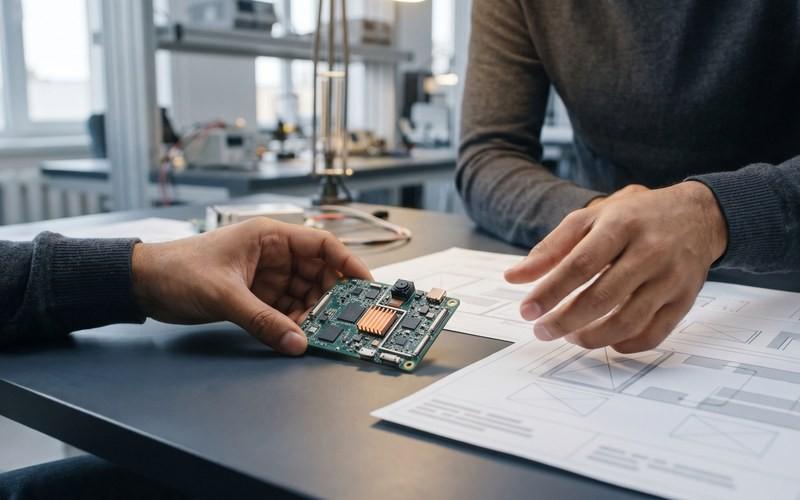
Deploying visual intelligence in enterprise operations requires bridging the divide between isolated laboratory benchmarks and turbulent physical environments. While proof-of-concept models often demonstrate high accuracy on clean validation datasets, production pipelines frequently encounter severe degradation caused by uncalibrated sensors, lighting shifts, and edge hardware bottlenecks. Following a comprehensive enterprise computer vision checklist enables engineering teams to uncover operational failure points before committing capital or deploying unreliable software to field devices.
Why Do Most Enterprise Computer Vision Pilots Fail Before Production?
Most visual AI initiatives stall during transition from experimental sandboxes to physical operations. In controlled development settings, curated datasets and stationary lighting establish an idealized operational envelope that rarely mirrors industrial factory floors, logistics hubs, or retail aisles. The primary driver of these computer vision adoption pitfalls is the stark performance gap between static benchmark metrics and chaotic operational reality. Models evaluated solely on aggregate mean average precision (mAP) collapse when exposed to mechanical vibration, oblique camera angles, motion blur, or dirty optical lenses.
Modern software teams frequently leverage AI coding agents and scaffolding harnesses like Antigravity to accelerate prototype construction, generate streaming ingestion boilerplate, and assemble testing utilities. While generative tools compress early development cycles, they cannot replace experienced system architecture. Automated code generators produce functional syntax, yet human engineers must architect the streaming pipelines, hardware memory buffers, and failover topologies. Without rigorous architectural oversight, edge pipelines suffer from silent failures where inference engines return low-confidence outputs under subtle distribution shifts. Using an enterprise computer vision checklist during initial scoping ensures teams scrutinize environmental variables, streaming bottlenecks, and state synchronization before declaring a lab pilot ready for production infrastructure.
How Do Environmental Variance and Sensor Drift Derail Edge Deployments?
Accounting for Lighting and Sensor Drift in Computer Vision Streams
Physical environments rarely maintain the photometric stability of development studios. As ambient sunlight shifts across skylights, factory luminaires age, or camera optics collect particulate residue, incoming video feeds undergo photometric distortion. Failing to account for lighting and sensor drift in computer vision streams leads to sudden false-positive cascades and missed detections. Without continuous normalization, automatic gain control and auto-white-balance algorithms inadvertently alter color histograms, invalidating feature weights established during model training.
Resilient edge systems counter these computer vision adoption pitfalls through deterministic preprocessing. Engineers implement automated exposure bounding, histogram equalization, and periodic background calibration against fixed reference targets. Rather than relying on raw frame streams, input ingestion layers quantify sensor noise and image sharpness, triggering alerts when optical degradation exceeds acceptable operational bounds.
Managing Edge Hardware Latency, Thermal Throttling, and Compute Constraints
Deploying computer vision models on constrained hardware demands strict physical and computational budgeting. Edge appliances such as embedded system-on-chip devices frequently operate within sealed enclosures where passive cooling proves insufficient under sustained inference workloads. As documented in the NVIDIA Jetson Linux Platform Power and Performance Guide, device thermal zones trigger dynamic clock throttling via power governors when internal temperatures breach safety thresholds.
When hardware throttles GPU and CPU clock frequencies to dissipate heat, inference latency doubles or triples, causing frame buffers to overflow and downstream queues to drop vital frames silently. Production engineering requires optimizing models via TensorRT INT8 quantization, enforcing thread priority boundaries, and structuring backpressure pipelines that manage frame drops gracefully during thermal excursions.
Which Dataset and Annotation Errors Cripple Model Accuracy?
Computer Vision Dataset Annotation Mistakes and Label Inconsistency
Production model accuracy is fundamentally constrained by annotation integrity. Among the most destructive computer vision dataset annotation mistakes is label inconsistency across distributed annotators. Ambiguous class taxonomies—such as differentiating superficial surface blemishes from structural fractures—inevitably cause divergent bounding box coordinates and conflicting segmentation masks. When supervisory loss functions train on contradictory ground truth, gradient updates destabilize, depressing detector confidence, increasing false alarms, and degrading edge localization precision across industrial deployments.
Equally critical are edge-case omissions caused by relying on static image datasets. Standard training sets capture expected operational states but routinely miss transient real-world anomalies, including mechanical conveyor jams, dropped tools, sudden lens smudges, and high-contrast specular reflections. Static image snapshots discard the temporal motion context present in live physical streams. When teams implement a comprehensive enterprise computer vision checklist, they mandate continuous stratified sampling across diverse shifts and seasons, ensuring edge cases are captured and labeled before real-world failures occur.
The Operational Traps of Misusing Synthetic Training Data
Generating synthetic imagery using 3D graphics engines and diffusion models offers an appealing shortcut to resolve physical data scarcity. Engineering teams can programmatically generate thousands of edge-case scenarios with automated, pixel-perfect semantic labels. However, over-relying on synthetic data introduces a treacherous sim-to-real domain gap. Rendered scenes frequently fail to reproduce micro-surface textures, complex ambient illumination scattering, and physical sensor readout artifacts such as rolling shutter distortion or thermal noise patterns.
When a vision model trains predominantly on synthetic distributions, it inadvertently learns non-transferable visual shortcuts that collapse when exposed to live camera telemetry. Synthetic data functions effectively as a targeted data augmentation technique to balance rare defect classes, but it cannot replace calibrated real-world telemetry. An actionable pre-deployment audit requires cross-validating synthetic-trained models against rigorous holdout sets gathered directly from operational cameras operating under variable environmental conditions.
Why Do Vibe-Coded Vision Implementations Stall at Enterprise Scale?
What AI Code Generation Handles Well vs. Where Human Engineering Must Intervene
Vibe coding and autonomous AI coding agents have transformed how engineering teams build software. Modern AI harnesses excel at scaffolding pipeline boilerplate, setting up streaming ingestion endpoints, writing tensor transformation routines, and generating OpenCV utility functions. Teams can construct a working proof-of-concept visual dashboard in hours rather than weeks. However, organizations that attempt to transition vibe-coded prototypes directly into enterprise deployments encounter critical computer vision adoption pitfalls.
While AI models generate functional syntax, they lack contextual understanding of hardware concurrency, zero-copy memory structures, and hardware-specific failure states. Senior software engineers must actively direct system architecture, enforce peer review standards, and govern release decisions. Human engineering oversight is indispensable for auditing security vulnerabilities, optimizing low-level memory allocation, and architecting multi-camera synchronization. Organizations partnering with Canvas Developers for custom computer vision engineering avoid unmaintainable prototype technical debt by combining AI-accelerated scaffolding with strict human architectural governance.
Data Ingestion, Network Latency, and Enterprise Security Vulnerabilities
Industrial vision systems ingest high-bandwidth video streams that quickly overwhelm unoptimized network architectures. Vibe-coded prototypes frequently rely on naive synchronous REST calls or unbuffered WebSocket loops that introduce severe latency spikes and buffer bloat. At scale, distributed camera setups require zero-copy buffer sharing, asynchronous RTSP and GStreamer pipelines, and batch serialization protocols to prevent CPU exhaustion and dropped frames.
Security vulnerabilities represent another severe hazard in rapidly assembled vision stacks. Ingestion endpoints frequently omit mutual TLS authentication, encrypted video transport, and role-based access controls, leaving camera feeds vulnerable to unauthorized access or video injection attacks. Furthermore, unhardened systems routinely omit deterministic fallback modes. A production-ready computer vision production rollout checklist requires failover safeguards: if an optical sensor disconnects or inference latency breaches SLA thresholds, the system must trigger mechanical rule-checks, alert human operators, or activate secondary sensors without halting enterprise operations.
How Do Lab-Benchmarked Models Compare Against Field Reality?
Comparing Static Test Set Metrics Against Real-World Telemetry
Evaluating vision models exclusively against offline test sets creates false confidence. In research and development environments, validation datasets are curated, balanced, and scrubbed of sensor artifacts. Physical deployment environments, however, exhibit extreme class imbalance, where target defects or anomalies occur in less than 0.1% of processed frames. In this regime, standard aggregate precision and recall metrics obscure high false-discovery rates that disrupt frontline operations.
Bridging this gap requires continuous telemetry tracking. As established in industrial computer vision model monitoring frameworks, maintaining production vision systems requires continuously logging confidence distributions, bounding box density, and inference latency alongside real-world predictions. Tracking these telemetry vectors enables engineering teams to detect operational degradation before false predictions impact product quality, worker safety, or automated decision pipelines.
Evaluating Private Local AI Infrastructure Against Cloud-Bound Vision APIs
Selecting an inference architecture requires balancing latency, operating cost, and data sovereignty. Cloud-bound computer vision APIs eliminate on-premise hardware management and simplify initial setup. However, streaming high-resolution industrial video feeds to external cloud endpoints incurs substantial network egress fees, introduces variable latency exceeding 200 milliseconds, and creates compliance hurdles when handling proprietary operational footage.
Conversely, private local AI infrastructure—such as on-premise edge servers running optimized open-weight vision models—delivers deterministic single-digit millisecond latency while keeping raw telemetry fully contained within client-controlled networks. When evaluating computer vision vendors, engineering leaders must include infrastructure isolation requirements on their computer vision production rollout checklist to ensure deployment architectures align with security policies and latency constraints.
What Belongs on Your Pre-Deployment Production Readiness Checklist?
Automating Detection for Data Distribution Drift and Retraining Triggers
Sustained production performance requires continuous statistical monitoring of incoming visual distributions. As operational conditions change, automated monitors must evaluate covariate shift using tests such as Population Stability Index (PSI), Kolmogorov-Smirnov statistics, and Wasserstein distance across extracted feature embeddings. Additionally, tracking summary image metrics—such as Laplacian blur variance, entropy, and exposure clipping—provides early warning signals before model accuracy degrades. When automated monitoring detects persistent distribution drift, an enterprise computer vision checklist should define automated retraining triggers or route low-confidence samples to human reviewers for active learning enrichment.
Verifying On-Device Hardware Resilience and Fallback Mechanisms
Hardware verification ensures edge nodes withstand real-world operational stress. Prior to site deployment, edge devices must undergo burn-in testing inside thermal chambers while logging thermal zones, power rails, and clock frequencies under maximum inference load. If device temperatures exceed thermal margins, dynamic voltage and frequency scaling must throttle predictably without dropping critical safety frames.
A complete computer vision production rollout checklist also mandates failover validation: edge devices must maintain local cache buffers during network disconnects, recover autonomously via hardware watchdog timers, and signal downstream mechanical controllers through deterministic fallback states. When evaluating computer vision vendors, technology leaders must examine these hardware resilience standards, code review protocols, and QA methodologies rather than relying on vendor slide decks or idealized laboratory benchmarks.
How Can You Validate and Harden Your Computer Vision Pipeline?
Transitioning computer vision from an experimental proof of concept to a dependable enterprise asset requires bridging the gap between rapid software scaffolding and resilient industrial engineering. Autonomous coding agents and harnesses like Antigravity dramatically compress early development timelines, but long-term operational success depends on senior engineers who own system architecture, conduct meticulous code reviews, and enforce rigorous release gates.
By systematically applying an enterprise computer vision checklist, engineering organizations protect their investments against sensor drift, thermal throttling, annotation errors, and edge hardware bottlenecks. When evaluating computer vision vendors or planning a critical deployment, partnering with an experienced software engineering team ensures your vision pipeline is architected for stability, security, and scalability. Tech leaders and founders can initiate a scoped architecture assessment by contacting the engineering team at Canvas Developers via https://www.canvasdevelopers.com/contact to harden their visual systems for dependable production performance.