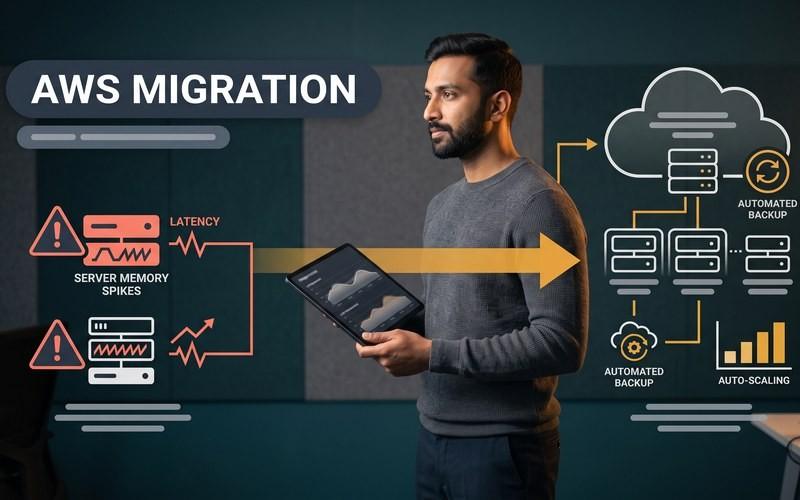
Estimating your Managed DevOps & Operations development cost requires evaluating architectural complexity, multi-environment release pipelines, compliance posture, and ongoing platform telemetry rather than guessing developer hourly rates. Engineering teams often encounter unexpected budget inflation when deployment scope, data persistence policies, and cloud infrastructure baselines are left underspecified before implementation begins.
By establishing rigorous workload boundaries and understanding where modern AI scaffolding accelerates infrastructure creation under senior technical governance, organizations can streamline cloud infrastructure budgeting and deploy reliable production systems without costly rework.
What Determines Managed DevOps & Operations Development Cost?
Establishing a predictable Managed DevOps & Operations development cost begins by isolating operational requirements from raw application code. Total engineering expenditure is primarily dictated by system topology, regulatory compliance, multi-environment provisioning, and continuous deployment frequency. Teams migrating from ad-hoc manual deployments to a unified operational model must budget for infrastructure-as-code modularity, secure credential distribution, and automated regression testing before production traffic arrives.
Rather than treating operations as an ambiguous line item, mature technical organizations classify expenditure across three core dimensions: architectural complexity, telemetry ingestion volume, and delivery cadence. According to the AWS Well-Architected Framework, operational excellence requires treating operations as versioned code and building automated change-flow quality gates across every workload lifecycle stage. When operational responsibilities are bundled into ad-hoc developer tasks without dedicated infrastructure ownership, delivery bottlenecks and configuration drift quickly inflate lifecycle maintenance costs.
Engaging professional Managed DevOps & Operations aligns technical execution directly with business uptime goals and budget predictability. By establishing transparent workload boundaries early—distinguishing essential staging parity from premature high-availability clustering—engineering leaders can prevent budget overruns while maintaining strict security, automated rollbacks, and deployment rigor across every release stage.
Clear operational specifications allow founders and engineering managers to evaluate third-party integrations, manage cloud compute baselines, and plan engineering sprints with full visibility into ongoing infrastructure expenses.
Which Architecture and Deployment Features Drive Up Project Scope?
Scope inflation in infrastructure engineering rarely comes from basic hosting provisioning; it stems from the operational complexity required to keep systems resilient, secure, and reproducible under production loads. Evaluating key technical requirements before development begins reveals how specific architectural decisions drive project hours.
CI/CD Pipeline Complexity and Multi-Environment Deployments
A major driver of engineering scope is the distance between a single-branch deployment script and an enterprise-grade delivery workflow. When an experienced Managed DevOps & Operations developer designs release automation, implementation effort scales with the number of discrete environments requiring parity, such as local containers, dynamic preview environments, staging, and production. Multi-stage pipelines that incorporate automated unit and integration tests, container image scanning, artifact versioning, and zero-downtime blue-green or canary release strategies require rigorous validation. Teams must verify that rollback triggers execute reliably without corrupting database records or dropping active user sessions.
Data Preparation, State Management, and Storage Reliability
Stateful workloads introduce critical DevOps cost drivers that stateless web containers avoid. Managing persistent state demands reliable schema migration choreography, automated snapshot schedules, and deterministic cache invalidation policies. When orchestrating infrastructure as code, maintaining centralized state with concurrency controls is essential. As outlined in HashiCorp Terraform collaboration documentation, remote backends must enforce state locking to prevent concurrent operations from generating conflicting resources and corrupting the environment. Configuring backup retention windows, verifying database read-replica promotion paths, and testing data hydration scripts ensure stability during scheduled updates.
Secret Management, Identity Boundaries, and Security Hardening
Securing modern cloud workloads requires fine-grained identity boundaries rather than static credentials stored in code repositories. Provisioning centralized secret management vaults, rotating access tokens dynamically, and configuring strict role-based access controls across container clusters demand meticulous configuration. Enforcing mutual TLS between internal services, restricting network ingress through hardened security groups, and implementing automated vulnerability scanning at the pull-request level prevent costly breach remediation, establishing solid operational guardrails from initial launch.
How Does Vibe Coding with Engineering Oversight Reduce Implementation Hours?
Accelerating infrastructure engineering through generative tooling has transformed software delivery, but cloud operations demand strict deterministic guarantees that probabilistic models cannot deliver unaided. Understanding the operational balance between rapid AI scaffolding and disciplined human verification protects project budgets from costly production outages.
Scaffolding Infrastructure-as-Code and Pipelines with AI Assistants
When applying Managed DevOps & Operations vibe coding workflows, AI assistants significantly reduce implementation hours by drafting boilerplate Infrastructure-as-Code (IaC) configurations, container definitions, and CI/CD workflow manifests. At Canvas Developers, teams leverage commercial AI coding environments—such as Claude Code and OpenAI Codex engineering workflows—or private, locally hosted open-weight models in client-controlled infrastructure to generate initial Terraform modules, Dockerfiles, and GitHub Actions pipelines. This automation rapidly eliminates repetitive setup tasks, creating faster feedback loops during early provisioning cycles and allowing teams to explore architecture patterns efficiently.
Where AI Tooling Fails: Network Topologies, State Locks, and Scale
Despite impressive syntax generation capabilities, unguided AI models regularly stumble over nuanced cloud topology dependencies and production realities. AI prompts frequently produce syntactically clean HCL or YAML configurations that fail during live deployment. Common failure points include broken remote state locking configurations, misconfigured VPC subnet routing tables, cyclic dependencies in resource dependency graphs, and overly permissive security group rules. Furthermore, models struggle to predict throughput bottlenecks, ephemeral port exhaustion under sustained network concurrency, or subtle permission mismatches across cross-account IAM boundaries. Without rigorous human inspection, these hidden flaws lead to runtime failures and costly debugging cycles.
Why Senior Engineers Must Own Architecture, Code Reviews, and Releases
Organizations looking to hire a vibe coder for Managed DevOps & Operations must recognize that AI-assisted generation is an operational accelerator, not a substitute for architectural ownership. Through Canvas Developers' managed operations services, experienced systems engineers review every configuration diff, validate network security perimeters, verify database replication strategies, and supervise release decisions. Human engineers ensure that generated pipelines include proper credential masking, idempotent execution steps, and graceful degradation paths, preventing subtle infrastructure defects from reaching production environments.
Which Third-Party Cloud and Tooling Expenses Must You Plan For?
Estimating ongoing cloud commitments requires distinguishing upfront engineering implementation from recurring vendor expenses. A realistic cloud infrastructure budgeting plan must anticipate baseline operational utilization alongside variable traffic surges across cloud platforms, managed data stores, and external developer tooling ecosystems.
Compute, Bandwidth, and Managed Cloud Service Baselines
Cloud compute instances, container runtimes, and managed databases form the baseline of monthly operational expenditure. Beyond core virtual servers, egress data transfer fees, cross-availability-zone network traffic, and managed NAT gateways frequently generate unexpected cost spikes as workloads expand. Choosing between self-hosted services and managed cloud offerings—such as managed PostgreSQL, distributed Redis caches, and cloud load balancers—requires weighing maintenance convenience against fixed platform rates. While managed services substantially reduce internal administrative burden and patching overhead, their licensing and capacity fees scale directly with provisioned storage, provisioned IOPS, and read-replica counts. Factoring in storage tiering, reserved instance commitments, and container autoscaling ceilings keeps operational bills predictable as user concurrency increases.
Observability, Telemetry, and Incident Alerting Platform Subscriptions
Real-time system observability is critical for rapid incident mitigation, yet unoptimized telemetry ingestion can inflate your ongoing Managed DevOps & Operations development cost. Centralized logging platforms, distributed tracing tools, and time-series metrics backends typically bill based on raw data volume ingested and active index retention windows. High-cardinality custom metrics and verbose debug logs left running in production environments can rapidly outpace basic compute spending. Configuring dynamic trace sampling rates, implementing structured log filters, and defining actionable incident alerting schedules ensure reliable operational awareness without incurring unnecessary vendor surcharges or storage bloat.
What Components Can Be Reused or Deferred to Protect Your Launch Budget?
Engineering teams frequently overextend their initial launch budget by engineering for massive enterprise scale on day one. A seasoned Managed DevOps & Operations developer protects capital by identifying which infrastructure elements can be accelerated through proven modular templates and which complex capabilities should be deferred until real product traffic justifies them.
Standardizing with Battle-Tested Modular Terraform and Open-Source Stacks
Rather than authoring configurations from scratch, engineering teams can standardize on mature, battle-tested Terraform modules for networking, container clusters, and identity management. Reusing verified building blocks across VPCs, managed Kubernetes clusters, and registries eliminates redundant engineering hours and maintains environment parity across development tiers.
- Modular IaC Blueprints: Pre-validated Terraform modules for VPC peering, IAM roles, and task definitions reduce initial setup time.
- OpenTelemetry Instrumentation: Vendor-neutral collectors provide tracing and metrics without proprietary lock-in.
- Standardized Ingress: Reusable load balancer patterns ensure uniform routing across environments.
Phasing Multi-Region Redundancy and Automated High-Availability Failover
Prematurely building multi-region active-active architectures inflates project scope with cross-region consensus, database synchronization, and global routing. In contrast, practical Managed DevOps & Operations establishes single-region multi-availability-zone (multi-AZ) resilience for initial launches, deferring global synchronization until traffic volume warrants the investment.
| Architecture Pattern | Engineering Scope | Target Resiliency | Recommended Phase |
|---|---|---|---|
| Single-Region Multi-AZ | Automated AZ failover, managed read replicas, and snapshot hydration | Protects against isolated data center failures | Initial MVP through launch |
| Multi-Region Active-Active | Global traffic steering and cross-region state replication | Survives complete regional cloud outages | Late-stage enterprise scale |
Automated container recovery, read replicas, and offsite snapshot scripts deliver high availability at a fraction of the cost, preserving launch capital while leaving clean architectural paths for future geographic expansion.
How Do You Validate Measurable Acceptance Criteria Before Handover?
A successful infrastructure engagement concludes not when code is merged, but when operational reliability is proven through reproducible acceptance gates. Establishing clear validation benchmarks protects your overall Managed DevOps & Operations development cost by preventing expensive post-launch firefighting and architectural drift.
Automated Health Checks, Rollback Verification, and Disaster Recovery Drills
Acceptance verification begins with automated resilience testing across all release pipelines. Teams should validate container liveness and readiness probes under simulated traffic load, confirming that failed deployment builds trigger immediate, automated rollbacks without manual intervention. Disaster recovery capabilities must be verified through practical drills: taking automated database snapshots, hydrating an isolated staging environment, and measuring recovery time objectives (RTO) and recovery point objectives (RPO) against agreed operational targets before cutover.
| Verification Gate | Validation Method | Acceptance Target |
|---|---|---|
| Health Probes & Liveness | Synthetic load generation | Zero-downtime rolling deploys with automated failure eviction |
| Pipeline Rollback | Simulated bad release artifact | Automatic traffic fallback to prior stable version in under 60 seconds |
| Disaster Recovery Drill | Snapshot hydration in staging | RTO and RPO verified against defined data-loss thresholds |
Monitoring Thresholds, Operational Runbooks, and Handover Walkthroughs
Production handover requires thorough operational documentation alongside active monitoring infrastructure. Reliable Managed DevOps & Operations delivery includes calibrated alert thresholds for CPU saturation, memory exhaustion, latency spikes, and error budget consumption to prevent on-call alert fatigue.
- Telemetry Calibration: Alert rules tied to error budgets and P95 latency thresholds rather than raw machine noise.
- Operational Runbooks: Step-by-step procedures for secret rotation, database scale-up, and incident escalation.
- Handover Walkthroughs: Architecture reviews and simulated deployment cycles transferring operational control to client teams.
At Canvas Developers, senior engineers pair AI-accelerated configuration scaffolding with comprehensive handover walkthroughs, ensuring your team has complete visibility and ownership of the deployed architecture. To evaluate your infrastructure requirements, review current workflows, and receive a scoped engineering assessment, share your current stack and target operational outcomes through our contact form.