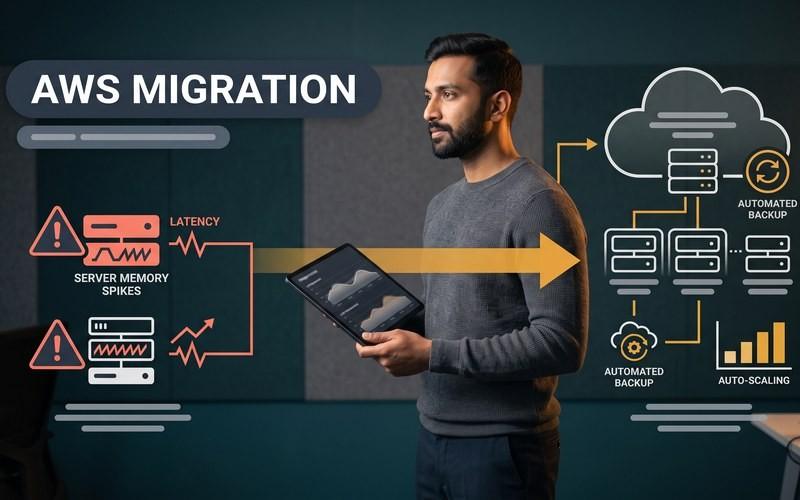
Establishing production-ready Managed DevOps & Operations development requirements is essential before hiring a developer or leveraging AI-assisted scaffolding to build your cloud infrastructure. While AI coding tools can rapidly draft deployment scripts and container configurations, operational reliability depends on strict architecture, least-privilege security, and deterministic release pipelines. Defining precise workflows, measurable acceptance criteria, and environment boundary standards ensures your systems remain resilient, maintainable, and audit-ready from day one.
What Are the Core Managed DevOps & Operations Development Requirements?
Defining formal Managed DevOps & Operations development requirements means establishing the baseline operational boundaries, provisioning standards, and verification mechanisms needed before any code reaches production. Too often, teams treat cloud infrastructure as an afterthought to application development, assuming that a functional container on a local machine easily translates into scalable cloud operations. In practice, enterprise Managed DevOps & Operations requires decoupling configuration from application logic, enforcing reproducible state management, and isolating network perimeters.
Before commissioning infrastructure work or attempting to build via natural-language generation, engineering teams must outline three non-negotiable operational deliverables:
- Infrastructure as Code (IaC) governance: Declarative specifications for every network route, compute instance, database cluster, and access policy managed under version control rather than manual cloud console modifications.
- Deterministic continuous integration and continuous deployment (CI/CD): Automated delivery pipelines with isolated build stages, automated linting, test suites, and cryptographic artifact signing.
- Centralized access and auditing: Strict role-based access control, federated authentication, and immutable audit logs that record all control-plane modifications.
At Canvas Developers, cloud architects treat operational requirements as engineering contracts. By specifying inputs, outputs, and concrete failure tolerances early, organizations avoid costly architectural rework when application traffic expands.
Where Vibe Coding Accelerates Operations—and Where It Breaks
Using natural language prompts and AI agents to scaffold cloud infrastructure—commonly known as Managed DevOps & Operations vibe coding—introduces a powerful mechanism for rapid prototyping. However, operational engineering requires a transparent understanding of where automated generation delivers speed and where human oversight remains indispensable.
What AI Scaffolding Handles Well: Scripts, Manifests, and Boilerplate
AI coding assistants excel at generating repetitive, syntactically rigid operational configurations. When guided by precise engineering constraints, AI harnesses can rapidly output Terraform or OpenTofu modules, Dockerfiles, Kubernetes manifests, and GitHub Actions workflow YAML files. Instead of writing boilerplate deployment stages or service definitions by hand, an engineer can use AI to scaffold baseline structures in minutes.
Furthermore, AI models perform well when translating reference architecture patterns into concrete code blocks, such as configuring standard reverse proxies, composing multi-stage container builds, or structuring boilerplate logging agents. At Canvas Developers, AI coding agents accelerate preliminary drafting across design, engineering, and DevOps tasks. This acceleration compresses feedback loops and eliminates routine manual transcription, freeing senior engineers to focus on architectural topology and security verification.
Critical Failure Points: IAM Governance, State Drift, and Secrets
Despite these scaffolding efficiencies, unguided vibe coding poses severe operational risks when applied to production cloud environments. AI models prioritize syntactic plausibility over systemic security. If you intend to hire a vibe coder for Managed DevOps & Operations without seasoned architectural oversight, critical vulnerabilities frequently emerge:
- Overprivileged Identity and Access Management (IAM): AI agents frequently generate wildcard permissions (such as
"Action": "*") to bypass access errors. According to the AWS IAM security best practices, teams must strictly apply least privilege by scoping actions only to necessary resources and eliminating long-term static credentials in favor of temporary, assumed IAM roles. - State drift and unmanaged resources: Generated scripts often fail to account for cloud state locking, backend synchronization, or cross-resource dependencies. As documented in the HashiCorp Well-Architected Framework for configuration drift detection, discrepancies between the declared Terraform state and real-world infrastructure cause deployment rollbacks, silent failures, and compliance breaches unless monitored via scheduled health assessments and drift detection runs.
- Hardcoded secrets and insecure key lifecycles: LLMs routinely embed default API tokens, plain-text environment variables, or insecure ingress rules into generated templates. Human engineers must establish secure key storage, automated credential rotation, and secret injection pipelines via services like AWS Secrets Manager or HashiCorp Vault.
Experienced DevOps specialists must review every generated line, own the underlying security architecture, and enforce rigorous automated validation before deploying to live infrastructure.
Defining the Operational Workflow: Inputs, Outputs, and Triggers
To successfully scope infrastructure engagements, a professional Managed DevOps & Operations developer must define operational processes around precise system inputs, deterministic outputs, and verifiable event triggers. Without formal workflow boundaries, automated pipelines become brittle and prone to uncoordinated production changes.
Continuous Delivery Inputs: Repository Triggers and Artifact Promotion
A resilient delivery pipeline requires unambiguous ingress criteria. Every operational task must begin with a version-controlled trigger rather than manual administrator intervention. Clear scoping documents specify how code commits, branch merges, and semantic tags initiate pipeline workflows:
- Trigger criteria: Pull requests against staging or production branches trigger automated linting, security scanning, and dry-run infrastructure plans. Merges to protected branches initiate artifact compilation.
- Immutable artifact creation: Application services are packaged into versioned container images tagged with immutable commit SHAs. Storing artifacts in private container registries prevents dependency drift across environments.
- Environment promotion gates: Promotion follows a strict hierarchy (development to staging, then to production). Promotion requires cryptographic validation, passed smoke tests, and designated peer approval gates before any deployment proceeds.
By capturing these promotion triggers as core Managed DevOps & Operations development requirements, teams eliminate ambiguous manual handoffs and ensure that every artifact deployed to production is reproducible from source control.
Operational Outputs: Observability Baselines and Runbook Automation
An operational system is incomplete if it fails to expose health telemetry and recovery automation. Scoping must establish what the infrastructure outputs to the engineering team when running in steady state or experiencing degradation:
- Telemetry and metrics: Real-time collection of golden signals—latency, traffic volume, error rates, and resource saturation—routed to centralized monitoring dashboards.
- Structured log aggregation: JSON-formatted application and access logs shipped to central search clusters, enriched with correlation IDs to trace requests across microservices.
- Automated runbooks: Codified incident response scripts that trigger automated container restarts, load balancer drain cycles, or database failovers during defined alert conditions.
Structuring these operational outputs ensures your operations team can diagnose system anomalies without requiring ad-hoc server access or manual troubleshooting during outages.
Minimum Useful Release: Decoupling Day-One Infrastructure from Day-Two Ops
A common pitfall when scoping cloud operations is overengineering the initial release. Attempting to deploy complex service meshes, multi-region failovers, and autonomous scaling on day one increases implementation cost and delays product launch. Effective Managed DevOps & Operations scoping decouples the minimum viable release from subsequent operational maturity phases.
The Day-One Core: Automated CI/CD, Isolated Environments, and Logging
The initial milestone must focus strictly on the fundamental operational spine necessary to support application development safely. Essential Day-One deliverables include:
- Isolated staging and production VPCs: Complete network separation preventing non-production tests or data from interacting with production workloads.
- Automated build and deploy pipelines: Streamlined CI/CD workflows that test, package, and deploy application updates without manual server manipulation.
- Centralized logging and basic alerts: Unified log retention and uptime alerts notifying engineers of availability regressions.
- Basic backup policies: Automated daily snapshots of databases and object stores with verified retention windows.
Establishing these elements satisfies the core cloud infrastructure acceptance criteria for an initial launch, providing a secure foundation without excessive operational overhead.
Day-Two Scaling: Zero-Downtime Rollouts, Auto-Scaling, and DR Drills
Once baseline infrastructure is stable and application traffic begins to scale, teams can schedule Day-Two operational capabilities. Scoping these as distinct subsequent milestones prevents launch delays:
- Zero-downtime deployment strategies: Blue-green or canary release configurations that route live user traffic seamlessly between container versions.
- Dynamic auto-scaling policies: Horizontal pod or instance auto-scalers configured against memory, CPU, or message queue depth thresholds.
- Disaster recovery and failover drills: Structured disaster recovery simulations verifying recovery point objectives (RPO) and recovery time objectives (RTO) across secondary zones.
Separating Day-One necessities from Day-Two enhancements enables founders and engineering leaders to achieve fast time-to-market while retaining a clear roadmap for long-term scalability.
The DevOps Handoff and Acceptance Checklist
A project is not complete until every operational asset is verified, documented, and formally handed over. Employing a rigorous DevOps scope of work checklist prevents vendor lock-in, eliminates hidden credentials, and guarantees that your internal team can operate the platform independently.
Verifiable Verification: Infrastructure as Code Validation and Dry Runs
Acceptance testing for cloud infrastructure must rely on deterministic validation tools rather than visual inspection. Before signing off on delivery, verify these technical benchmarks:
- Clean dry-run execution: Running
terraform planortofu planagainst the provisioned environment must return zero pending changes or unexpected modifications. As highlighted in HashiCorp drift detection documentation, continuous health assessments and plan verification ensure the declared code mirrors live state perfectly. - Automated static analysis: All IaC manifests must pass security linters (such as Checkov or tfsec) with zero unresolved high or critical vulnerabilities.
- Pipeline end-to-end rehearsal: A clean commit pushed to a test branch must automatically trigger tests, build an image, deploy to a staging namespace, and execute automated smoke tests without manual intervention.
- Automated teardown and recreate drill: In non-production environments, the developer must prove that IaC manifests can tear down and completely recreate the staging stack deterministically.
Access, Secrets, and Documentation Handover Protocols
The final phase of Managed DevOps & Operations development requirements involves securing administrative control and institutionalizing operational knowledge:
- Zero shared root credentials: Primary ownership of cloud accounts, domain registrars, and repository administrative rights must reside exclusively with client leadership. Client teams should verify that developer access is provisioned via scoped IAM roles.
- Automated credential rotation: In alignment with AWS IAM security best practices, all temporary access tokens, deployment keys, and database passwords must be rotated immediately upon project sign-off.
- Architecture diagrams and disaster recovery runbooks: Delivery must include comprehensive network topology diagrams, environment variable inventories, and step-by-step procedures for database restoration and emergency access.
Enforcing these acceptance protocols ensures complete ownership transfer and eliminates operational ambiguity.
Gathering Estimation Inputs and Next Steps for Your Cloud Environment
Securing a predictable estimate before you engage a Managed DevOps & Operations developer or hire a vibe coder for Managed DevOps & Operations requires preparing specific technical inputs. Clear scoping documentation prevents costly scope creep and allows engineers to evaluate your exact operational landscape.
Before requesting estimates, assemble the following baseline information:
- Current technical stack and cloud accounts: Your application runtime, database technologies, third-party API dependencies, and existing cloud provider allocations.
- Target traffic patterns and availability requirements: Expected concurrent active users, data throughput baselines, and business tolerance for planned maintenance windows.
- Security, compliance, and residency boundaries: Regulatory requirements (such as SOC 2, HIPAA, or GDPR) and geographical data storage restrictions.
- Repository and team workflow preferences: Branching conventions, code review protocols, and internal deployment cadence.
At Canvas Developers, experienced engineers leverage AI coding agents and structured harnesses to accelerate infrastructure scaffolding while senior specialists direct architecture, enforce security reviews, and manage releases. Whether you require our Private / Local AI Engineering package for isolated, private environments or commercial Claude Code / OpenAI Codex workflows, our team delivers hardened cloud systems built for resilience.
To scope your cloud infrastructure and establish measurable operational milestones, explore our managed operations services or request an engineering assessment through our contact form.
Step by step
Define Core Infrastructure as Code Standards
Specify declarative IaC modules, repository triggers, and environment isolation rules before writing deployment code.
Audit IAM Policies and Secret Management
Enforce least-privilege role-based access control and configure automated credential rotation via centralized secret managers.
Establish Continuous Delivery and Promotion Gates
Set up automated test pipelines, immutable artifact tagging, and multi-stage promotion from staging to production.
Execute Dry Runs and Drift Verification
Run dry-run execution checks with terraform plan and automated security linters to ensure zero state drift before production handoff.