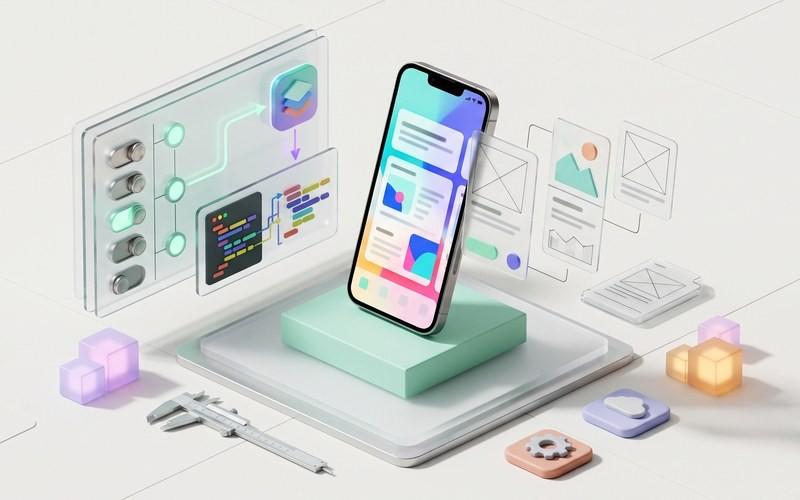
Determining a realistic mobile app development cost requires looking past generic hourly averages to evaluate engineering scope, architectural complexity, and lifecycle maintenance. Whether an organization builds a cross-platform minimum viable product or dual native applications, total expenditure is shaped primarily by platform architecture, third-party backend integrations, security requirements, and ongoing store compliance.
This technical guide provides an engineering-backed financial blueprint to evaluate native versus cross-platform stacks, structure milestone budgets, and account for critical operational overhead across iOS and Android.
Why Do Initial Mobile App Development Cost Estimates Rarely Hold Up?
Initial project estimates frequently fail when stakeholders rely on generic blended hourly rates rather than precise architectural requirements. Estimating custom mobile app development cost by simply multiplying projected developer hours against regional averages overlooks critical system variables: asynchronous data synchronization pipelines, authentication complexity, and target hardware fragmentation. These surface-level calculations mistakenly treat software engineering as interchangeable labor rather than an evolving distributed system.
Furthermore, early architectural shortcuts create compounding technical debt that destabilizes baseline financial planning. Skipping rigorous domain modeling, neglecting decoupled API contracts, or choosing an unsuitable client framework to meet premature milestones inevitably forces extensive structural refactoring during late-stage QA. Disciplined mobile application development budgeting instead treats software as an integrated lifecycle asset, accounting for edge-case failure modes, backend throughput constraints, and automated regression testing before committing development capital.
A resilient budget therefore starts with a realistic evaluation of the underlying technical stack and codebase maintenance model.
Native vs. Cross-Platform App Cost: How Does Tech Stack Choice Impact Budget?
Choosing between dual native engineering and a unified multiplatform framework represents the most consequential architectural decision affecting long-term capital allocation and engineering velocity.
Dual Native Builds (Swift & Kotlin): The Reality of Maintaining Separate Codebases
Maintaining dedicated native codebases—writing Swift for iOS and Kotlin for Android—fundamentally doubles frontend engineering commitments. Each operating system requires distinct repository management, platform-specific build pipelines, isolated UI hierarchies, and separate automated test suites. When evaluating total native vs cross-platform app cost, organizations must account for implementing every UI component, state machine, and business logic branch twice. However, native architecture completely eliminates runtime abstraction layers, offering direct access to platform hardware, low-latency background execution, and immediate support for newly released OS capabilities without third-party wrapper lag.
Cross-Platform Frameworks (Flutter & React Native): Upfront Efficiency vs. Edge-Case Complexity
Cross-platform frameworks consolidate client logic into a unified repository, establishing attractive baseline cross platform mobile development pricing for data-driven business applications. Engineering teams share core business logic, API networking layers, and interface components across iOS and Android from a single code tree. Technical complexity emerges when applications require low-level device access, proprietary hardware protocols, or specialized Bluetooth peripherals. As documented in official Flutter platform channel specifications, communicating between client code and native host platform APIs requires custom messaging channels, binary serialization, and platform-specific implementations. When extensive native interoperability is necessary, bridging maintenance and third-party plugin upkeep can gradually diminish initial codebase efficiencies. Consequently, teams building complex audio engines, intensive computational graphics, or continuous background sensors often find that dual native engineering provides lower architectural risk despite higher upfront investment.
What Does a Realistic Mobile Application Development Budgeting Breakdown Include?
A dependable engineering budget separates development capital into explicit architectural milestones rather than relying on ungrounded hourly estimates. Structuring financial plans around technical deliverables ensures full transparency across initial discovery, core system engineering, and production hardening.
Phase 1: Architecture, Product Design, and Scope Definition
Early technical discovery defines the operational and architectural boundaries of the entire software build. This phase encompasses technical architecture design, database schema modeling, client-side state management strategy, and interactive UI/UX prototyping. Product designers structure interfaces around platform conventions—such as Human Interface Guidelines for iOS and Material Design for Android—to ensure native usability and minimize interface friction. Establishing explicit data contracts, OpenAPI specifications, and edge-case handling rules before writing application code prevents costly structural revisions later in the development lifecycle. Clear architectural scoping also defines third-party service dependencies, preventing unexpected subscription overhead during runtime. Engaging experienced engineering oversight through structured mobile app development services aligns technical constraints with core business objectives during discovery.
Phase 2: Core Engineering, UI Implementation, and API Integration
The largest allocation within custom mobile app development cost covers client-side interface construction, business logic implementation, and backend orchestration. Engineers build modular presentation layers, configure secure authentication flows, establish encrypted local caching, and integrate network services with resilience against transient network latency. Furthermore, integrating third-party software development kits (SDKs)—such as analytics engines, geolocation tracking, and real-time socket connections—requires meticulous background thread management to prevent frame drops and UI freezes.
Equally critical to realistic mobile application development budgeting is allocating dedicated capacity for QA release assurance and physical device testing. Simulators and emulators alone cannot replicate real-world operating conditions, memory constraints, or hardware-specific quirks. Dedicated testing cycles must validate builds across fragmented screen resolutions, diverse chipset architectures, thermal throttling thresholds, and varied OS permission models. Conducting automated regression testing alongside manual physical device testing isolates memory leaks, battery consumption spikes, and edge-case exceptions. Automating build pipelines through continuous integration ensures that every pull request triggers lint checks, unit tests, and compilation across target platform variants before merging into production branches. Addressing these stabilization factors during core engineering guarantees production stability and avoids expensive emergency patching prior to store submission.
What Is the Real Cost to Build an Enterprise Mobile App vs. a Lean MVP?
The disparity in budget between an early-stage release and an organizational platform stems from system scale, security baselines, and integration depth. Evaluating the true cost to build an enterprise mobile app against a focused minimum viable product requires distinguishing between validating market demand and supporting mission-critical enterprise workflows.
Scoping Startup MVPs: Prioritising Core Workflows Over Redundant Features
For emerging products and startup initiatives, capital discipline depends on aggressive feature prioritization. A lean MVP concentrates exclusively on core value delivery—validating primary user workflows, transaction funnels, or messaging loops—while deferring non-essential secondary features like multi-tenant dashboards or complex configuration panels. Leveraging structured SaaS MVP development frameworks allows teams to deploy a functional, hardened product to market quickly without premature engineering overhead. Keeping the client surface area compact minimizes the initial custom mobile app development cost while generating authentic user metrics to guide future capital allocation. Early focus on a clean architectural core ensures that when the product achieves product-market fit, engineers can scale features without discarding the codebase.
Enterprise Systems: Multi-Role Permissions, ERP/CRM Sync, and Offline Data Integrity
In contrast, enterprise mobile applications must satisfy stringent operational, regulatory, and architectural criteria that significantly expand engineering scope. These systems require complex Role-Based Access Control (RBAC) models, Single Sign-On (SSO) integrations via SAML or OpenID Connect, and bi-directional synchronization with back-office ERP and CRM platforms such as SAP, Salesforce, or custom business databases.
Furthermore, enterprise deployments frequently operate in volatile field environments requiring sophisticated offline data integrity. Engineers must build conflict-resolution algorithms (such as Last-Write-Wins or Operational Transformation), transactional SQLite local storage, and background delta-sync workers to prevent data corruption during intermittent network drops. Beyond synchronization, enterprise security mandates end-to-end data encryption at rest and in transit (using AES-256 and TLS 1.3 certificate pinning), comprehensive audit logging, mobile device management (MDM) compatibility, and adherence to strict regulatory standards such as SOC 2, HIPAA, or GDPR. Additionally, enterprise deployments demand dedicated staging environments, penetration testing audits, and disaster recovery runbooks. These infrastructure safeguards ensure business continuity and protect sensitive organizational records against zero-day vulnerabilities.
What Hidden Infrastructure and Mobile App Maintenance Costs Should You Expect?
Deploying an application to production represents only the beginning of software ownership. Long-term operational budgets must account for non-negotiable platform overhead and recurring infrastructure, which directly influence total mobile app maintenance costs over the product lifecycle.
App Store and Google Play Review Guidelines, Compliance, and Signing Overhead
Maintaining active commercial listings requires adherence to strict developer terms and ongoing cryptographic signing procedures. According to official Google Play Console documentation, distributing Android software requires a US$25 one-time registration fee along with verified developer identity checks and closed testing requirements for personal accounts. Similarly, publishing to the iOS ecosystem requires enrollment in the Apple Developer Program at $99 per year, as outlined in Apple's developer account documentation.
Beyond account fees, engineering teams face recurrent overhead managing certificate signing requests, provisioning profiles, privacy nutrition labels, and app store review guidelines. Major annual operating system updates regularly deprecate core APIs, requiring proactive refactoring, dependency updates, and regression testing to maintain store compliance and avoid unexpected delisting.
Cloud Infrastructure, Database Scaling, and Push Notification Gateways
Client applications rely heavily on resilient cloud backends to deliver live services. Serverless compute, relational databases, cache clusters, and file storage scale dynamically with user concurrency, impacting the ongoing mobile app development cost footprint. Furthermore, reliable message delivery requires maintaining high-throughput push notification gateways—such as Firebase Cloud Messaging (FCM) and Apple Push Notification service (APNs)—with proper payload handling, background wake-ups, and token invalidation queues. Sustained application health demands continuous monitoring, automated security patching of third-party libraries, and scheduled database optimization to prevent degraded performance under production loads.
How Does Modern AI Acceleration Change Custom Mobile App Development Cost?
Modern development workflows increasingly integrate AI coding agents to optimize baseline custom mobile app development cost. By compressing initial engineering cycles, teams streamline exploratory prototyping and boilerplate construction while keeping engineering standards high.
Where AI Coding Harnesses Speed Up Scaffolding, Unit Tests, and Repetitive Logic
In structured mobile projects, AI coding agents and harnesses like Antigravity accelerate repetitive engineering tasks. They rapidly generate data models, construct boilerplate client scaffolding, mock REST endpoints, and draft comprehensive unit test suites. This automation shortens feedback loops during early UI iteration and routine component layout. By streamlining predictable code paths, teams lower the friction of initial builds, which positively influences cross platform mobile development pricing during early discovery and feature staging.
Where Automated Generation Breaks Down: Security Vulnerabilities, Payment Flows, and Scale
Despite rapid generation speeds, automated coding cannot replace disciplined systems architecture. AI-generated code frequently introduces subtle architectural flaws: insecure token handling, unvalidated deep-link parameters, improper payment gateway error handling, and unoptimized memory usage that degrades under load. Critical workflows—including PCI-compliant in-app purchases, bi-directional background synchronization, and enterprise cryptographic key management—demand rigorous manual scrutiny.
At Canvas Developers, experienced engineers, QA specialists, and system architects direct all AI coding agents, enforce strict code reviews, and retain final release authority. Whether deploying through Private/Local AI Engineering environments or managed commercial harnesses, human verification ensures every production build remains secure, scalable, and fully maintainable.
How Should You Plan and Scope Your Mobile Engineering Roadmap?
Transitioning from speculative estimates to milestone-based scoping is essential for predictable mobile application development budgeting. Rather than committing capital against open-ended hourly projections, engineering teams should structure delivery around concrete verification stages: technical architecture discovery, MVP core feature rollout, API integration hardening, and store compliance testing. This phased cadence controls scope creep, mitigates technical risk, and ensures every software module meets production standards before deployment.
Ultimately, a sustainable mobile app development cost reflects your target architecture, security requirements, and operational maintenance overhead. Whether evaluating cross-platform framework efficiency or investing in dedicated dual native platforms, early architectural alignment prevents expensive downstream refactoring. Canvas Developers collaborates with founders and technical leaders to define clear engineering milestones, manage risks, and deliver resilient software. You can initiate a scoped technical assessment detailing your current stack, workflow constraints, and target outcomes through the contact form at Canvas Developers.