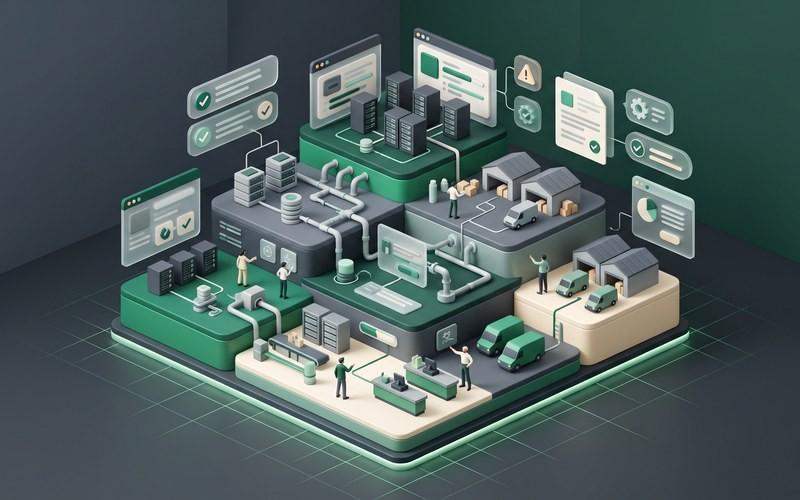
Selecting the right underlying platform between Shopify and WooCommerce is one of the most consequential technical decisions an e-commerce engineering leader or founder will make. While both platforms power high-volume commerce, they represent fundamentally divergent philosophies: a multi-tenant, fully managed Software-as-a-Service (SaaS) ecosystem versus an open-source, self-hosted relational application framework.
A successful approach to Shopify & WooCommerce development requires evaluating total cost of ownership, database scalability, checkout customisation boundaries, and engineering maintenance overhead. Understanding these architectural trade-offs upfront prevents compounding technical debt, ensures transactional reliability during peak traffic, and aligns your platform choice with your engineering team's long-term operational capabilities.
Why Platform Architecture Directly Dictates E-Commerce Growth and Tech Debt
The architectural foundation of an e-commerce store directly governs feature velocity, operational overhead, and transaction resilience under sustained traffic. When brands evaluate WooCommerce vs Shopify for scaling brands, the decision hinges on a central architectural trade-off: absolute code and data autonomy balanced against the operational burden of infrastructure management.
Early-stage development decisions often prioritize initial time-to-market over operational durability. Choosing an open-source framework provides unlimited flexibility to modify core behaviour, but it shifts infrastructure provisioning, security compliance, and database indexing directly onto internal engineering teams. Conversely, selecting a managed SaaS environment delegates infrastructure reliability and checkout security to a hosted provider, trading granular backend execution control for standardized scalability and predictable operational uptime.
As catalog complexity and transaction volumes scale, architectural mismatches compound into engineering friction. Teams either struggle against the functional constraints of closed APIs or spend disproportionate development cycles debugging database deadlocks and third-party plugin regressions. Disciplined Shopify & WooCommerce development requires technical founders and engineering leaders to assess these systemic overheads before committing resources, ensuring that the technology stack matches organizational capabilities rather than short-term convenience.
SaaS vs. Self-Hosted: Comparing Storefront Architecture and Checkout Control
When selecting a core platform, engineering teams must evaluate how each system handles rendering, state management, and transactional processing. The choice between a managed multi-tenant SaaS and a self-hosted modular framework shapes your ongoing development velocity and system boundaries.
Shopify Core: Liquid Templating, Managed Scalability, and Checkout Constraints
Shopify encapsulates the presentation tier within its Liquid template engine, combined with managed edge caching and global CDN distribution. This architectural abstraction removes server administration and automated scaling concerns during sudden traffic spikes. However, this operational convenience introduces rigid boundaries. Standard Shopify configurations restrict checkout customization to predefined theme settings, while advanced transactional customization requires enterprise licensing and Checkout Extensibility (utilizing UI components and WebAssembly-based Shopify Functions). For organizations evaluating custom Shopify vs WooCommerce development, these guardrails ensure strict checkout security and reliable payment processing, but they enforce platform constraints that prevent arbitrary backend code execution during order finalization.
WooCommerce on WordPress: Relational Databases, Custom Hooks, and Data Autonomy
WooCommerce operates within the WordPress open-source runtime, executing PHP logic directly against a self-hosted relational database. Historically bound to the generic WordPress post tables, modern WooCommerce architectures leverage High-Performance Order Storage (HPOS), which isolates order transactions into dedicated database tables (_wc_orders, _wc_order_addresses, and operational metadata) to decouple order processing from content queries. Through WordPress action and filter hooks, developers obtain complete data sovereignty and can alter any aspect of cart calculation, order routing, or checkout logic. This level of extensibility makes Shopify & WooCommerce development in WooCommerce ideal for complex custom workflows, provided the engineering team possesses the discipline to maintain database indexes, object caches, and runtime security.
Total Cost of Ownership: Development, Hosting Infrastructure, and Maintenance
Calculating the true Shopify & WooCommerce development cost requires looking far beyond initial theme implementation or custom development fees. Engineering leadership must account for ongoing infrastructure overhead, third-party software licensing, routine maintenance cycles, and compliance obligations across the lifecycle of the store.
App Licensing Fees vs. Dedicated Server and DevOps Costs
In a Shopify ecosystem, infrastructure management is bundled into recurring platform subscriptions, but functional expansion relies heavily on third-party SaaS applications. Adding complex subscription billing, custom bundle logic, advanced filtering, or wholesale portals typically introduces multiple monthly software subscriptions. Over time, recurring application licensing costs accumulate, creating an ongoing operational expense alongside transaction processing fees. Conversely, WooCommerce incurs negligible licensing costs for core functionality, but high-transaction stores require dedicated cloud infrastructure. Operating scalable WooCommerce deployments requires production-grade virtual private clouds, managed Redis or Memcached clusters, relational database read replicas, and containerized deployment pipelines. Engineering organizations must budget for dedicated DevOps engineering hours or specialized managed hosting providers to orchestrate auto-scaling and ensure uptime during demand spikes.
Security Patching, PCI Compliance, and Database Optimization
Operational maintenance profiles diverge sharply when addressing platform security and data integrity. In custom Shopify vs WooCommerce development, Shopify serves as a Level 1 PCI-DSS compliant service provider, absorbing the liability and engineering effort required to secure payment handling, server operating systems, and core network boundaries. In contrast, self-hosted WooCommerce architectures place PCI compliance obligations, web application firewall (WAF) configuration, and security patch governance directly on the store operator. Development retainers for high-transaction WooCommerce stores must continuously allocate engineering resources toward weekly plugin audits, staging environment regressions, database indexing, and query profiling. When forecasting development retainers across high-transaction environments, Shopify retainers tend to focus primarily on conversion rate optimization and feature releases, whereas WooCommerce retainers divide engineering capacity between feature delivery and defensive infrastructure maintenance.
Headless E-Commerce: When to Decouple the Front-End for Maximum Performance
As digital storefronts demand sub-second page transitions, dynamic personalization, and omni-channel distribution, decoupling the presentation layer from backend business logic has become a dominant architectural pattern. Exploring headless Shopify and WooCommerce development allows engineering teams to optimize rendering pipelines while retaining reliable transactional backends.
Shopify Storefront API vs. WooCommerce REST and GraphQL Interfaces
Decoupled architectures depend fundamentally on API throughput, payload structure, and rate-limiting governance. According to official Shopify API limits documentation, the Shopify Storefront API operates differently from administrative endpoints: standard buyer traffic is not constrained by strict request-count rate limits, utilizing IP-based throttling and token buckets primarily to mitigate automated scrapers and bot traffic. However, mutations and array inputs enforce an input ceiling of 250 items, with object pagination capped at 25,000 entities. In contrast, headless WooCommerce setups rely either on the native WordPress REST API or community GraphQL implementations such as WPGraphQL. Because WooCommerce runs on self-hosted infrastructure, API rate limits are entirely determined by your edge reverse proxy, caching layers, and database concurrency. While this removes third-party API ceilings, unoptimized GraphQL resolvers can easily overwhelm self-hosted database servers with recursive relational queries.
Evaluating Next.js and Modern Front-End Frameworks for Decoupled Stores
Building a decoupled storefront using modern frameworks like Next.js, Nuxt, or Hydrogen enables Incremental Static Regeneration (ISR), React Server Components, and optimized edge delivery. For technical decision-makers evaluating WooCommerce vs Shopify for scaling brands, going headless introduces substantial architectural complexity. A decoupled frontend requires independent continuous integration and deployment (CI/CD) pipelines, edge caching orchestration, real-time inventory synchronization, and custom session handling for carts and authentication. Headless commerce delivers superior Lighthouse scores and presentation freedom, but teams must weigh these benefits against the operational overhead of maintaining two separate distributed software environments.
Migrating from WooCommerce to Shopify: Architectural Risks and Data Integrity
When high-growth brands encounter database concurrency bottlenecks or rising DevOps maintenance overhead, migrating from WooCommerce to Shopify frequently becomes an architectural priority. However, transitioning between an open-source relational database and a closed SaaS ecosystem introduces significant data integrity and search visibility risks.
Safeguarding Order History, Customer Records, and Custom Meta Fields
Extracting historical records from WordPress requires precise schema normalization. WooCommerce stores customer details, order lines, and transaction states across relational tables—either classic posts and postmeta or dedicated High-Performance Order Storage tables. Transferring this dataset into Shopify requires mapping complex relational attributes and serialized records into structured Shopify Metafields. Furthermore, because cryptographic password hashes cannot be directly transferred from WordPress to Shopify's proprietary authentication system, engineering teams must deploy automated customer invite workflows rather than direct credential migrations. A specialized Shopify and WooCommerce development agency implements resilient extract-transform-load (ETL) pipelines with dry-run verification steps to validate historical order totals, currency values, and customer IDs before production cutover.
Preserving SEO Rankings Through Comprehensive 301 Redirect Mapping
Replatforming inevitably alters URL structures. While WooCommerce supports flexible, deeply nested permalink hierarchies (such as /shop/%category%/%postname%/), Shopify strictly enforces standardized URL routing patterns (/products/product-handle and /collections/collection-handle). Unmapped endpoints immediately trigger HTTP 404 errors, causing rapid erosion of accumulated search authority. Engineering teams must conduct comprehensive crawl audits across all legacy products, category archives, blog posts, and taxonomy pages to generate deterministic 1:1 301 redirect mappings. Verifying canonical headers and submitting updated XML sitemaps ensures search engines index the new platform structure while minimizing search visibility volatility during the transition period.
Engineering Governance: What AI Acceleration Delivers vs. What Engineers Must Audit
Modern software engineering workflows increasingly integrate AI coding assistants to shorten feedback loops and accelerate implementation cycles. In custom Shopify vs WooCommerce development, leveraging AI-assisted scaffolding provides tangible velocity advantages when managed with rigorous technical discipline.
Where AI Tooling Speeds Delivery: Component Scaffolding and Repetitive Logic
AI coding agents and modern development harnesses excel at automating structural, repetitive programming tasks. In Shopify storefronts, automated tooling rapidly generates Liquid section schemas, responsive UI components, and mock product feeds. In headless architectures, AI accelerates boilerplate GraphQL queries, Next.js page layouts, and TypeScript interfaces. For WooCommerce builds, automated models quickly scaffold custom post types, register admin setting fields, and draft standard unit tests. By handling predictable implementation patterns, AI tooling reduces manual boilerplate overhead and accelerates early prototyping phases.
Where Automation Fails: Payment Pipelines, Concurrency, and Security Hardening
Despite significant productivity gains, automated code generation creates severe risks when applied to mission-critical commerce systems without human verification. AI tools frequently mishandle transactional race conditions during inventory reservations, misconfigure webhook idempotency keys, or overlook database sanitization vulnerabilities in custom SQL queries. At Canvas Developers, an experienced Shopify and WooCommerce development agency, AI coding tools accelerate implementation while senior engineers maintain total architecture ownership. Every pull request undergoes manual code reviews, security audits, and strict integration testing before production releases. Whether deploying via Private / Local AI Engineering in isolated environments or commercial Claude Code / OpenAI Codex workflows, experienced human developers retain ultimate authority over release decisions and financial logic.
Choosing Your Platform Path: Technical Due Diligence and Next Steps
Selecting between Shopify and WooCommerce is an architectural commitment that must align with your team's operational capabilities, data governance requirements, and scaling trajectory. CTOs and technical founders should evaluate four core criteria:
- Infrastructure Ownership: Choose Shopify for managed edge reliability, automated PCI compliance, and zero server maintenance; choose WooCommerce for relational database autonomy and self-hosted data sovereignty.
- Customization Boundaries: Choose WooCommerce if checkout workflows require bespoke database hooks or complex business rules; choose Shopify if standardized Checkout Extensibility satisfies your operational requirements.
- Operational Overhead: Compare cumulative SaaS third-party app licensing fees against dedicated DevOps engineering retainers required to maintain self-hosted cloud infrastructure.
- Presentation Architecture: Evaluate whether dynamic omni-channel requirements justify the operational complexity of a headless frontend, or if a monolithic architecture delivers faster velocity.
Partnering with an experienced Shopify and WooCommerce development agency ensures your architecture scales smoothly. To evaluate your stack or begin custom Shopify & WooCommerce development, initiate an architectural scoping assessment via the Canvas Developers contact form.