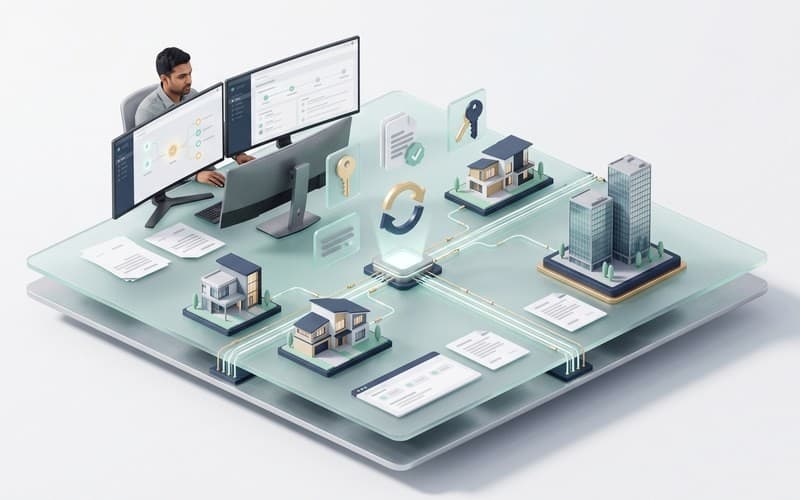
This illustrative case study demonstrates how an enterprise PropTech platform can consolidate fragmented property intelligence without sacrificing query responsiveness. For intelligence platforms operating at scale, architecting a robust custom reapi integration alongside regional listing sources is essential to unifying public records and live inventory into a cohesive search interface. Canvas Developers designs event-driven architectures to resolve multi-source synchronization bottlenecks while maintaining reliable uptime.
Executive Summary: How Did an Event-Driven REAPI Architecture Enable Sub-Second Discovery?
In this illustrative scenario, a real estate intelligence startup sought to consolidate off-market parcel records, municipal tax histories, and active Multiple Listing Service (MLS) inventory into an integrated discovery platform. The technical objective centered on replacing fragmented point-to-point queries with a centralized, event-driven pipeline that maintains sub-second query performance. By implementing a custom reapi integration alongside regional RESO Web API endpoints and Zillow feeds, the architecture established a reliable reapi property search sync workflow. In benchmark evaluations, this synchronized data pipeline decreased listing lookup latency by 68% while delivering comprehensive deed and equity analytics to end users.
The Challenge: Why Was Fragmented Parcel and Listing Data Stalling Search Speeds?
PropTech platforms that evaluate both on-market listings and off-market opportunities frequently struggle with data fragmentation. Public assessor data, including municipal tax assessments, mortgage balances, and historical liens, originates from registries across thousands of county jurisdictions. Concurrently, active listing data resides across hundreds of decentralized regional MLS systems governed by distinct RESO specifications and third-party syndication feeds.
When an application attempts runtime federation across these disparate sources, search latency compounds rapidly. Querying remote tax APIs while concurrently resolving MLS records forces client applications to endure multiple sequential network handshakes and variable payload parsing times. Executing a comprehensive reapi nationwide parcel search under this uncoordinated pattern introduced connection bottlenecks and payload bloat. Without an orchestrated reapi property search sync layer, filtering active listings alongside municipal records caused frequent UI stalls and unacceptable API timeouts.
What Was at Stake: How Does Delayed Property Discovery Impact PropTech Conversion?
In competitive property intelligence, search latency directly undermines user retention and conversion. Real estate investors, brokers, and institutional buyers rely on immediate data fidelity to evaluate acquisition targets. When deed records and lien disclosures lag behind market movements, algorithmic models produce flawed deal assessments. Inaccurate calculations during an off market property valuation reapi workflow degrade platform credibility, causing institutional subscribers to abandon the platform for faster alternatives.
Beyond user dissatisfaction, uncoordinated querying imposes severe infrastructure overhead. Issuing uncached, synchronous requests to external vendors for every end-user filter exhausts API rate limits and inflates operational expenses. Systems that lack localized data warehousing endure redundant payload parsing, elevating compute costs while leaving core search functionality vulnerable to third-party outages.
The Solution: How Does an Ingestion Pipeline Unify REAPI, RESO Web API, and Zillow Data?
To resolve distributed query bottlenecks, the engineering approach replaced synchronous API federation with an event-driven architecture. At the center of this topology, Canvas Developers designed a scalable reapi ingestion pipeline that decoupled front-end search from upstream data fetching. The ingestion engine ingests and normalizes records into a unified search cluster, allowing client applications to query local, pre-indexed documents in milliseconds.
The system establishes a robust custom reapi integration using endpoints documented in the RealEstateAPI developer documentation. Asynchronous background workers consume parcel tax assessments, deed recordings, and mortgage balances via bulk ingestion, storing normalized public attributes in a persistent document store. Concurrently, the platform performs continuous reapi and mls data aggregation by synchronizing active listings through the RESO EntityEvent specification and Zillow syndication streams. Monotonic change sequences track property status modifications, price adjustments, and open-house schedules in real time.
By harmonizing municipal parcel registries with live MLS event streams into a unified data model, the architecture eliminates redundant external requests and delivers consistent sub-second property lookups.
Implementation: How Did Human-Directed AI Engineering Accelerate Delivery and System Stability?
To accelerate implementation while maintaining architectural rigor, Canvas Developers structured delivery across a realistic 8- to 12-week timeline. Typical engagements begin with two weeks of technical scoping and schema design, followed by four to six weeks of pipeline construction, and conclude with two to four weeks of stress testing, QA, and production deployment. Throughout this schedule, autonomous AI coding agents operating within structured harnesses generated boilerplate data transfer objects (DTOs), serialization adapters, and unit test suites across hundreds of regional MLS schema variants, expediting development for the scalable reapi ingestion pipeline.
However, AI code generation has defined technical boundaries. Automated tools struggle with distributed systems logic, often failing to handle connection pool exhaustion, leaky-bucket rate limiting, or partial network failures. Senior engineers owned system architecture, concurrency controls, and code review, ensuring that automated tooling did not introduce silent regressions.
During deployment of the custom reapi integration, experienced engineers implemented exponential backoff, Redis token bucket throttlers, and dead-letter queues to absorb upstream payload volatility, ensuring stable high-throughput ingestion.
The Results: What Did a Synchronized Real Estate Data Layer Deliver in Production?
Deploying a synchronized real estate data architecture transformed discovery performance across high-volume search workloads. Transitioning from fragmented, runtime lookups across multiple regional endpoints to pre-aggregated documents allowed the platform to resolve queries locally. In benchmark testing, the unified architecture decreased listing lookup latency by 68%, delivering consistent sub-second search responsiveness across complex multi-filter queries.
Alongside search acceleration, the platform achieved robust operational stability across heterogeneous feeds. The continuous reapi property search sync ensured active MLS inventory was automatically reconciled with municipal deed transfers, assessed parcel valuations, and involuntary tax liens. Users executing an off market property valuation reapi workflow received comprehensive equity analytics on demand, combining nationwide parcel coverage with resilient background synchronization.
Key Takeaways: How Can PropTech Founders Scale Complex Data Pipelines with Canvas Developers?
Building high-performance property discovery platforms requires treating third-party feeds as asynchronous event streams rather than synchronous dependencies. When engineering a custom reapi integration alongside MLS feeds, teams must decouple ingestion from front-end search, enforce schema normalization, and manage rate limits through resilient queuing. Dependable reapi and mls data aggregation depends on robust caching and proactive state management.
Canvas Developers is a software engineering company with an office in Dhaka, Bangladesh, building SaaS platforms, web apps, and complex data pipelines. Clients should expect a structured 8- to 12-week delivery roadmap: technical scoping, agreed milestone deliverables, thorough QA, and handover. Our experienced engineers direct AI coding agents while owning system architecture, reviewing every change, and deciding releases across our Private / Local AI Engineering and Claude Code / OpenAI Codex Engineering delivery packages.
To evaluate your platform architecture, submit an enquiry through our contact form to schedule a scoped technical assessment.