The problem
When developers, reviewers, and operations engineers provision on-demand staging or preview environments, procedural friction and unhandled parameter errors frequently delay release cycles. Exposing environment creation capabilities introduces acute cloud security risks if administrative credentials reach client-facing browsers. Additionally, mid-flight network interruptions during multi-step provisioning operations risk leaving orphaned cloud resources or duplicate deployments.
Approach
Canvas Developers models the workflow around a core release task record traversing an entry screen, task detail view, and confirmation screen. The architecture decouples diagnostic usability instrumentation into an isolated telemetry layer routed to an analytical datastore away from transactional provisioning queues. Backend orchestration workers execute with least-privilege cloud credentials in isolated subnets and utilize client-generated idempotency keys with automated compensation sagas to guarantee resilient recovery.
Outcome
The architecture ensures that an interrupted submission resumes smoothly without duplicate records or lost user input. Role-based log sanitization and strict environment boundaries preserve corporate cloud compliance while providing interface clarity for usability evaluators.
Establishing an effective Usability Testing self-service environment setup requires engineering teams to balance intuitive user interfaces with rigorous cloud infrastructure boundaries. When developers, reviewers, and operations engineers provision on-demand staging or preview environments, procedural friction and unhandled input errors frequently delay release cycles. In this architectural walkthrough, Canvas Developers outlines how decoupling diagnostic usability instrumentation from transactional provisioning engines creates predictable release task workflows, enforces least-privilege security policies, and guarantees idempotent state recovery.
Why Integrate Usability Testing into Self-Service Environment Setup Workflows?
Mapping Roles and the Release Task Lifecycle Across Entry and Confirmation Screens
In modern engineering organizations, self-service platforms falter when internal interfaces ignore the differing operational responsibilities of participating stakeholders. A robust Usability Testing self-service environment setup balances three primary roles: developers requesting ephemeral preview instances, reviewers evaluating functional changes, and operations engineers governing cloud quotas. Without role-aligned interfaces, parameter mistakes compound into stalled release pipelines.
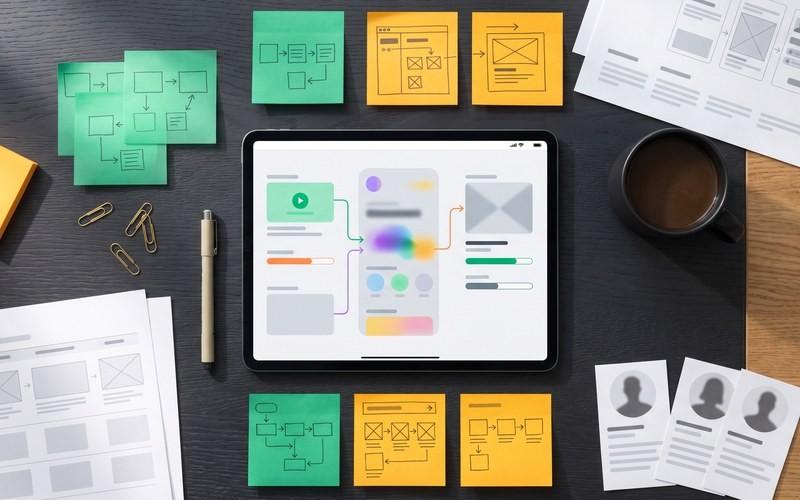
Our approach models the lifecycle around a core release task record traversing three clear interfaces: an entry screen capturing branch parameters and service seeds, a task detail view displaying progress telemetry and peer approvals, and a confirmation screen returning verified endpoints. Conducting structured evaluations via user testing protocols pinpoints friction across these screen transitions before automated provisioning initiates.
Separating Usability Testing Tooling from Automated Provisioning Engines
A common misstep during self-service environment setup development is coupling usability instrumentation directly with transactional orchestration engines. Diagnostic telemetry and feedback widgets are vital for assessing interface ergonomics, but they must remain outside the critical provisioning path.
As documented in research by the Nielsen Norman Group on task success metrics, tracking completion rates provides a fundamental baseline for identifying user friction, as task completion represents the bottom-line metric of usability. In our architecture, client instrumentation runs within an isolated telemetry layer. Interaction events stream asynchronously to an analytical sink, ensuring monitoring tools never block transactional worker queues or expose infrastructure control planes.
What Security Constraints and Failure Paths Govern Self-Service Release Tasks?
Enforcing Least-Privilege Credentials and Strict Environment Boundaries
Exposing environment creation capabilities to developers and non-technical reviewers introduces acute cloud security risks if administrative credentials reach client-facing browsers. Our architecture maintains isolated environment boundary validation by enforcing complete credential isolation at the orchestration layer. The client application authenticates against an internal gateway using standard scoped JSON Web Tokens that grant permission only to create, inspect, or terminate personal release tasks.
Backend orchestration workers execute within isolated subnets, obtaining short-lived, least-privilege cloud credentials via ephemeral role assumption. These workers cannot access production data stores, shared virtual private clouds, or billing management consoles. Network boundary controls mandate that dynamically generated preview clusters reside inside disposable virtual networks with strict ingress firewall rules, ensuring preview workloads cannot bridge into core corporate infrastructure.
Designing Resilient Rollbacks and Idempotent Resumption for Interrupted Requests
Cloud provisioning involves multi-step distributed operations—allocating compute containers, binding DNS hostnames, and mounting sanitised data volumes. When network interruptions, container quota limits, or client drops occur mid-flight, conventional scripts often leave orphaned cloud resources or duplicate deployments. Implementing idempotent environment provisioning directly mitigates these distributed failure modes through deterministic state tracking.
Every release task is assigned a client-generated idempotency key at the entry screen. If a network failure interrupts communication during cluster bootstrapping, re-submitting the request causes the orchestration engine to inspect the current state table rather than provisioning duplicate assets. If an unrecoverable provisioning error arises—such as a VPC peering failure—the orchestration worker initiates an automated compensation saga. This rollback routine safely de-allocates allocated compute, releases reserved IP allocations, and marks the release task state as failed with diagnostic telemetry accessible in the task detail screen.
How Does Request Validation and State Persistence Flow Through the System Architecture?
Tracing the Data Path from Entry Screen Input to Persisted Release Task State
Understanding how user selections translate into cloud infrastructure requires tracing a concrete transactional request. In our release task workflow architecture, data moves sequentially through schema validation, transactional persistence, and asynchronous task dispatching:
- Input Capture and Client Validation: On the entry screen, the developer inputs target repository branches, required microservice profiles, and synthetic dataset toggles. A local schema validator verifies field syntax, ensuring memory sizing limits and branch naming patterns conform to policy before payload dispatch.
- API Gateway and Security Ingestion: The payload arrives at the API gateway alongside a unique client-generated idempotency key and user bearer token. The gateway authenticates user permissions and validates the request against strict server-side JSON schemas.
- Transactional Persistence: The gateway writes a new
release_taskentity to the relational database inside an ACID transaction. The record stores parameters, idempotency token, user metadata, and an initial status ofPENDING_VALIDATION. - Asynchronous Message Publishing: Upon successful database commit, the API layer publishes an event to an internal message broker. An immediate acknowledgment containing the task identifier returns to the browser, transitioning the user interface to the task detail view.
Decoupling User Testing Instrumentation from Core Infrastructure APIs
A resilient Usability Testing integration demands complete architectural isolation between feedback collection tools and infrastructure control planes. User experience instrumentation captures mouse tracking, interface dwell time, step confusion, and subjective ratings. Streaming these payloads through operational databases creates unacceptable contention and elevates security attack surfaces.
Our architecture routes UI telemetry through a dedicated edge endpoint terminating at an analytical datastore. The telemetry payload contains session IDs and anonymized interaction paths, completely stripped of infrastructure credentials, API tokens, or server identifiers. Conversely, the provisioning workers communicate exclusively with transactional message queues and container orchestrators. This separation ensures that even if a third-party evaluation SDK encounters network outages or client script failures, core release task orchestration continues without interruption.
Which Acceptance Criteria and Architectural Tradeoffs Validate the Setup?
Verifying Idempotency and State Recovery Under Mid-Flight Network Interruptions
A dependable self-service platform requires comprehensive acceptance testing to verify fault tolerance during unpredictable network failures. When implementing idempotent environment provisioning, the primary acceptance requirement mandates that an interrupted form submission must resume smoothly without duplicating infrastructure resources or losing user input.
During acceptance test suites, automated chaos harnesses simulate network drops at three critical junctures:
- Pre-Persistence Drop: The browser disconnects after input entry but before the API gateway commits the record. The client caches form state locally, allowing the user to refresh and resubmit without data re-entry.
- In-Flight Handshake Drop: The database commits the
release_taskrecord, but the client disconnects before receiving the acknowledgment response. Upon reconnection, submitting the identical idempotency key detects the existing record and routes the user directly to the task detail screen. - Worker Orchestration Drop: A worker restarts during container allocation. The task scheduler reconciles cluster state against the database, resuming provisioning at the exact checkpoint rather than spinning up parallel virtual instances.
Balancing User Feedback Granularity Against Infrastructure Security Boundaries
During Usability Testing development, engineering teams must evaluate a fundamental trade-off: providing granular feedback to guide evaluators versus enforcing strict zero-trust boundary isolation. Exposing detailed container orchestration logs directly to preview reviewers improves contextual debugging, but it risks leaking internal subnet IPs, service mesh endpoints, and configuration secrets.
Our approach resolves this tension through role-based log sanitization and aggregated status states. Reviewers and evaluators receive high-level lifecycle badges (such as Allocating Resources, Running Database Seeds, and Environment Ready). Detailed container build logs remain restricted to operations engineers behind privileged role checks. This boundary preserves interface clarity during usability evaluations while maintaining corporate cloud compliance.
How Does Canvas Developers Deliver This Setup Through Vibe Coding and Engineering Review?
Accelerating UI and Scaffolding with AI Coding Tools Under Rigorous Engineering Oversight
At Canvas Developers, our software engineering teams leverage advanced AI harnesses and coding agents to accelerate interface scaffolding, form validation logic, and component state management. In complex workflows like Usability Testing vibe coding, AI generation rapidly produces initial UI wireframes for entry and confirmation screens, draft schema validators, and mock event emitters.
However, AI-generated code frequently falls short on security boundaries, race conditions, distributed state synchronization, and idempotency guarantees. Our model pairs automated generation with strict human oversight: experienced engineers direct architecture, conduct meticulous code reviews, and verify distributed state machines before code enters deployment pipelines. AI tools speed up repetitive drafting, but senior engineers enforce credential boundaries, concurrency locks, and database transaction integrity.
Scoping Your Environment Provisioning and Usability Testing Architecture
Organizations aiming to reduce deployment bottlenecks and improve internal tooling ergonomics benefit from structured technical scoping. When architecting Usability Testing development workflows, simpler projects may require only lightweight container templates and pre-commit review hooks, whereas multi-tenant enterprise platforms demand full asynchronous queueing and automated rollback sagas.
Canvas Developers offers two flexible AI delivery models tailored to your security posture: 'Private / Local AI Engineering' utilizing privately hosted open-weight models within your controlled infrastructure, and 'Claude Code / OpenAI Codex Engineering' leveraging commercial AI tools under client-approved security configurations. Each engagement begins with technical scoping, followed by agreed milestones, rigorous acceptance testing, and seamless handover. To discuss your current stack, workflow constraints, and deployment targets, request a scoped technical assessment via our contact form.