Enterprise automation workflows frequently encounter operational friction when generative models yield borderline predictions on mission-critical data. Implementing an AI app rescue low-confidence answer review architecture establishes a resilient boundary between automated generation and downstream system mutations. By isolating borderline predictions into structured tasks, organizations maintain operational continuity while giving specialists full visibility into model uncertainty before taking consequential actions.
What is low-confidence answer review and which roles depend on it?
A low-confidence answer review workflow intercepts automated agent outputs whose probabilistic certainty falls below governed thresholds or exhibits data ambiguity before committing downstream transactions. Rather than stalling background processing pipelines or allowing unverified data to reach production records, the system transitions uncertain operations into a discrete reviewable AI task exception handling state.
Three primary organizational roles depend on this operational boundary:
- Knowledge workers: Subject-matter specialists who evaluate operational context, inspect source citations, and verify whether suggested answers satisfy business requirements.
- Reviewers: Dedicated personnel who assess flagged exceptions against compliance criteria, adjust field-level values, and provide formal human sign-off before consequential mutations take effect.
- Workspace administrators: Operations leads who govern escalation rules, configure confidence thresholds across model versions, and audit operator throughput and error distribution.
As documented in Microsoft Learn's architectural guidance on confidence-based escalation workflows, effective oversight combines statistical confidence with business impact assessment and ambiguity detection. In our approach to an AI app rescue low-confidence answer review build, the core record is maintained as an isolated reviewable entity. Source access, model uncertainty scores, and operator approvals remain visible at every checkpoint, ensuring that no consequential external action occurs without explicit human authorization.
How do the core screens, review states, and interaction drawers function?
Exception inbox and record comparison screen hierarchy
The presentation layer organizes review workflows through a clear operational hierarchy designed for rapid triage. Built with component frameworks like React and Next.js, the exception inbox serves as the central operational hub, aggregating flagged reviewable AI tasks by SLA urgency, calibrated score thresholds, and policy exceptions. The inbox handles state transitions predictably: skeleton loaders indicate active background ingestion, a structured empty state confirms cleared backlogs, and non-blocking banner alerts signal upstream API latency or network degradation.
Selecting an entry activates the record comparison screen. This view presents a structured dual-pane layout contrasting raw input queries and retrieved evidence passages against the candidate model output. During low-confidence answer review development, our engineers structure this hierarchy so disputed tokens, low-probability extractions, and policy triggers are visually highlighted against baseline schema rules, giving operators immediate context without inspecting backend JSON logs.
Resolution drawer, confidence indicators, and error boundaries
Direct intervention takes place within the resolution drawer, an accessible slide-over panel built on headless UI primitives that keeps the reviewer grounded in the active queue. The drawer provides editable form controls for value overrides, direct reference links to primary source documents, and explicit approval or rejection triggers. Prominent confidence badges display calibrated certainty ratings alongside risk tiers, guaranteeing that model uncertainty remains fully visible before any consequential downstream update is authorized.
During AI app rescue development at Canvas Developers, our engineers wrap each review panel and interactive drawer in granular React error boundaries. If an unhandled token sequence or corrupted payload fails during diff rendering, the boundary catches the failure locally. The surrounding inbox remains fully responsive, displaying a fallback diagnostic card that allows operators to reassign or quarantine the specific record without disrupting ongoing queue triage.
How does data move from exception capture to isolated, replayable correction?
Tracing flagged tasks through visible source citation and human sign-off
Tracing an exception begins when an asynchronous ingestion worker built on FastAPI or Node.js evaluates a model response against threshold criteria. If the calibrated confidence falls below the acceptance cutoff or an ambiguity rule triggers, the orchestrator halts autonomous execution. Instead of discarding transient state, the pipeline encapsulates the input prompt, retrieved context chunks, and raw model output into an immutable reviewable AI task record in PostgreSQL.
Within the review interface, source citations are linked directly to primary originating documents, ensuring evidence remains visible alongside inferred fields. A reviewer inspects the provenance, corrects misaligned data, and records an auditable approval signature. Consequential operations, such as external database writes or ERP synchronization webhooks, remain gated until this verified human sign-off is committed.
Decoupled state management and single-record replay architecture
A frequent failure mode in early prototypes is state coupling, where reprocessing an exception risks re-executing an entire ingestion batch. In our AI app rescue integration architecture, state management is decoupled using unique idempotency keys and partitioned transactional outbox tables in PostgreSQL backed by Redis queues. This ensures an operator can resolve one failed record without replaying unrelated successful records.
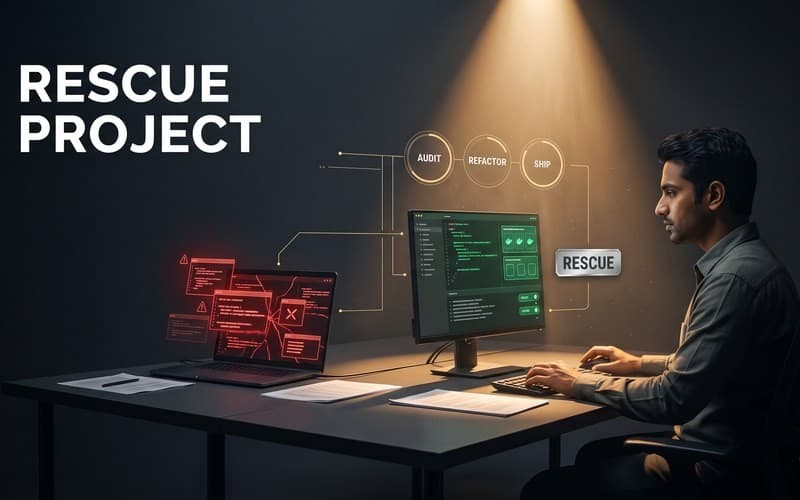
When initial scaffolding originates from rapid prototyping or AI app rescue vibe coding sessions, Canvas Developers engineers refactor the pipeline to enforce strict isolation. Unsupported or experimental capabilities are separated into dedicated worker modules. Once an operator commits a correction in the resolution drawer, an isolated event triggers only the specific downstream mutation, fulfilling core acceptance criteria while preserving audit integrity.
How do engineers verify acceptance and harden AI-scaffolded rescue code?
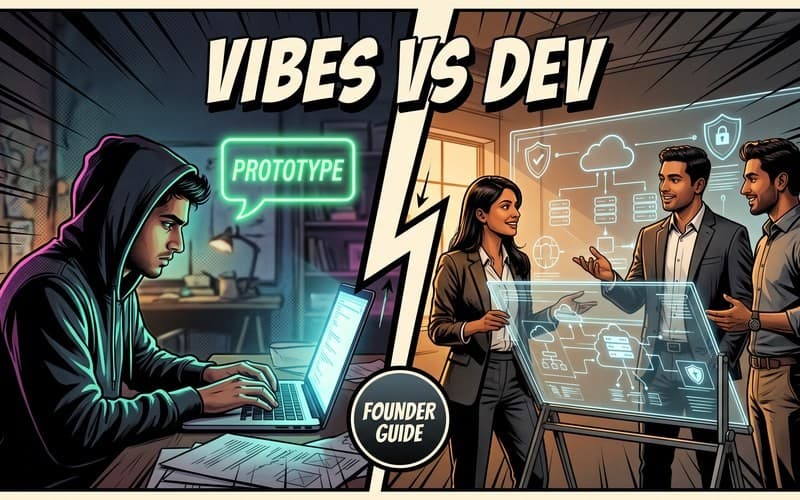
AI-assisted coding harnesses and vibe-coding workflows accelerate the initial scaffolding of review interfaces, schema definitions, and exception queues. During rapid AI app rescue vibe coding sprints, developers can generate interactive drawer components, comparison diff views, and state transitions in hours rather than weeks. This automated scaffolding tightens feedback loops, enabling teams to evaluate interface usability and queue dynamics before committing full engineering resources.
However, production reliability requires rigorous human engineering oversight. In our AI app rescue development process, experienced engineers take ownership of the underlying architecture, security models, and release decisions. Engineering review enforces strict acceptance tests across the workflow:
- Single-record replay validation: Verifying that reprocessing an isolated review task never triggers side effects or re-executes adjacent queue items.
- Access control enforcement: Ensuring role-based permissions prevent unauthorized overrides or unrecorded approvals.
- Payload integrity checks: Validating schema contracts and sanitizing model outputs before external webhooks or database writes execute.
While AI scaffolding can reduce initial rework and shorten delivery iterations, sustained stability depends on disciplined engineering teams hardening data pipelines, concurrency limits, and transactional safety.
How do you scope a low-confidence review rescue project?
Scoping an AI app rescue low-confidence answer review build depends on task consequence and transaction volume. For low-stakes workflows, built-in model thresholds or basic logging queues often suffice. Custom review architectures become necessary when autonomous actions trigger irreversible database updates or regulatory exposure.
A robust AI app rescue integration starts with a clear assessment of your tech stack, uncertainty triggers, and reviewer capacity. To discuss your workflow constraints, architecture, and deployment options—whether via Private / Local AI Engineering or commercial tooling—submit your project details through the Canvas Developers contact form or explore our AI app rescue services for a scoped technical evaluation.
Outcome
Operators can resolve individual failed records without replaying unrelated successful records, ensuring consequential mutations occur only after explicit human authorization. Disciplined engineering review and single-record replay validation harden AI-scaffolded components to reduce rework and shorten feedback loops while preserving audit integrity.