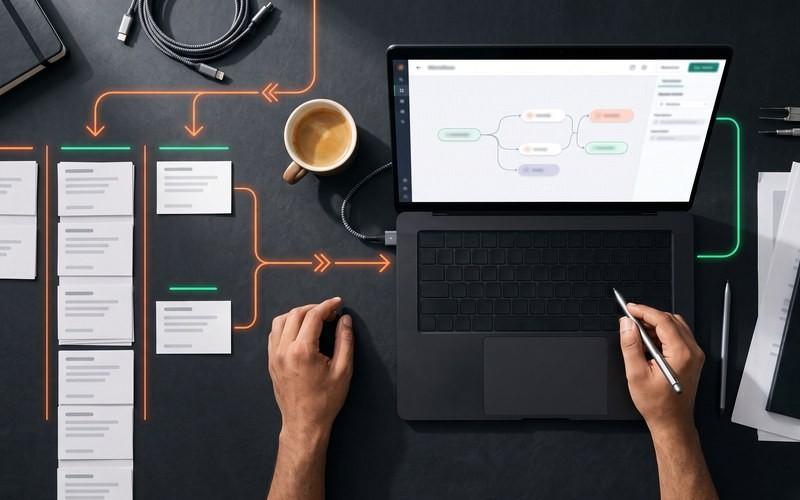
Operational teams managing heavy inbound documentation require reliable intake interfaces that prevent unverified AI actions. An AI Chatbots & Assistants document intake and review workspace couples automated document parsing with explicit human supervision. By organizing unstructured files into a centralized operations queue, teams triage extractions, flag ambiguity, and verify business records before committing permanent data updates. Canvas Developers designs these review workspaces to unify intelligent extraction with strict human oversight.
What Does an AI Document Intake and Review Workspace Do?
Modern operational workflows often ingest diverse unstructured documents—ranging from vendor invoices and onboarding packets to compliance affidavits. An effective system for AI Chatbots & Assistants document intake and review transforms these disparate inputs into a disciplined operations stream. Rather than executing uninspected end-to-end automations, the architecture anchors every incoming document around a core entity: the reviewable AI task. This persistent record tracks original document blobs, structured metadata extractions, and model confidence flags before any downstream record mutation occurs.
During enterprise document intake and review development, engineering teams must isolate operational permissions across distinct user personas. Knowledge workers monitor ingestion feeds, review initial parsing outputs, and resolve manual exceptions. Secondary reviewers audit complex or low-confidence records that exceed predefined risk thresholds, ensuring that ambiguous extractions receive validation. Meanwhile, workspace administrators manage parsing templates, define routing guardrails, and audit model execution metrics across teams. Structuring these boundaries directly within the review environment prevents silent schema drift and eliminates unverified writes to production databases. At Canvas Developers, our engineering approach pairs AI-driven parsing with deterministic operational controls, establishing transparency before any downstream sync takes place.
How Are the Work Queue, Assignment Detail, and Activity Timeline Structured?
Work Queue and Assignment Detail for Knowledge Workers and Reviewers
The operational interface organizes incoming records through three coordinated views: the work queue, the assignment detail screen, and the activity timeline. In the work queue, knowledge workers triage inbound records categorized by document category, urgency level, and ingestion channel. Each entry displays ingestion timestamps, source file formats, and extraction progress, preventing unassigned documents from stalling. When an operator selects an item, the assignment detail screen renders the original source document alongside parsed structured data fields. Specialized input fields feature confidence badges next to extracted line items, vendor entities, and totals, allowing reviewers to verify values instantly. In practical AI Chatbots & Assistants development, linking extracted fields directly to source document coordinates ensures that operators verify context without navigating away from the review pane. Role-based view permissions guarantee that sensitive personal or financial documents remain restricted to authorized personnel.
Activity Timeline, Source Uncertainty, and Actionable Error States
The activity timeline records an immutable event log covering ingestion, automated parsing passes, validation checks, and reviewer modifications. When extraction models encounter ambiguous handwriting, low contrast, or incomplete schemas, the timeline displays explicit uncertainty indicators rather than defaulting to silent assumptions. Consequential operations remain suspended until an authorized reviewer inspects and approves the pending payload, preventing premature updates to business systems. Furthermore, when external services encounter rate limits or payload failures, the interface exposes actionable error states equipped with diagnostic codes and idempotent retry actions. This robust AI Chatbots & Assistants integration ensures that operators maintain continuous oversight across source access, model uncertainty, and state transitions before final approval.
How Does the Intake Data Flow from Ingestion to Visible Completion?
Tracing Queued Events Through Assignment and Idempotent State Changes
In our event-driven architecture, inbound documents trigger an ingestion event that assigns a unique idempotency key to each file payload. The event queues asynchronously, registering the document in an unassigned state before worker assignment. As the parsing worker processes the document, extraction pipelines populate structured draft tables while keeping source document access and field-level uncertainty scores fully visible. Because upstream network calls can experience transient disruptions, the event handling pipeline enforces idempotent execution. If an event is retried, database unique constraints and transactional state guards guarantee that business state updates occur exactly once. When parsing encounters unrecoverable structural anomalies, the pipeline transitions the task to an actionable failure state rather than dropping the message silently.
Balancing Local Open-Weight Infrastructure Against Commercial AI Tools
Deploying an enterprise AI Chatbots & Assistants integration requires choosing the right model hosting paradigm. Canvas Developers structures delivery across two core deployment packages. For organizations handling sensitive compliance records or strict sovereignty mandates, our Private / Local AI Engineering package deploys open-weight models within client-controlled infrastructure or agreed isolated environments. For teams prioritizing rapid iteration and reasoning capabilities, our Claude Code / OpenAI Codex Engineering package utilizes commercial AI tools under client-approved cloud configurations. While managed retrieval services handle document indexing—such as the vector store capabilities documented in the Azure OpenAI Assistants file search guide—transactional database writes and human approvals remain in dedicated backend services. This separation ensures that document intake and review development maintains operational integrity regardless of the underlying inference provider.
How Are Vibe-Coded Scaffolding and Idempotent Acceptance Handled?
Modern engineering workflows leverage AI coding harnesses and agentic generation to scaffold UI components, queue routing logic, and data schemas rapidly. In practice, executing AI Chatbots & Assistants vibe coding allows teams to prototype queue interfaces and review layouts quickly, significantly shortening initial feedback loops. However, unguided model generation frequently introduces fragile error handling or speculative data mutations. At Canvas Developers, experienced engineers direct the scaffolding process, establish the core system architecture, and conduct rigorous code reviews before anything reaches staging or production.
To transition fast scaffolding into hardened software, production-grade AI Chatbots & Assistants development enforces strict acceptance checks. For this document intake workflow, our engineering validation focuses on three mandatory guardrails:
- Idempotency verification: Retried ingestion events execute business mutations exactly once.
- Source traceability: Every parsed field maps directly to document coordinates and model confidence scores.
- Actionable exception paths: Parsing timeouts or schema anomalies surface clear error states for operators.
While automated scaffolding accelerates layout construction, critical data validation, security, and schema maintenance remain human engineering responsibilities. Furthermore, when intake schemas are uniform and fixed, standard deterministic parsers often provide a simpler, more cost-effective alternative to generative models.
How Should You Scope a Document Intake Assistant with Canvas Developers?
Planning tailored AI Chatbots & Assistants development for operational workflows begins by defining document boundaries, exception volumes, and audit requirements. Canvas Developers structures every engagement around upfront technical scoping, transparent milestone deliverables, rigorous peer reviews, and comprehensive acceptance testing before final handover. Whether an organization selects our Private / Local AI Engineering package for strict data sovereignty or commercial cloud models, our experienced engineers govern the architecture to safeguard data privacy, prevent hallucinated writes, and maintain schema integrity.
To plan an enterprise AI Chatbots & Assistants document intake and review workflow aligned with your operational goals, connect with our team through our contact form or explore our AI chatbot services. We invite prospective partners to share their current software stack, ingestion bottlenecks, and compliance constraints to initiate a concrete architectural assessment.