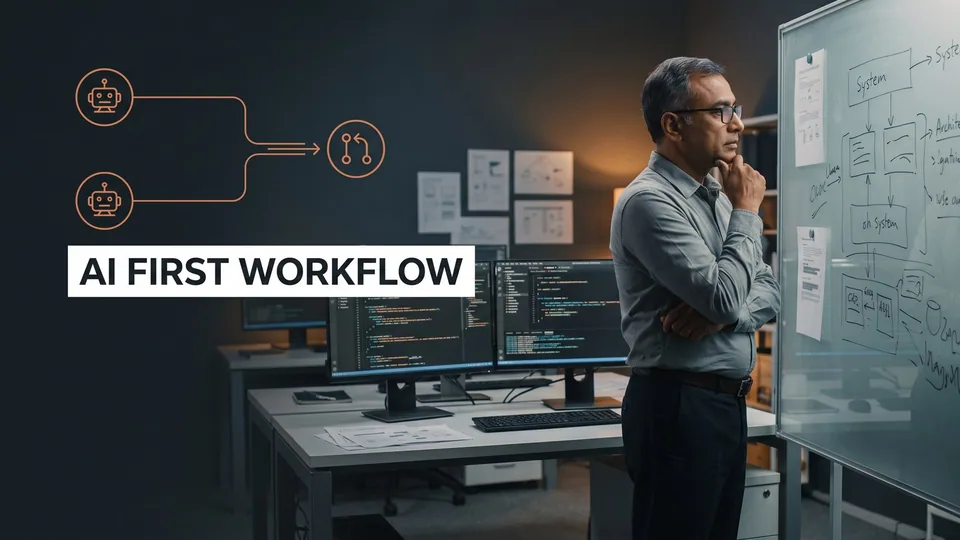
Adopting an AI first engineering workflow allows software engineering teams to accelerate code generation, routine test scaffolding, and boilerplate implementation across production sprints. However, raw velocity introduces severe risks when automated outputs bypass rigorous architectural scrutiny.
While autonomous coding agents generate functional code at high speed, sustainable delivery still demands strict human ownership. Senior software engineers must govern system design, enforce automated verification gates, and review every pull request before deployment to safeguard production reliability, data integrity, and long-term maintainability.
Why Are AI Coding Agents Causing Bottlenecks in Production Sprints?
The PR Deluge: When Agent Generation Outpaces Human Code Review
Autonomous tools generate complex routines in seconds, yet overall delivery stalls when pull request queues overwhelm senior staff. Successfully integrating AI coding agents into production sprints requires recognizing that generation speed does not equal finished work. When agents flood repositories with unconstrained multi-file pull requests, engineering teams face severe review fatigue. Reviewers either spend hours untangling sprawling diffs or risk rubber-stamping changes, shifting the bottleneck directly from code authoring to human verification.
The Illusion of Velocity: Unvetted Boilerplate vs. Long-Term Maintainability
Apparent speed gains quickly evaporate when engineering organizations confuse raw code volume with genuine progress. Unvetted agent boilerplate frequently introduces hidden technical debt, including redundant dependencies, brittle abstractions, and subtle regressions across existing services. Sustainable delivery depends on managing AI developer velocity through strict scope constraints and automated test gates. Technical leaders must ensure senior engineers evaluate architectural coherence and maintainability before any synthetic code merges into the main branch.
What Is an AI First Engineering Workflow and Why Does It Require Human Ownership?
Defining the AI-First Paradigm: Speeding Up Scaffolding Without Abdicating Architecture
An effective AI first engineering workflow fundamentally restructures how software engineering organizations run delivery cycles. Rather than expecting autonomous agents to invent system topologies, engineering leaders deploy coding assistants as rapid implementation accelerators for boilerplate code, database schema migrations, and initial test suites. This approach dramatically shortens cycle times on routine development tasks while keeping foundational system design firmly rooted in proven architectural patterns.
When engineering teams delegate core system boundaries to generative models, codebases quickly fracture into disparate services with incompatible abstractions and brittle dependencies. True velocity stems from structural clarity, not raw volume of generated syntax. Modern development teams must establish unambiguous domain boundaries where autonomous agents operate within strictly defined service interfaces, schemas, and architectural guardrails dictated by human technical leads.
Why Senior Engineers Must Retain Full System Design and Release Authority
A realistic CTO AI workflow guide establishes that autonomous generation cannot replace veteran technical judgment. While agents synthesize routine utility functions and draft test suites, experienced software engineers must preserve absolute ownership of system architecture, data models, and production release pipelines. Senior engineers possess contextual understanding of operational trade-offs, concurrency hazards, and business logic requirements that synthetic models cannot infer from isolated files.
Production stability demands human accountability across every production pull request. Delegating code execution to automated tooling without manual inspection creates unacceptable risks around data consistency, third-party dependencies, and edge-case failures. Retaining final deployment authority guarantees that all software assets meet strict enterprise benchmarks for security, scalability, and maintainability before reaching end users.
How Do You Configure an AI Harness for Engineering Teams?
Structuring Repositories for Commercial and Local Agent Environments
Scaling automated code generation across distributed teams starts with repository structure. Whether deploying privately hosted open-weight models within dedicated client infrastructure or managing production engineering with Claude Code and commercial cloud platforms, repositories require explicit architectural boundaries. High-performing setups isolate domain logic, define strict module interfaces, and maintain clean separation between infrastructure code, core business logic, and test suites.
Clear repository conventions, including standardized configuration manifests, typed interface definitions, and modular component directories, allow coding agents to parse source trees without wasting token context on irrelevant files. When directory trees follow predictable hierarchies, autonomous tools locate target modules quickly and produce targeted, predictable modifications that integrate cleanly into established codebases.
Sandboxing Tool Execution, Credential Access, and File Boundaries
Granting autonomous tools unfettered terminal or filesystem permissions introduces substantial security risks into development pipelines. Modern engineering organizations isolate agent execution environments within ephemeral containers or restricted virtual sandboxes. Strict file boundaries must prevent agents from modifying root configuration files, CI/CD workflows, or deployment manifests without direct engineer authorization.
Credential management requires uncompromising zero-trust controls. Coding agents should never access production database credentials, private API secrets, or unrestricted network endpoints. Providing agents with localized mock environments, synthetic fixtures, and scoped development tokens prevents data exposure and ensures automated processes cannot impact external services or confidential records.
Automating Context Assembly and Test Harness Generation
A purpose-built AI harness for engineering teams delivers the precise technical context required for targeted sprint tasks. Rather than passing entire codebases into context windows, an effective harness parses Abstract Syntax Trees, database schemas, and API contracts to assemble minimal, highly relevant context packages for each user story.
In addition to context retrieval, the harness should automatically generate unit test harnesses and mock dependencies before prompting an agent for implementation code. By establishing deterministic test suites first, engineering teams force agent outputs to satisfy concrete programmatic assertions, confirming that newly generated routines meet interface contracts before submitting changes to peer review.
What Code Review Policies Prevent AI Hallucinations from Reaching Production?
Enforcing Strict Human Audits for Data Models, Migrations, and Security Boundaries
Modern engineering teams must establish strict AI code review policies that mandate senior engineer sign-off on any modifications affecting data persistence or boundary protection. While generative agents can draft schema definitions and migration scripts quickly, they frequently overlook subtle locking behaviors, index bloat, and transactional isolation issues. An unvetted migration can degrade database performance under production query volume or corrupt relational integrity across critical business tables.
Security perimeters require an even higher threshold of manual inspection. Synthetic code often defaults to overly permissive role configurations, misses cross-site request forgery protections, or mishandles input validation in boundary controllers. Seasoned engineers must scrutinize authentication logic, session handling, and role-based access control rules, ensuring every incoming change adheres to defense-in-depth principles before entering deployment staging.
Pre-Review CI Gates: Automated Linting, Static Analysis, and Unit Verification
As outlined in any rigorous CTO AI workflow guide, pull requests generated by AI agents should never reach a human reviewer until they pass exhaustive continuous integration gates. Before senior engineers spend valuable review time inspecting diffs, automated pipelines must verify code formatting, type checking, static security analysis, and test coverage thresholds.
Automated static analysis tools flag common vulnerabilities, such as hardcoded credentials, unsafe query concatenation, and deprecated library methods, without human overhead. If an agent-generated change fails a linting rule, breaks an existing regression test, or introduces untested branches, the continuous integration pipeline immediately rejects the pull request. This automated filtering ensures that senior engineers review only syntactically sound, verified code.
Diff Size Controls: Capping AI PR Volume to Prevent Reviewer Fatigue
Reviewer fatigue represents one of the greatest operational vulnerabilities in an AI-accelerated sprint. When autonomous tools submit sprawling diffs touching dozens of files across multiple layers, reviewers naturally struggle to identify subtle logic errors or performance regressions.
Engineering leaders should establish hard constraints on pull request volume, capping AI submissions at manageable thresholds such as two hundred lines of code or single-feature boundaries. Enforcing atomic pull requests compels agents to solve narrow, well-defined problems. Smaller diffs enable senior reviewers to perform thorough, focused inspections, ensuring that automated generation velocity never degrades production software quality.
Where Does AI Coding Excel and Where Does It Reliably Fail?
High-Yield Tasks: Repetitive Scaffolding, Unit Test Matrices, and API Glue
When integrating AI coding agents into sprint workflows, teams achieve the greatest returns on predictable, repetitive development tasks. Autonomous tools excel at generating standardized boilerplate, mapping data transfer objects, and constructing comprehensive unit test matrices for pure functions. Generating extensive test assertions and mocking external dependencies through automated prompts saves substantial engineering time without compromising system structure.
Similarly, standard API glue represents an ideal target for synthetic code. Agents reliably parse OpenAPI schemas, create data validation layers, and assemble basic webhook listeners. Human engineers can verify these isolated interface components quickly, accelerating routine feature development.
Critical Vulnerabilities: Flawed Payment Logic, Race Conditions, and Broken Auth
Conversely, generative tools fail reliably when managing state transitions, cryptographic operations, or financial transactions. Autonomous agents frequently introduce critical flaws in payment workflows, such as omitting idempotent request headers, neglecting double-entry reconciliation controls, or miscalculating rounding across currencies. Synthetic code may appear functional while quietly introducing catastrophic settlement errors.
Security boundaries present comparable hazards. Coding agents often introduce subtle token validation oversights, permissive cross-origin policies, or flawed session expiration logic. Senior engineers must inspect all authentication logic and financial interfaces to verify compliance with strict security standards.
Handling Scalability: Why Concurrency and State Require Seasoned Engineers
Scaling concurrent systems within an AI first engineering workflow demands seasoned architectural oversight. Generative models struggle with distributed systems challenges, such as database lock contention, distributed cache invalidation, and thread pool exhaustion. They frequently introduce blocking operations within asynchronous event loops or create race conditions in shared state routines.
Experienced engineers must govern database isolation levels, evaluate connection pooling, and design distributed state synchronization. This senior oversight ensures high-throughput services maintain resilience and data consistency under intense production demand.
How Should Engineering Leaders Roll Out AI Workflows Across Sprints?
Auditing Existing Git Workflows to Identify Safe Automation Targets
Rolling out autonomous tooling requires a phased approach across development sprints. Rather than introducing agents into entire repositories simultaneously, engineering managers should audit git commit histories and pull request lifecycles to pinpoint low-risk, repetitive tasks. Routine unit test scaffolding, interface typing, and documentation updates offer ideal starting points for managing AI developer velocity without compromising critical systems.
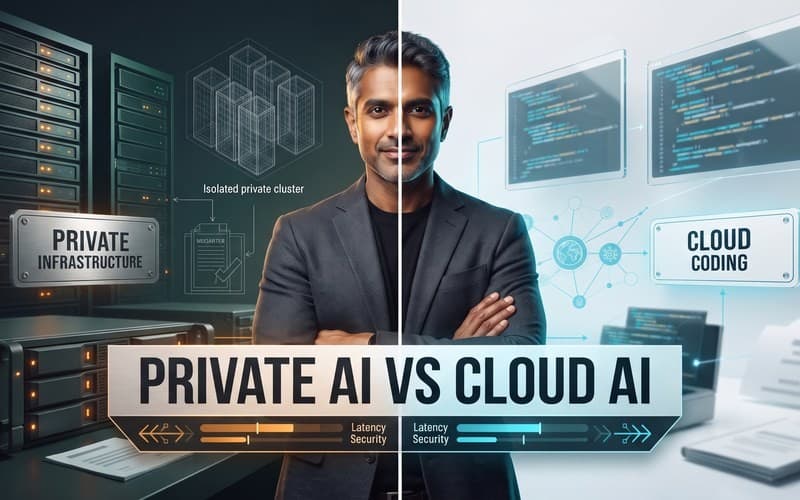
Establishing Private Infrastructure vs. Cloud AI Tooling Protocols
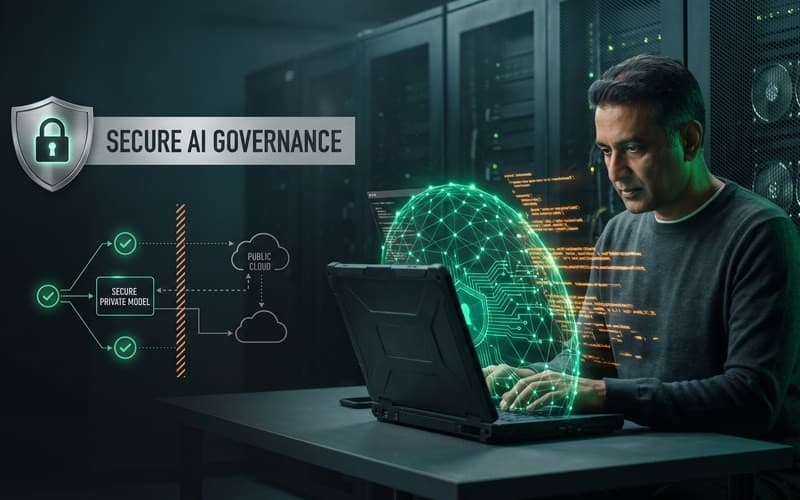
Technical leaders must establish clear governance policies regarding cloud versus on-premise model execution. Organizations operating under strict compliance, proprietary intellectual property protections, or strict data residency mandates frequently require dedicated private cloud infrastructure. Under this model, teams deploy open-weight coding models within client-managed virtual private clouds, isolating source code and proprietary assets from public training corpora.
For organizations utilizing commercial platform providers, leaders must enforce strict data processing agreements and zero-retention policies. Configuring a secure AI harness for engineering environments guarantees that all telemetry, source code snippets, and generated context adhere to organization-wide security boundaries.
Training Engineers to Direct Autonomous Agents and Scrutinize Edge Cases
Transforming a development team into an AI-enabled engineering organization requires retraining engineers from raw code typists to rigorous technical directors and critical reviewers. Engineers must learn to craft unambiguous technical prompts, define deterministic acceptance criteria, and scrutinize synthetic diffs for subtle logic errors, missing edge cases, and architectural drift before issuing approvals.
How Can Technical Leaders Safely Adopt Claude Code and Codex Delivery?
Deploying Dedicated Engineering Delivery with Canvas Developers
Modern engineering teams do not have to navigate the transition to AI-assisted delivery alone. Canvas Developers provides dedicated software engineering services across startup MVPs, SaaS platforms, mobile applications, and enterprise systems, as well as stabilizing and hardening AI-built applications. Through specialized delivery models, including Private or Local AI Engineering on client-controlled infrastructure and commercial production engineering with Claude Code and OpenAI Codex, experienced software engineers, QA specialists, and DevOps architects direct every coding agent, own the underlying architecture, and decide all production releases.
Scheduling a Scoped Architecture and Workflow Assessment via the Contact Form
Adopting autonomous agents requires mature governance, clear architectural boundaries, and strict AI code review policies that protect production systems. Whether your team needs to finish an AI-built product, build new software from scratch, or establish automated engineering guardrails, every engagement starts with structured scoping and agreed milestones. Contact the engineering team through the contact form at https://www.canvasdevelopers.com/contact to schedule an architecture and workflow assessment.