Product leaders under pressure to accelerate software product roadmap delivery increasingly deploy autonomous coding agents across sprint cycles. While automated tooling generates boilerplate code and interface scaffolds at remarkable speed, unmanaged code generation introduces latent technical debt, architectural drift, and security vulnerabilities.
Maintaining product quality requires disciplined human oversight. At Canvas Developers, senior software engineers direct AI coding workflows, taking full ownership of system architecture, security reviews, and release readiness so product teams move faster without sacrificing long-term software stability.
Why Are Product Roadmaps Stalling Despite Faster Sprint Cycles?
The Backlog Compression Dilemma for Modern Product Teams
Engineering organizations frequently discover that writing code faster does not automatically translate into shipped customer value. When engineering teams introduce automated generation tools, pull request volume surges, yet cycle times often stagnate. This disparity exposes the fundamental dilemma of software backlog acceleration: rapid code synthesis merely shifts delivery friction downstream to code review queues, manual regression checks, and staging environment verification.
Where Traditional Sprint Planning Creates Delivery Bottlenecks
Traditional sprint planning assumes predictable ticket estimation, standard developer velocity, and balanced peer review workflows. When generative workflows inject rapid code increments without defined boundaries, sprint ceremonies struggle to keep pace. Team leads and reviewers find themselves inundated with sprawling pull requests containing unverified design choices, making technical verification laborious and degrading sprint predictability.
To sustainably accelerate software product roadmap delivery, product leaders must address these structural handoffs directly. Accelerating initial code creation yields little commercial advantage if production releases remain blocked by testing bottlenecks. Engineering organizations require unified workflows where automated generation operates within clear architectural guardrails, ensuring that accelerated ticket completion translates reliably into production-ready software.
What Does AI Coding Actually Accelerate Across the Feature Lifecycle?
High-Velocity Scaffolding, UI Iteration, and Boilerplate Logic
Autonomous code generation delivers clear advantages when applied to repetitive, well-defined development patterns. When engineering teams direct AI agents to build standard CRUD routes, draft schema definitions, or create presentation components, they significantly speed up engineering velocity. Front-end engineers and designers can rapidly prototype interactive mockups, validate interface flows, and generate client-side state logic in hours rather than days.
For a product leader, this capability shortens the feedback loop between initial wireframes and interactive user validation. Reusable component generation, automated unit test creation, and API contract scaffolding allow product teams to experiment with alternative layout configurations and user interaction designs without consuming weeks of dedicated manual drafting.
Where AI Models Fail: Security, Payment Gateways, and Complex Data Models
Despite impressive generation speed, autonomous models struggle when confronted with mission-critical domain logic and strict enterprise guardrails. Effective product manager AI coding workflows recognize that AI models lack contextual awareness regarding transactional safety, data migration integrity, and distributed systems resilience. When tasked with multi-table relational schema designs or payment gateway webhooks, models frequently produce syntactically valid code that fails subtle concurrency scenarios or introduces race conditions.
Security and compliance vulnerabilities represent an even greater operational hazard. Unsupervised code generation regularly omits granular tenant isolation, mishandles authentication token lifecycles, and overlooks input sanitization across edge cases. Consequently, experienced engineers must scrutinize every data layer mutation and external integration before any AI-generated feature touches staging environments.
How Should Product Managers Direct AI Coding Agents During Sprints?
Structuring Functional Specs for Autonomous Coding Agents
Directing autonomous coding agents requires a fundamental shift in how product managers author user stories and technical specifications. Vague requirements or loosely defined acceptance criteria produce fragmented code implementations that drift from product intent. To enable reliable execution, product managers must structure functional specifications with unambiguous system boundaries, explicit input-output schemas, and comprehensive edge-case declarations.
A resilient specification defines deterministic inputs, error states, and expected performance thresholds before prompting any agent. Additionally, linking each specification to exact interface contracts prevents hallucinated dependencies. When tickets include explicit data models, database relationships, and UI component states, autonomous agents generate targeted code that aligns with existing repositories rather than introducing conflicting architectural patterns.
Integrating AI Feature Delivery into Sprint Planning Rituals
Modern engineering teams adopting AI assisted sprint planning must recalibrate traditional capacity estimation. Instead of sizing tickets solely on manual implementation hours, teams evaluate tasks based on architectural complexity, context window scope, and review effort. Routine UI elements or standard API wrappers can be scoped for rapid delivery, allowing engineering teams to compress standard iteration milestones.
To effectively manage AI development sprints, backlog grooming sessions should categorize backlog items into agent-executable tasks and architect-led initiatives. Structuring sprints in this manner ensures that developers maintain clear oversight over dependencies, preventing uncoordinated pull requests from overwhelming sprint reviews and disrupting release schedules.
Establishing Human-in-the-Loop Boundaries for PR Reviews
Autonomous generation should never bypass rigorous peer review. Engineering organizations must establish explicit guardrails that dictate how generated code moves from local branches to shared repositories. Automated static analysis, linting suites, and test runners serve as the initial validation filter, but senior engineering judgment remains mandatory for merging code.
Senior reviewers evaluate whether new pull requests adhere to domain boundaries, manage memory allocations efficiently, and maintain consistent error handling conventions across the entire application. This human-led verification guarantees that automated speed does not degrade overall software resilience.
Who Owns System Architecture and Release Decisions When AI Writes Code?
Why Senior Engineers Must Direct Architecture and Guardrails
While generative tools construct functions and modules rapidly, they lack holistic comprehension of system topology, distributed state management, and long-term software maintainability. Establishing an effective AI feature delivery roadmap requires senior technical leads to establish foundational domain boundaries, service contracts, and database schema designs before delegating tasks to autonomous agents. When experienced engineering leads establish strict structural guardrails, coding agents operate within validated design patterns, preventing fragmented implementations from destabilizing core system health.
Senior engineers also evaluate dependency health, third-party library licenses, and API deprecation risks that automated models routinely overlook. By supervising interface contracts and schema migrations, human technical leaders maintain architectural consistency across multi-service environments.
Navigating Private Local AI vs Approved Cloud-Based Coding Tooling
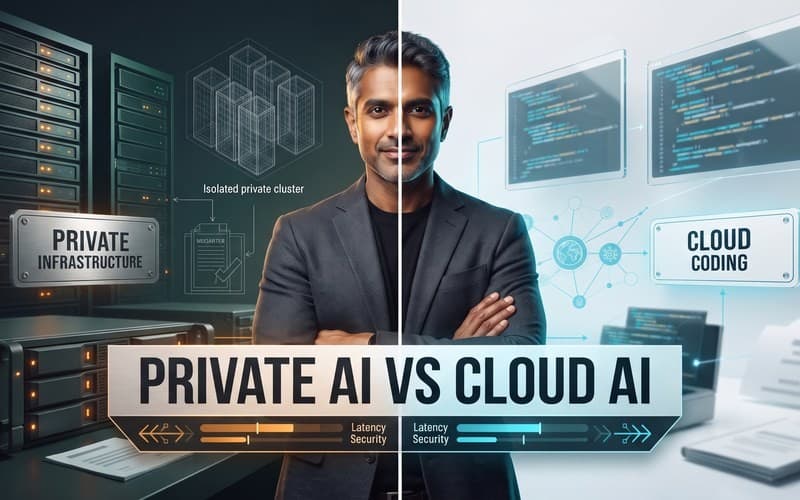
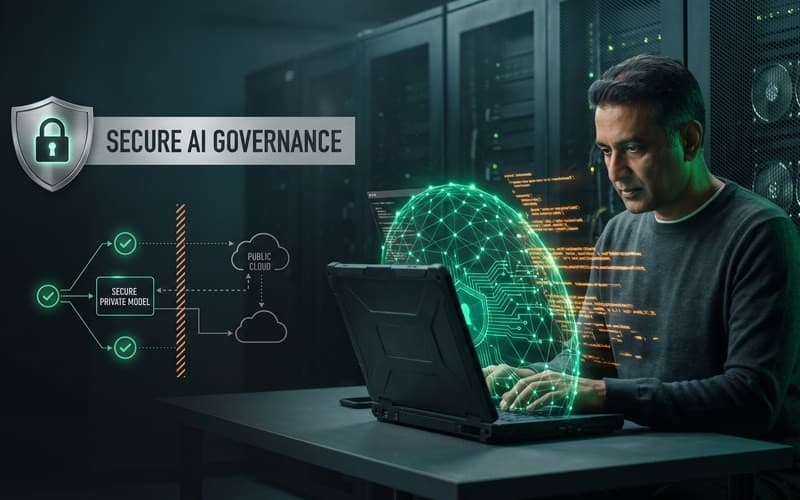
Product teams handling proprietary algorithms, confidential business records, or regulated healthcare and financial data must select their development environments deliberately. Teams requiring strict data residency and governance rely on Private / Local AI Engineering, executing open-weight models directly within client-controlled infrastructure or agreed isolated environments. This architecture guarantees that source code and proprietary IP never leave private security perimeters.
Conversely, teams building standard web applications, consumer portals, or internal administrative tools often utilize Claude Code / OpenAI Codex Engineering environments. These workflows deploy commercial AI tools under approved enterprise configurations to speed up engineering velocity while maintaining clear compliance and privacy controls.
Enforcing QA, DevOps, and Release Assurance Before Production Handover
Generating functional code represents only the initial phase of software delivery. Ensuring release readiness demands thorough quality assurance, automated CI/CD pipeline integration, and infrastructure provisioning. Dedicated QA specialists execute rigorous end-to-end regression tests, validate payment gateway webhooks, and audit authorization logic across complex edge cases.
Simultaneously, DevOps engineers configure resilient deployment pipelines, cloud environments, and real-time observability telemetry. Final production release decisions remain the strict responsibility of experienced engineering leads, ensuring that accelerated generation translates into dependable software in production.
How Does Unchecked AI Generation Compare to Human-Supervised AI Engineering?
Vibe-Coding Vulnerabilities vs Hardened Production Repositories
The emergence of vibe coding enables founders and product teams to assemble functioning application prototypes in record time. However, building an exploratory prototype differs fundamentally from maintaining a hardened production environment. Unchecked AI generation often introduces brittle assumptions, unindexed database queries, inconsistent dependency versions, and absent input sanitization. While the front-end user interface appears polished and responsive, these hidden structural flaws create severe vulnerabilities when subjected to live customer traffic, unexpected edge cases, or malicious payloads.
Human-supervised engineering bridges this gap by integrating generative drafting within disciplined development pipelines. Senior engineers audit every generated component against industry security standards, establish defensive data layers, and implement automated regression test suites. Furthermore, experienced engineering leads evaluate architectural cohesion across microservices, ensuring that database connections and external API calls remain resilient under sustained load, transforming fragile prototypes into hardened, production-grade applications.
Technical Debt Accumulation Across Multi-Sprint Roadmaps
When organizations deploy autonomous coding tools without strict architectural governance, technical debt accumulates rapidly across consecutive iterations. Early gains in development speed quickly diminish as disjointed AI-generated modules clash, producing duplicated business logic, inconsistent state handling, and untraceable side effects. Rather than achieving durable software backlog acceleration, teams find roadmap delivery stalled by mounting maintenance overhead and fragile dependencies.
To sustainably manage AI development sprints, engineering teams must pair rapid code generation with continuous architectural reviews. Human technical leaders enforce clean design patterns, retire obsolete scaffolding, and verify system cohesion before technical debt compromises roadmap execution.
What Are the Essential Rules for Managing AI-Assisted Sprints Safely?
Critical Quality Gates for Data Integrity and Scale
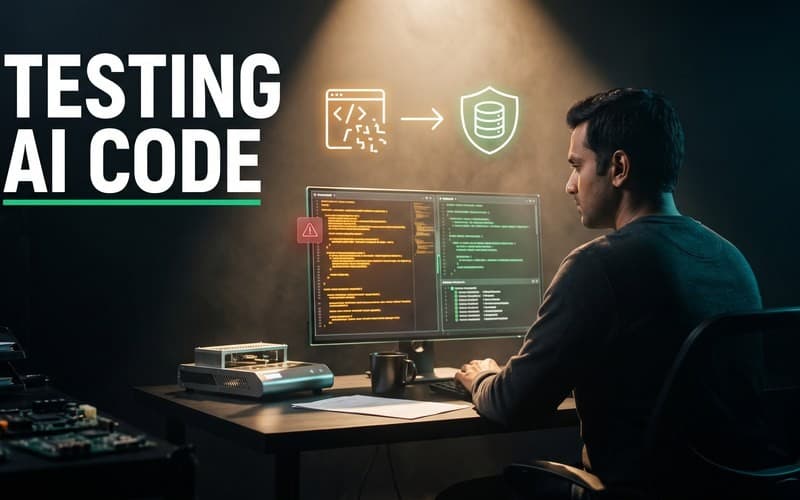
Maintaining high software quality during accelerated sprints requires establishing deterministic quality gates before code reaches deployment branches. Automated testing frameworks must validate schema constraints, transactional rollbacks, and high-volume throughput limits to ensure database stability. Furthermore, engineering teams should mandate comprehensive integration tests for asynchronous background workers, third-party payment gateways, and external service webhooks.
Within disciplined AI assisted sprint planning routines, quality gates must also audit caching strategies, indexing structures, and resource concurrency. Senior architects must establish performance baselines and load testing suites early to identify query bottlenecks before code reaches staging. Verifying that newly generated logic can handle concurrent database read and write cycles prevents performance degradation as active user traffic scales across distributed infrastructure environments.
Common Pitfalls Product Managers Must Avoid with AI Agents
A frequent mistake in modern product manager AI coding initiatives is treating autonomous agents as independent software engineers. When product managers assume that generated pull requests require minimal peer review, critical edge cases and data migration risks slip into production unnoticed. Generative models excel at pattern replication, but they lack awareness of broader organizational compliance, multi-tenant boundaries, and system constraints.
Another common pitfall is overloading user stories with vague, unstructured requirements. Expecting an AI agent to resolve ambiguous business rules inevitably leads to architectural drift, orphaned database records, and redundant logic. Product managers maintain sprint momentum by defining precise input-output contracts, bounding task scopes, and relying on senior engineering leads to inspect and validate all merged code before release.
How Can You Safely Accelerate Your Product Roadmap Today?
Aligning Milestones with Managed AI Engineering Packages
Organizations aiming to accelerate software product roadmap delivery can pair internal product roadmaps with structured development packages. Canvas Developers offers two distinct delivery models tailored to enterprise requirements: Private / Local AI Engineering, which deploys open-weight models within private, client-controlled infrastructure, and Claude Code / OpenAI Codex Engineering, which leverages commercial tooling within client-approved cloud environments.
Under both delivery models, AI coding agents and advanced tooling accelerate design, development, and QA cycles, while experienced software engineers, UI/UX designers, and DevOps specialists direct the architecture, review every pull request, and guarantee release readiness across the entire AI feature delivery roadmap.
Initiating a Scoped Engineering Assessment with Canvas Developers
Whether your organization needs to build a new SaaS platform, stabilize a vibe-coded MVP, or accelerate enterprise feature backlogs, every engagement begins with clear scoping, agreed milestones, and disciplined testing before handover. Based in Dhaka, Canvas Developers builds web applications, mobile apps, business systems, e-commerce platforms, and custom AI features with rigorous engineering oversight.
To evaluate your product backlog and explore human-supervised AI engineering, initiate a scoped engineering assessment through the contact form at https://www.canvasdevelopers.com/contact.