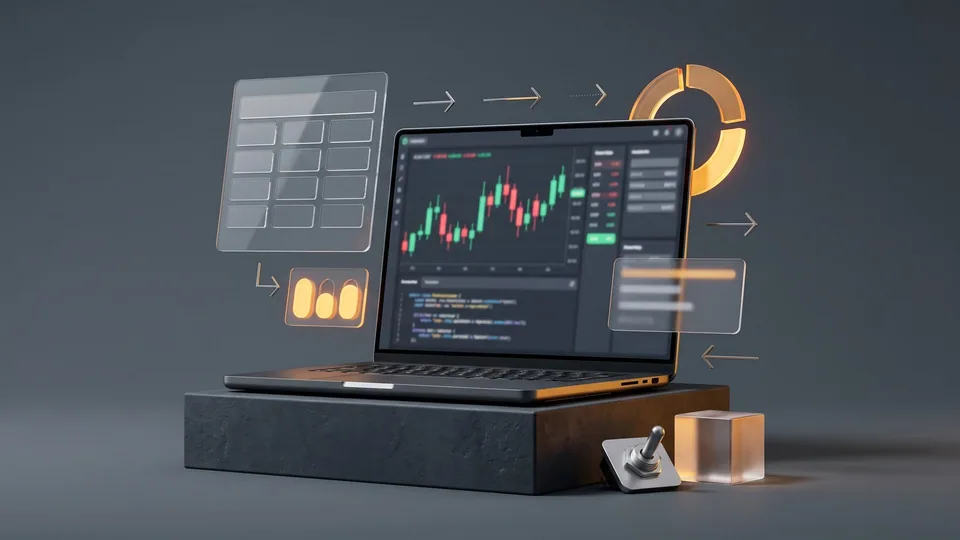
Determining a realistic Pine Script development cost requires evaluating technical scope, execution requirements, and post-delivery maintenance rather than looking for a fixed rate. Script budgets vary significantly depending on whether a project involves basic visual overlays, multi-timeframe analytics, or fully automated webhook strategies connected to third-party brokers.
While modern AI tooling and vibe coding accelerate initial code generation, professional engineering remains essential to eliminate repainting defects, handle runtime limits, and safeguard execution logic. At Canvas Developers, our engineers direct AI-assisted scaffolding to deliver institutional-grade TradingView solutions without sacrificing architectural rigor.
What Drives Pine Script Development Development Cost on TradingView?
Understanding Pine Script development cost begins with breaking down the boundary between simple mathematical calculations and production-grade execution systems. In tradingview indicator development, a script that simply plots moving averages, custom oscillators, or visual support levels carries a minimal engineering footprint. Such projects require only basic arithmetic and standard drawing functions on a single chart timeframe.
In contrast, production-grade tools require significant architecture. When a project demands multi-timeframe security requests, custom historical metrics, or automated order dispatch via external webhooks, engineering effort expands substantially. Key budget drivers separate into five distinct categories:
- Algorithm Complexity: Mathematical state tracking, volatility normalization, and dynamic range filtering.
- Data Pipeline: Managing higher-timeframe data feeds, intrabar precision, and TradingView call quotas.
- External Plumbing: Formatting structured webhook payloads, secret token authorization, and broker delivery semantics.
- Testing and Verification: Eliminating repainting bugs, forward-looking bias, and backtest anomalies.
- Lifecycle Maintenance: Updating deprecated runtime functions across Pine Script version releases.
Founders and trading desks can optimize development spend by clearly defining acceptance criteria upfront, reusing validated component libraries, and deferring non-critical visual decorations during the initial development cycle. Scoping these boundaries accurately ensures transparent budgeting before requesting formal engineering estimates.
Technical Scope Drivers That Dictate TradingView Script Pricing
Script Classification: Visual Indicators Versus Automated Execution Strategies
The foundational distinction governing project scope is whether the deliverable is an indicator() or a strategy(). A visual indicator calculates mathematical transforms—such as custom momentum oscillators, volatility bands, or visual liquidity zones—and renders them onto chart panels or tables. These tools focus primarily on clean rendering and state calculations across historical bars.
Developing a custom pine script strategy introduces substantially higher complexity. Strategies manage simulated trade portfolios, position sizing, order types (market, limit, stop), and execution rules using built-in functions like strategy.entry() and strategy.exit(). Engineers must model slippage, trading commissions, and capital allocation accurately to prevent synthetic backtest performance from diverging from live market behavior. Accounting for tick-level order fills and state transitions requires rigorous verification, increasing the necessary development and QA effort.
Data Architecture: Multi-Timeframe Feeds, Security Calls, and Bar Magnifier
When an indicator or strategy requires data beyond the primary chart context, engineering scope expands. Fetching higher-timeframe trends or cross-asset market correlations relies on request.security() calls. According to official TradingView documentation, scripts are subject to strict platform quotas, including a cap of 40 unique request.*() calls per script under standard plans and a combined limit of 127 tuple elements.
Architecting multi-timeframe feeds requires careful data structures to prevent runtime timeout errors and handle session gaps during non-trading hours. Furthermore, enabling Bar Magnifier features to simulate intrabar order fills requires processing granular intrabar data without exceeding memory limits. Managing these constraints while preventing historical calculation latency represents a core technical scope driver affecting Pine Script development cost.
Execution Plumbing: Webhooks, Payload Formatting, and Broker Limits
Transitioning from visual chart signals to automated execution requires robust outbound communication. Pine Script does not establish direct TCP socket connections; instead, it relies on TradingView alert webhooks to transmit real-time instructions to external webhook listeners, execution bridges, or broker APIs.
Engineers must format dynamic JSON payloads within the alert_message parameter, injecting variables such as contract IDs, exact order sizes, and authentication tokens. The engineering scope must also address payload serialization, delivery semantics, and downstream broker constraints—such as API rate limits and rejection handling during volatile market openings. Establishing structured payload templates and validating message payloads minimizes trade execution errors and ensures stable automated execution.
How Vibe Coding Speeds Pine Script Delivery—and What Engineers Must Harden
Scaffolding Indicator Logic and Syntax Quickly with AI Models
Modern generative AI models and coding assistants have fundamentally transformed routine script writing. In Pine Script Development vibe coding, prompts quickly generate mathematical formulas, standard indicator scaffolding, input panels, and dashboard tables in minutes. Rapid AI-assisted iteration allows developers to experiment with indicator concepts and visual variations without writing repetitive boilerplate syntax by hand.
At Canvas Developers, engineers use AI coding harnesses to compress initial development cycles, rapidly transforming mathematical specifications into functioning draft scripts. However, raw AI generation is merely a scaffolding mechanism. Generative models frequently hallucinate deprecated functions, mishandle series execution mechanics, and struggle with multi-timeframe synchronization. Seasoned engineers must direct the process, owning architectural structure and reviewing every line before testing.
Eliminating Repainting, Lookahead Bias, and Order Drift Flaws
Founders who simply hire a vibe coder for Pine Script Development without dedicated engineering oversight often encounter deceptive visual performance. Unverified AI code frequently introduces repainting bugs, where signals appear on historical bars that could never have occurred in real-time trading. Common culprits include improperly configured higher-timeframe requests and calculations referencing unconfirmed price action.
Experienced software engineers harden the codebase against these fatal flaws by:
- Enforcing strict signal confirmation rules using
barstate.isconfirmedto prevent disappearing alert triggers. - Configuring historical security lookahead flags defensively to eliminate lookahead bias in backtests.
- Audit-testing intrabar order execution to ensure simulated strategy entries do not suffer from unrealistic price fills.
Version Governance: Pine Script v6 Best Practices and Backtest Verification
As documented in the official announcement for the TradingView Pine Script v6 release, modern development benefits from significant architectural upgrades, such as dynamic security requests inside loops and lazy boolean evaluation. Professional engineering ensures legacy code is refactored away from deprecated v4 or v5 patterns into robust v6 syntax.
Furthermore, engineers implement formal backtest verification protocols. They stress-test strategies across varied market regimes, incorporating realistic broker commission models and slippage tolerances to verify that theoretical alpha translates reliably into live execution.
Evaluating Delivery Models: Solo Freelancers vs. Managed Engineering Teams
Single Freelancer Handoffs Versus Structured Code and Architecture Review
Hiring an independent pine script developer on a gig marketplace often appears economical for isolated script requests. However, solo freelancer engagements frequently lack structured quality control, documentation, and continuous maintenance. When an individual contractor delivers unversioned code without systematic regression testing or multi-timeframe validation, trading teams inherit technical debt that surfaces during live market volatility.
In contrast, engaging a managed engineering firm pairs a dedicated Pine Script Development developer with established peer review, architecture governance, and QA release assurance. Experienced engineers verify algorithmic boundaries, stress-test execution logic against synthetic edge cases, and maintain clean repository versioning so the script can adapt as market conditions and TradingView runtime environments evolve.
Protecting Proprietary Trading Alpha: Local AI Versus Cloud AI Environments
For proprietary trading desks, family offices, and quantitative asset managers, protecting intellectual property and execution alpha is paramount. Feeding proprietary mathematical formulas, custom momentum models, or confidential trading rules into public cloud AI interfaces creates genuine compliance and IP leakage concerns.
To eliminate these risks, Canvas Developers provides two distinct engagement packages. Clients handling sensitive trading algorithms can opt for Private / Local AI Engineering, where privately hosted open-weight models operate entirely within client-controlled infrastructure or an agreed isolated environment. For teams prioritizing commercial AI capabilities, our Claude Code / OpenAI Codex Engineering package uses commercial development tooling under strictly client-approved privacy settings. In both models, professional software engineers own the architecture and review every line of code to ensure absolute data confidentiality and operational integrity.
Costly Technical Pitfalls to Avoid in Custom Pine Script Projects
TradingView Execution Limits: Plot Maximums and Runtime Timeouts
Unbudgeted development expenses often arise when an indicator or strategy breaches TradingView platform constraints. Under TradingView platform limitations, scripts operate within strict resource ceilings. TradingView caps plots at 64 per script, restricts drawing objects to 500 active line, box, or label identifiers, and enforces a strict per-bar execution budget where loops exceeding 500 milliseconds trigger fatal runtime timeouts.
When unoptimized algorithms attempt nested loops across extensive lookback periods or generate excessive visual objects, the script crashes or silently purges older drawings from historical bars. Refactoring an over-engineered indicator to respect memory budgets and pre-calculate array operations requires deep algorithmic restructuring. Factoring these platform constraints into the initial technical architecture avoids expensive code rewrites after delivery.
Unclear Signal Logic: Overfitting, Slippage Assumptions, and Execution Gaps
A frequent trap in custom pine script strategy development is mistaking curve-fitted historical backtests for durable forward trading performance. Naive parameter optimization often produces backtests that show impressive historical returns but fail immediately in forward paper trading.
Technical pitfalls that distort strategy calculations include:
- Unrealistic Fill Modeling: Assuming market orders execute at the exact closing price of a signal bar rather than the open of the subsequent bar.
- Zero Slippage and Commission Omission: Ignoring exchange maker/taker fees, spread variations, and liquidity slippage during volatile trading sessions.
- Intrabar State Oscillations: Firing multiple contradictory entry and exit orders within an unconfirmed price bar when tick-level calculation rules are improperly specified.
Long-Term Maintenance: Pine Script Deprecations and Alert Failure Handling
Deploying a script is not a one-time event; ongoing maintenance represents a tangible cost driver. Upgrading legacy codebases to pine script v6 requires adapting to stricter data typing, updated boolean evaluation semantics, and refined strategy exit parameter hierarchies. When TradingView deprecates legacy methods, unmaintained scripts eventually stop executing on live charts.
Additionally, automated systems must anticipate alert execution failures. If an external webhook receiver experiences downtime or returns HTTP 429 rate limit responses, standard scripts have no native retry queues. Engineering resilient alert message structures and pairing them with external server-side logging ensures that missed signals are surfaced before they lead to unmanaged position risk.
Scoping Checklist: How to Define Your Requirements for an Accurate Quote
Securing a predictable Pine Script development cost requires replacing ambiguous trading concepts with a precise, testable technical specification. Before requesting an engineering quote or engaging a team, trading desks and fund managers should establish clear boundaries between core analytical logic and secondary visual decorations.
Preparing the following scoping checklist ensures that an engineering team can assess architectural complexity accurately without speculative budget buffers:
- Script Classification: State whether the deliverable is an analytical
indicator(), a backtestedstrategy(), or a modular library. - Mathematical Definitions: Document indicator formulas, smoothing algorithms, and signal triggers in exact mathematical formulas or pseudocode.
- Data Dependencies: Detail all required secondary timeframes, cross-asset tickers, or external benchmark data feeds to evaluate
request.security()quotas. - Order Routing & Alerts: Define position sizing logic, slippage tolerances, and exact JSON webhook payload schemas for broker routing bridges.
- Visual Acceptance Criteria: Outline table layouts, plot counts, and configurable input settings.
At Canvas Developers, our experienced engineers direct AI coding tools to accelerate development while ensuring institutional rigor across architecture, QA, and security review. To evaluate your project scope and engage a dedicated Pine Script Development developer, submit your trading specifications, platform constraints, and target outcomes through our contact form to receive a structured milestone assessment.