The problem
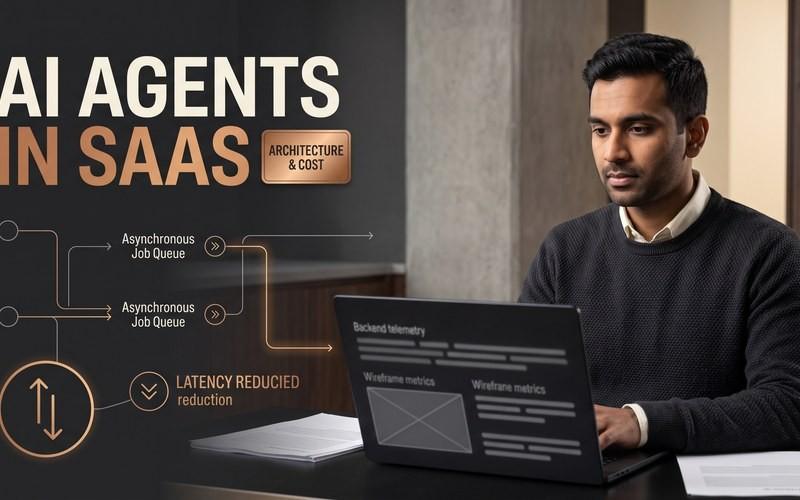
Mobile document triage requires balancing complex automated processing with constrained mobile viewports. Deploying autonomous agents on mobile endpoints introduces distinct operational vulnerabilities when fluctuating cellular connectivity intersects with irreversible backend mutations. Additionally, running multi-hop agent deliberation synchronously introduces latency that degrades mobile usability.
Approach
The architecture structures mobile document workflows around deterministic, reviewable AI task states featuring direct source verification, uncertainty scoring, and human validation gates. The mobile client maps these tasks across a task list, a focused action screen, and visible sync indicators, utilizing local-first transactional journals for idempotent offline recovery. Heavy document parsing is decoupled into asynchronous ingestion microservices, leaving multi-agent supervisor graphs to manage coordination and state checkpointing.
Outcome
Pairing rapid AI scaffolding with senior engineering reviews and verification tests shortens feedback loops and reduces initial effort while mitigating technical debt.
Deploying Multi-Agent System Orchestration mobile document triage enables operational teams to process complex business records safely on compact mobile devices. By decomposing document classification, data extraction, and verification into discrete subagents coordinated by a central supervisor, organizations preserve rigorous human oversight while automating repetitive analysis.
At Canvas Developers, our approach structures mobile document workflows around deterministic, reviewable AI task states. This architecture surfaces direct source verification, uncertainty scoring, and human validation gates before any consequential downstream updates take effect.
How Does Multi-Agent System Orchestration Solve Mobile Document Triage?
Mobile document triage requires balancing complex automated processing with constrained mobile viewports. Implementing Multi-Agent System Orchestration mobile document triage allows backend workers to perform resource-intensive parsing, tabular extraction, and cross-field validation asynchronously, while the client interface remains responsive and focused on swift human verification.
Structuring the Reviewable AI Task Across Narrow Screen Interfaces
Mobile document triage development succeeds when the core entity presented to users is an atomic reviewable AI task. Rather than overwhelming field personnel with raw model outputs or multi-page document attachments, the mobile interface organizes triage into focused sequential cards. Each card surfaces extracted key-value pairs, a high-contrast snippet crop of the source document coordinates, and a concise validation rationale generated by the supervisory agent. This structure ensures operators evaluate discrete decisions rather than zooming through dense text on handheld screens.
As demonstrated in the langgraph-supervisor architecture, specialized worker agents pass structured tool messages to a central coordinator. On compact displays, the mobile presentation layer translates these orchestration states directly into high-priority action cards, allowing staff to tap through approvals, modify line items, or trigger targeted re-extractions without interface friction.
Role Separation Across Knowledge Workers, Reviewers, and Workspace Administrators
A resilient multi-agent architecture enforces clear operational boundaries across three primary roles to maintain workflow integrity:
- Knowledge Workers: Triage incoming mobile queues, confirm routine metadata, and verify low-risk classifications directly from the field.
- Reviewers: Evaluate high-value transactions, audit flagged discrepancies, and resolve low-confidence edge cases escalated by automated validation agents.
- Workspace Administrators: Configure system-wide validation rules, audit agent handoff traces, and calibrate automated uncertainty thresholds.
By separating execution, exception escalation, and governance, the system preserves verifiable auditability across all mobile interactions.
What Constraints and Failure Paths Threaten Mobile Document Triage Workflows?
Deploying autonomous agents on mobile endpoints introduces distinct operational vulnerabilities, especially when fluctuating cellular connectivity intersects with irreversible backend mutations. A disciplined Multi-Agent System Orchestration integration must establish defensive constraints that protect enterprise resource planning (ERP) and document storage systems from unverified agent conclusions.
Enforcing Visible Source Access and Uncertainty Scoring Before Consequential Actions
Field triage cannot rely on black-box agent classifications. Before any high-consequence action—such as releasing payment batches, routing legal summons, or updating tax filings—the interface mandates transparent validation. The orchestration layer attaches an uncertainty score to each extracted field alongside direct source access to the original document coordinates.
According to LangGraph human-in-the-loop persistence specifications, human approval workflows rely on graph checkpoints that pause execution before destructive tool invocation. By enforcing dynamic breakpoints whenever field uncertainty exceeds predefined thresholds, the system requires explicit reviewer confirmation before downstream APIs commit mutations.
Handling Network Interruptions with Unambiguous Pending States and Safe Recovery
Mobile field personnel routinely navigate unstable cellular environments, making mobile offline sync recovery a primary engineering constraint. If a network connection drops during task adjudication, the application cannot leave the operation in an ambiguous state or trigger duplicate submissions upon reconnecting.
Our approach manages this failure path through local-first transactional journals. When an operator approves or corrects a document task offline, the mobile client assigns a client-generated UUID, logs the mutation to persistent local storage, and transitions the card to an explicit pending sync state. Once connectivity resumes, the client replays the journal to the orchestrator using idempotent endpoints, verifying state synchronization before clearing the local queue.
How Is the Multi-Agent Orchestration Architecture Implemented Across Screen States?
Translating agent coordination into an intuitive mobile experience demands clean separation between presentation state and background computation. In robust Multi-Agent System Orchestration development, the mobile client reflects stateful transitions rather than executing complex agent logic directly on device hardware.
Orchestrating Task Lists, Focused Action Screens, and Visible Sync States
The client application maps the reviewable AI task architecture across three dedicated interface views:
- Task List: Displays pending document batches prioritized by arrival urgency, document category, and agent uncertainty scores. Visual badges indicate whether a task requires routine knowledge-worker review or supervisor escalation.
- Focused Action Screen: Isolates a single document record. It presents extracted metadata in editable input fields alongside side-by-side snippet crops of the source text. When a reviewer taps "Approve" or "Correct", the interface provides immediate client-side feedback while issuing a background state mutation.
- Visible Sync Status: A persistent indicator at the top of the interface conveys network transmission state—such as Synced, Syncing (3 pending), or Offline (Queued locally)—ensuring users never wonder whether their review reached central storage.
Isolating Core Orchestration from Document Extraction Pipelines
A critical architectural boundary separates multi-agent decision routing from heavy document ingestion. In the hierarchical supervisor pattern, agent graphs excel at conversational routing, tool coordination, and state checkpointing. However, raw PDF rendering, layout analysis, and optical character recognition represent non-conversational, CPU-intensive pipelines that must live in dedicated microservices.
In our approach, an asynchronous ingestion pipeline pre-processes inbound PDFs and multi-page scans, writing normalized JSON tokens and bounding coordinates into object storage. Only then does the orchestrator instantiate agent nodes to evaluate field compliance, assess cross-document discrepancies, and prepare the reviewable task state. Our approach at Canvas Developers structures multi-agent orchestration systems around this boundary to prevent heavy extraction tasks from blocking agent execution or client responsiveness.
Which Acceptance Criteria and Engineering Tradeoffs Define a Resilient Triage System?
Validating an enterprise mobile triage system requires rigorous acceptance testing that simulates real-world network instability and concurrency challenges. In our Multi-Agent System Orchestration development workflow, engineering teams establish automated test suites to verify that both mobile state and agent graphs recover deterministically from sudden connection drops.
Verifying Idempotency and Human Approval Under Controlled Network Disruption
To ensure resilience, we subject the triage pipeline to controlled disruption testing across several verification criteria:
- Idempotent State Commit: If an operator approves a document record and the connection severs mid-flight, retried requests using identical task idempotency keys must not duplicate audit logs or trigger repeated downstream events.
- Gated Mutation Verification: Graph checkpoints must verify that no downstream tool call can fire while a task remains paused at an approval breakpoint.
- Pending State Recovery: Upon restoring connectivity after airplane mode or signal loss, the client re-syncs pending local mutations and transitions UI badges from Pending to Verified without user intervention.
Balancing Rapid Client-Side Feedback Against Distributed Agent Latency
During mobile document triage development, engineers face an inherent tradeoff between conversational multi-agent reasoning and interface responsiveness. Running multi-hop agent deliberation synchronously introduces several seconds of latency, which degrades mobile usability.
Our approach decouples these operations through optimistic UI patterns and asynchronous event streaming. When a worker submits a correction, the interface acknowledges the change instantaneously, updates local layout views, and queues verification in the background. If a simpler rule-based schema validation or deterministic regex check satisfies the document type, teams should bypass multi-agent consensus altogether—reserving multi-agent orchestration for ambiguous or high-risk records where deep reasoning is genuinely required.
How Does Canvas Developers Deliver and Harden Agentic Systems with Scoped Engineering?
Modern engineering teams frequently begin prototyping mobile workflows through rapid generative tooling. In Multi-Agent System Orchestration vibe coding, AI coding agents and harness frameworks accelerate initial UI scaffolding, state models, and boilerplate logic. However, transitioning rapid prototypes into production requires senior engineering oversight. While AI coding excels at generating components and parsing schemas, it often fails at subtle edge cases, concurrency controls, and complex state lifecycles. Experienced engineers must rigorously inspect and verify security, data integrity, payment processing, and high-load architectural scale.
At Canvas Developers, our software engineering team in Dhaka directs AI coding agents through disciplined workflows. We own the underlying architecture, review every code commit, and enforce release gates. For mobile document triage, our approach pairs rapid AI scaffolding with engineering reviews and verification tests—checking offline storage journals, API idempotency, and checkpointer persistence before deployment. This structured approach shortens feedback loops and reduces initial effort while mitigating technical debt.
We deliver AI solutions under two flexible models: Private / Local AI Engineering using privately hosted open-weight models inside client-controlled infrastructure, and Claude Code / OpenAI Codex Engineering using approved commercial tools. Engagements start with upfront scoping, followed by agreed milestones, testing, and handover.
To evaluate your mobile architecture, share your current stack, workflow constraints, and operational goals through our contact form to start a scoped engineering assessment.