This illustrative example presents MetaGuard, an institutional risk architecture concept designed by Canvas Developers to demonstrate our systems engineering capabilities for automated trading desks. Built to solve systemic exposure challenges across distributed trading environments, this concept illustrates how custom engineering delivers resilient metatrader group risk management software without compromising execution speed.
Project at a Glance: Institutional Multi-Terminal Risk Architecture
Proprietary trading desks, multi-strategy family offices, and pooled fund managers frequently operate dozens of segregated accounts to isolate algorithmic strategies or satisfy investor mandates. Managing risk across disparate accounts becomes fragile when done through fragmented terminal scripts. MetaGuard addresses this operational challenge by providing centralized exposure oversight across distributed trading environments.
The technical scope centers on a high-throughput backend daemon compiled in Go that bridges 50+ MetaTrader terminal instances simultaneously. Operating as specialized metatrader group risk management software, the daemon maintains persistent socket connections to synchronize live order books, margin commitments, and asset exposures into a unified analytical state.
The Challenge: Why Multi-Terminal MetaTrader Deployments Leak Risk
Standard MetaTrader setups isolate account state within individual client terminals. While terminal-level stop losses protect a single account balance, they cannot protect pooled funds against systemic failures across multiple terminals. When sudden market volatility strikes, independent algorithms across segregated accounts often accumulate overlapping directional exposure. A sharp macro swing in a single currency pair cascades across the aggregate balance sheet, generating drawdowns that isolated terminal safeguards never anticipate.
Without a centralized metatrader floating drawdown monitor, risk desks remain unaware of portfolio-level asset concentration. Two algorithmic strategies executing independently on EUR/USD and GBP/USD can quietly multiply aggregate US dollar exposure beyond firm limits. MetaGuard resolves this vulnerability by operating as a multi account metatrader equity guard. The engine tracks aggregate floating positions in real time, detecting correlation spikes before margin compression forces broker liquidation.
Engineering Approach: AI-Accelerated Development Under Senior System Oversight
At Canvas Developers, our engineering workflow pairs AI coding tools with experienced senior engineers who direct system design, review code, and decide production releases. In developing this centralized mt4 risk controller concept, AI agents accelerated boilerplate scaffolding, telemetry serialization, and protocol parsing routines across diverse terminal APIs. Generating unit tests and realistic simulation harnesses through automated coding tools reduced initial development cycles substantially.
However, mission-critical financial systems reveal clear boundaries where autonomous AI generation fails. AI models frequently overlook nuanced thread synchronization, goroutine lifecycles, and memory contention under peak transaction volume. Our senior systems engineers designed the underlying concurrency architecture, non-blocking channels, and zero-allocation buffer pools directly. Human specialists audited state synchronization routines, verified race conditions, and hardened network boundaries to guarantee deterministic execution during extreme market volatility.
What Was Built: Telemetry Aggregation and Automated Circuit Breakers
The core engine is a compiled Go service that aggregates live tick feeds, open positions, and account balances across 50+ MetaTrader instances. Each terminal client streams telemetry over non-blocking TCP sockets using low-overhead framing, configured via standard MQL5 network functions and handled concurrently through the Go net package. Streaming connections bypass slow polling mechanisms, feeding an in-memory portfolio state tree that recalculates aggregate risk in sub-millisecond intervals.
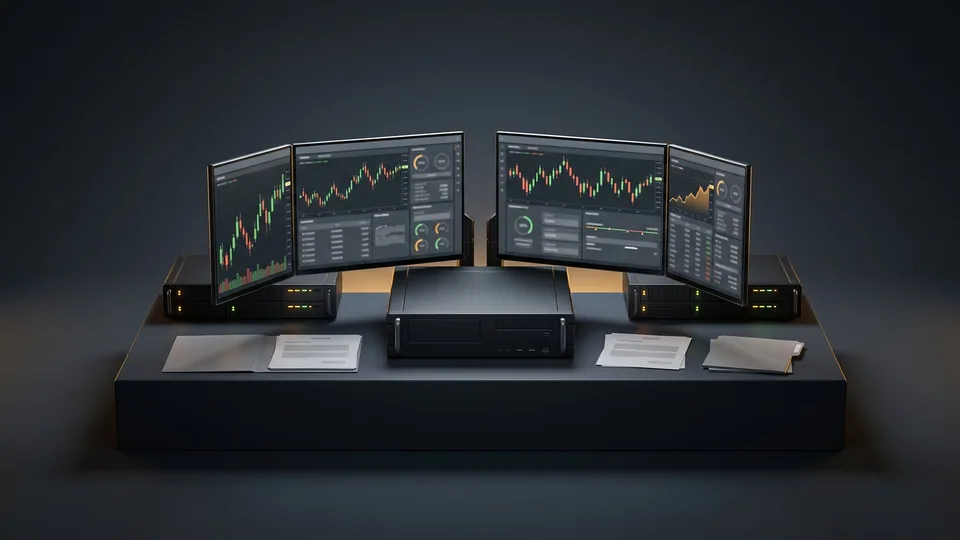
Risk officers monitor live exposure through a centralized telemetry console featuring real-time cross-terminal asset heatmaps, floating equity drawdown gauges, and live execution audit feeds. Built to function as an automated prop firm risk manager, MetaGuard enforces dynamic safeguards when portfolio equity breaches predefined risk tiers. Rather than relying on static account-level rules, the controller executes an automated mt5 portfolio stop loss using configurable firm parameters. The system automatically deploys tiered delta hedges on correlated index contracts, triggers bulk order cancellations, or issues synchronized parallel liquidation commands across all connected terminals to protect pooled capital under high volatility.
Operational Reliability: Security Controls, Latency, and Failure Modes
Operational reliability in institutional trading environments requires strict network isolation and defensive fault tolerance. In this centralized mt4 risk controller architecture, communication between trading terminals and the Go daemon relies on mutual TLS authentication over isolated subnets. Terminal instances never expose external management ports, establishing zero-trust perimeter boundaries across distributed server infrastructure.
To eliminate catastrophic failure modes, our senior engineers conducted rigorous release audits focused on fail-closed state machines. If a network partition interrupts a terminal connection, the multi account metatrader equity guard flags stale telemetry immediately and executes localized defensive rules rather than failing open. Concurrency profiling and deadlock analysis ensure the daemon delivers predictable sub-millisecond response times and minimal memory allocations even during intense market volatility.
Start a Similar Build: Scoping Custom Financial Infrastructure
Building specialized financial infrastructure requires aligning engineering speed with strict intellectual property and data governance. Canvas Developers offers two structured delivery packages: Private / Local AI Engineering, which uses privately hosted open-weight models within client-controlled infrastructure, and Claude Code / OpenAI Codex Engineering, which utilizes approved commercial toolchains.
Whether your trading firm requires custom metatrader group risk management software, bespoke execution bridges, or automated capital protection systems, our experienced engineers direct every milestone from initial architecture scoping through deployment. To evaluate your platform requirements and plan a structured delivery roadmap, request an architecture scoping assessment through the Canvas Developers contact form.