Understanding your total Cursor & Claude Code Consulting development cost requires evaluating repository readiness, enterprise security guardrails, and ongoing workflow maintenance before engaging external specialists. While AI coding tools streamline repetitive generation, engineering teams must configure deterministic context systems, establish sandboxed execution boundaries, and enforce rigorous automated quality assurance to capture tangible business value.
Organisations looking to modernize their engineering pipelines must distinguish between rapid prototype generation and stable production deployment. Scoping an advisory engagement accurately allows leadership to deploy Cursor & Claude Code consulting effectively, pairing autonomous agent speed with seasoned architectural governance.
What Factors Shape Cursor & Claude Code Consulting Development Cost?
Evaluating the true Cursor & Claude Code Consulting development cost begins with analyzing how deeply AI tooling must integrate into your existing development lifecycle. Rather than a flat advisory rate, implementation budgets fluctuate based on repository complexity, codebase cleanliness, team size, and regulatory security standards. Teams migrating from ad-hoc developer prompting toward structured team-wide adoption face distinct organizational challenges that dictate the consulting scope.
Specialized cursor ide consulting typically focuses on five core budget drivers:
- Codebase Organization and Legacy Architecture: Monorepos, deeply nested microservices, and poorly documented legacy frameworks demand substantial pre-configuration before AI agents can interpret context accurately.
- Security and Sandboxing Requirements: Enterprises operating under strict compliance frameworks require isolated execution environments, fine-grained permission rules, and network boundaries.
- Context Ingestion and Custom Tooling: Designing structured rule hierarchies, Model Context Protocol (MCP) integrations, and context filters directly impacts the engineering hours required.
- Developer Training and CI/CD Pipeline Alignment: Establishing automated test suites, linting hooks, and review protocols ensures that generated code meets production standards without introducing regressions.
- Ongoing Workflow Maintenance: Agent definitions and prompt libraries drift as dependencies update, requiring scheduled maintenance retainers or internal handover documentation.
By assessing these variables prior to procurement, technical leaders can isolate essential setup milestones from discretionary enhancements, establishing predictable budgets while avoiding unnecessary operational overhead.
Which Technical Drivers Increase or Decrease Your Consulting Budget?
Repository Architecture and Custom .cursorrules Configuration
The organizational structure of your repository directly dictates the engineering hours needed to configure AI development tooling. In sprawling monorepos or poorly decoupled codebases, AI assistants struggle with circular dependencies and ambiguous import paths. During custom cursorrules development, engineers replace monolithic prompt files with modular rule structures located in .cursor/rules/ using the .mdc format. By defining precise glob patterns, team-specific architectural standards, and strict typing conventions, consultants ensure that rules activate only for relevant file types. This targeted approach prevents context saturation, maintains consistent naming conventions across teams, and stops conflicting instructions from misdirecting agent generation.
Context Indexing, Tool Calling, and Enterprise API Limits
Context retrieval mechanisms represent another substantial cost driver during implementation. Cursor parses repository structures and symbols to power semantic codebase queries, but unoptimized indexing inflates token usage and degrades retrieval precision. Engineers must author meticulous .cursorignore files to exclude compiled build artifacts, package locks, log outputs, and third-party dependencies from vector representations.
In a comprehensive claude code enterprise setup, context engineering expands to include Model Context Protocol (MCP) integrations and enterprise quota management. Connecting custom MCP servers allows agents to interface with internal documentation, issue trackers, and database schemas. Consultants establish prompt caching strategies, query throttling, and context truncation policies to prevent automated agent loops from exhausting monthly API quotas or triggering vendor rate limits during intensive refactoring tasks.
Local Sandboxing, Permission Scopes, and Third-Party Integrations
Enabling autonomous command-line execution requires robust defensive isolation. When AI agents execute shell scripts, run automated tests, or interact with external services, organizations face potential data exfiltration and accidental system modification risks. According to Anthropic's Claude Code security documentation, safe agentic workflows rely on a permission-based architecture featuring working directory boundaries, filesystem isolation, and granular permission modes that govern tool execution.
Consulting engagements address these governance requirements by provisioning sandboxed container environments, defining explicit command allowlists and denylists, and securing third-party API credentials within operating system keychains or enterprise secret stores. Implementing strict network egress filters and automated approval workflows ensures that agentic tooling operates safely within corporate compliance standards without hindering developer velocity.
Where Does Vibe Coding Save Budget and Where Does It Require Engineering?
Accelerating Boilerplate and Scaffolding with AI Coding Agents
The emergence of conversational software synthesis has fundamentally transformed exploratory development, leading teams to adopt vibe coding practices for rapid initial prototyping. When applied to predictable boilerplate—such as generating REST API client wrappers, object-relational mapping (ORM) entities, standard CRUD handlers, and baseline UI layouts—autonomous coding agents compress early milestone timelines significantly. A skilled Cursor & Claude Code Consulting developer uses agentic prompts to scaffold full-stack application architectures in hours rather than weeks. By delegating repetitive interface components and syntax generation to AI models, development teams create immediate, clickable prototypes that allow stakeholders to validate product designs and user flows early in the development lifecycle.
Critical Human Oversight: Architecture, Security, Payments, and Data Integrity
While AI coding models accelerate initial scaffolding, they lack the holistic context required to maintain enterprise software standards. Automated generation tools operate on statistical pattern matching, making them susceptible to subtle architectural flaws, obsolete library dependencies, and security vulnerabilities that automated tools cannot identify on their own. At Canvas Developers, the engineering standard is uncompromising: AI coding agents and leading agent harnesses speed up design and implementation, but senior software engineers direct system architecture, conduct line-by-line code reviews, and retain exclusive authority over production releases.
Certain technical domains demand rigorous human verification before reaching staging environments:
- Payment Gateways and Transactional Integrity: Coding agents frequently overlook idempotency handling, webhook signature validation, and atomic database transactions, creating risks of duplicate charges or inconsistent financial ledgers.
- Authentication and Access Controls: Generative tools regularly generate simplistic role-based checks, misconfigure JWT refresh mechanisms, or introduce cross-tenant data leaks in multi-tenant SaaS environments.
- Data Integrity and Query Optimization: AI-scaffolded queries often omit necessary indexes, create N+1 query bottlenecks, or fail to manage connection pools under heavy concurrent workloads.
Preventing Technical Debt from Unchecked AI Generation
Uncontrolled generative sessions—where developers accept automated suggestions without strict architectural constraints—inevitably accumulate brittle technical debt. Left unchecked, independent agent prompts introduce duplicate utility functions, contradictory state management patterns, and incompatible third-party packages across different services. In structured Cursor & Claude Code Consulting vibe coding projects, consulting engineers establish automated static analysis gates, strict typing configurations, and end-to-end regression suites within CI/CD pipelines. This disciplined oversight ensures that rapidly scaffolded applications are systematically hardened into maintainable, production-ready systems capable of scaling alongside business growth.
How Do Private Local AI and Commercial Cloud Deployments Differ in Cost?
Private and Local AI Engineering Setup on Controlled Infrastructure
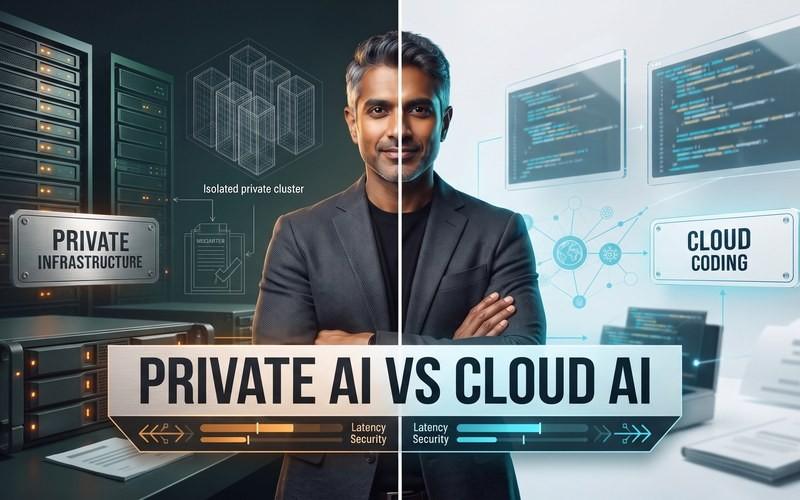
Organizations operating under strict data privacy regulations, healthcare compliance standards, or proprietary intellectual property protections frequently opt for an isolated deployment architecture. Under a Private / Local AI Engineering package, software engineers deploy privately hosted open-weight models directly within infrastructure the client controls or an agreed isolated virtual private cloud (VPC). This deployment model requires upfront engineering investment for hardware provisioning, model weight quantization, container orchestration via vLLM or Triton, and internal network gateway configuration. Although initial setup and infrastructure management require higher upfront engineering allocation, this architecture eliminates ongoing per-token commercial API billing, keeps sensitive source code strictly within corporate network boundaries, and provides complete autonomy over data retention policies.
From a budgeting perspective, local setups shift financial commitments from variable operational expenditure to predictable infrastructure hosting. Engineering teams must account for dedicated GPU instances, persistent storage volumes, and periodic model weight updates, balancing these operational baseline costs against the volume of developer queries generated across the organization.
Commercial Claude Code and OpenAI Codex Cloud Workflows
For organizations prioritizing rapid setup velocity and minimal infrastructure overhead, managed commercial coding platforms offer an agile alternative. Canvas Developers provides a Claude Code / OpenAI Codex Engineering package that integrates commercial AI coding tools with cloud settings the client reviews and approves. In this operational model, external ai coding workflow consulting focuses on configuring secure API proxies, team permission boundaries, and usage analytics.
Deploying a robust claude code enterprise setup involves structuring prompt caching policies, rate-limiting rules, and automated context truncation to prevent runaway token consumption during large refactoring tasks. While initial provisioning costs are lower compared to dedicated local clusters, operational budgeting requires continuous monitoring of recurring API consumption fees, team seat licenses, and automated tool-calling quotas across engineering departments. Establishing clear organizational spending thresholds ensures teams capture immediate velocity gains while keeping cloud expenditures strictly within planned budget envelopes.
How Can You Lower Implementation Costs Without Weakening Acceptance Criteria?
Reusing Existing Scaffolding, Tooling Scripts, and Staging Pipelines
Engineering teams can substantially reduce their total advisory expenditure by conducting an internal inventory of reusable development assets. Rather than paying external consultants to build environment scripts, formatting configurations, and integration harnesses from scratch, organizations should connect AI coding assistants to existing infrastructure assets:
- Containerized Local and Staging Environments: Reusing established Docker Compose manifests and Kubernetes staging environments avoids bespoke sandboxing configurations.
- CI/CD Linting and Formatting Standards: Pre-existing ESLint, Prettier, Ruff, or SonarQube configs can be incorporated directly into agent pre-commit hooks and rule directories.
- Design Systems and Component Libraries: Pointing coding assistants to established Tailwind tokens or UI libraries prevents agents from generating incompatible CSS or fragmented design patterns.
When leadership considers whether to hire a vibe coder for Cursor & Claude Code Consulting or partner with an engineering firm, asset reuse is a critical differentiator. Casual prompters often rebuild standard utilities from scratch, creating redundant code, while disciplined engineers leverage existing pipelines to streamline delivery.
Defining Concrete Acceptance Criteria and Automated Test Coverage
Unambiguous, measurable acceptance criteria protect project budgets from scope expansion. When requirements lack clear verification boundaries, advisory engagements easily inflate as teams debate subjective code quality. Establishing deterministic validation gates controls your overall Cursor & Claude Code Consulting development cost by shifting verification from manual reviews to automated checks.
| Validation Layer | Automated Verification Gate | Delivery Outcome |
|---|---|---|
| Type Safety | Strict compiler checks (TypeScript/mypy) with zero diagnostics | Eliminates runtime type errors and null-pointer exceptions |
| Test Suites | Passing unit and integration tests covering business logic | Prevents regressions across iterative agent prompting cycles |
| Security Audits | Static security scans verifying credential management | Ensures no exposed secrets or unauthorized shell execution |
| Release Decisions | Peer architectural review and staging smoke testing | Confirms clean system design and production readiness |
What Information Should You Prepare Before Requesting a Scoped Quote?
Auditing Your Current Repository, Tech Stack, and Developer Workflow
Preparing clear technical documentation before requesting an implementation quote ensures precise scoping and prevents unnecessary project delays. When technical leadership provides transparent visibility into current codebase architecture and engineering bottlenecks, consultants can establish realistic delivery milestones without padding estimates for unknown architectural risks.
Before briefing a Cursor & Claude Code Consulting developer, engineering teams should audit and assemble several foundational technical inputs:
- Repository Health and Dependencies: Monorepo boundaries, package manager configurations, framework versions, build scripts, and known architectural debt.
- Developer Workflows and Tooling: Local development environments, containerized setups, CI/CD pipeline triggers, branch protection rules, and automated test coverage metrics.
- Security and Access Policies: Data sensitivity classifications, repository access boundaries, network isolation requirements, and operating system secret management standards.
- Target Acceptance Gates: Defined success criteria for implementation, such as standardized prompt libraries, reduced onboarding friction, or automated test verification gates.
Engaging Canvas Developers for a Scoped Assessment and Milestones
Adopting agentic coding workflows successfully requires pairing automated generation speed with rigorous human engineering governance. Canvas Developers is a software engineering company with an office in Dhaka, Bangladesh, engineering web and mobile applications, SaaS platforms, enterprise systems, and custom AI capabilities. Through specialized ai coding workflow consulting, our team configures Cursor and Claude Code environments, builds modular rule architectures, and hardens vibe-coded applications for enterprise stability.
Our delivery approach pairs AI coding agents with experienced engineers who direct architecture, conduct peer reviews for every change, and decide production releases. Engagements begin with structured technical scoping, followed by agreed milestones, automated testing, and comprehensive handover. To plan your implementation, share your current stack, developer workflow constraints, and target outcomes through the Canvas Developers contact form.