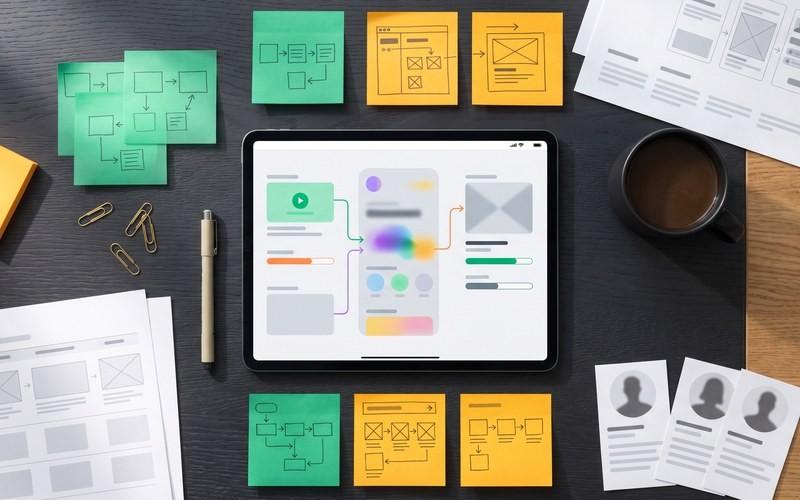
Establishing precise wireframing & prototyping development requirements is the difference between a functional product validation asset and an expensive, unmaintainable prototype. Generative AI development and prompt-driven scaffolding—commonly known as vibe coding—allow builders to generate screens and interactive user flows in hours. However, without defined technical boundaries, interface prototypes quickly accumulate structural debt, broken state logic, and unvalidated edge cases.
Whether you engage a standalone specialist or an integrated software engineering team, scoping your workflow inputs, state transitions, and acceptance criteria upfront ensures your clickable prototype answers key product questions without creating throwaway code.
What Are the Essential Wireframing & Prototyping Development Requirements?
Before initiating any interface build, defining formal wireframing & prototyping development requirements prevents costly misalignment between design vision and technical execution. An effective prototype is not merely a collection of decorative screens; it is an empirical instrument designed to validate user workflows, technical feasibility, and business logic before committing substantial engineering capital. According to research on prototype fidelity published by the Nielsen Norman Group, prototypes should be treated as testable hypotheses where the level of fidelity—whether static wireframe or interactive interface—directly matches the specific question being evaluated.
To establish an actionable scope, product owners must specify three core technical pillars before kickoff:
- Workflow State Definitions: Explicit documentation of user navigation paths, entry triggers, error conditions, and terminal success states.
- Data and Payload Expectations: Clear definitions of mock schemas, sample records, form input validations, and state mutations rather than hardcoded static strings.
- Target Environmental Constraints: Viewport boundaries, responsive breakpoints, supported browser engines, and platform interaction standards.
When you hire a dedicated wireframing & prototyping developer or partner with an engineering team, these requirements establish objective boundaries. Scoping these parameters upfront prevents feature bloat, clarifies what must be mocked versus executed, and ensures the resulting artifact delivers reliable feedback for subsequent development milestones.
Why Does Vibe Coding Require Stricter Scope Than Traditional Prototyping?
Prompt-driven generative tools have transformed front-end development, enabling founders and product teams to translate conceptual wireframes into interactive screens at unprecedented speed. However, relying on wireframing & prototyping vibe coding without rigid architectural parameters introduces subtle technical risks. While traditional prototyping in design platforms establishes visual intent, AI code generators immediately produce executable scripts that can appear polished on the surface while masking deep architectural defects underneath.
Where AI Scaffolding Excels in Rapid Interface Prototyping
Generative AI models and coding harnesses excel at eliminating repetitive structural tasks. When supplied with clear component specifications, automated coding tools can generate responsive layouts, boilerplate styling, mock data objects, and interactive form controls in minutes. This acceleration allows product teams to test visual hierarchy and ergonomic layout choices with end users earlier in the product lifecycle.
At Canvas Developers, engineering teams use automated AI scaffolding to accelerate interface generation and explore alternative design directions rapidly. By collapsing the feedback loop between wireframe sketches and clickable DOM elements, teams can iterate on layout usability and stakeholder presentations without dedicating days to manual component boilerplate creation.
Where Unchecked AI Coding Fails Without Explicit Technical Guardrails
Despite their velocity, generative models lack contextual judgment regarding application maintainability, data integrity, and runtime state management. When non-technical builders attempt to hire a vibe coder for wireframing & prototyping without strict technical guardrails, common failure modes emerge quickly:
- Fragmented Component Architecture: AI assistants frequently generate inline styles, duplicate UI components across views, and hardcode logic directly into markup rather than abstracting reusable primitives.
- Fragile Client-Side State: Complex user flows requiring asynchronous validation or cross-screen data persistence often devolve into brittle state trees that collapse under basic edge-case inputs.
- Premature Code Entanglement: Without strict boundaries separating presentation from backend abstractions, mock data becomes tightly coupled to layout elements, making future production integration far more costly.
Accelerated scaffolding delivers genuine value only when human software architects govern the underlying foundation. Without senior oversight, rapid prototyping creates technical debt that ultimately requires complete rewrites.
How Do You Separate a Minimal Clickable Prototype from Production Code?
A frequent trap in rapid interface development is scope creep masquerading as technical completeness. Founders and product managers often struggle to determine where rapid validation ends and full-scale production engineering begins. Calibrating your interactive prototype scope requires establishing strict functional boundaries so that the prototype serves its primary purpose: validating user interaction and product viability without consuming capital on premature infrastructure.
Defining Core User Workflows Versus Secondary Edge Cases
A clickable prototype must focus strictly on the primary value path—the critical sequence of steps an end user takes to achieve the core product outcome. For instance, in a SaaS onboarding workflow, the primary path covers account creation, workspace initialization, and the completion of the first core action. Secondary paths, such as forgotten password flows, multi-tenant billing tier changes, complex notification settings, and account deactivation, should be deferred to post-validation development phases.
Documenting these distinctions in your wireframing & prototyping development requirements ensures that the development effort concentrates on testing the core business hypothesis. Attempting to build complete edge-case handling into an initial prototype inflates delivery timelines and diverts attention away from validating workflow clarity, information architecture, and layout ergonomics with prospective users.
Distinguishing Static Mockups from Functional State and Mock APIs
To keep prototyping efficient while delivering a realistic testing experience, teams must specify how data and state will be managed across screens. Prototypes do not require live production databases, third-party payment webhooks, or scalable server clusters. Instead, effective prototypes leverage deterministic mock data layers:
- In-Memory Client State: Managing interface state (such as selected filters, modal toggles, and multi-step navigation) locally in the client runtime without persistent server storage.
- Mock API Contracts: Using predefined JSON response fixtures to simulate server latency, status responses, and validation alerts without deploying actual backend endpoints.
- Synthetic User Profiles: Providing pre-populated mock datasets so stakeholders can experience fully populated tables, charts, and activity feeds without tedious manual data entry.
By clearly separating presentation state from production infrastructure, teams can evaluate user flows rapidly, saving real backend architecture and database modeling for validated concepts.
What Must Human Engineers Verify in an AI-Generated Prototype?
While rapid AI-driven generation can assemble visual layouts within hours, turning raw scaffolding into a dependable technical asset requires rigorous human verification. When organizations engage in wireframing & prototyping vibe coding, experienced software architects must evaluate the resulting codebase to ensure it follows sound engineering practices rather than disposable scripting shortcuts.
Architectural Hygiene and Reusable Component Boundaries
AI code generators often assemble interfaces by copying markup across different pages or nesting deep hierarchies of unstyled DOM nodes. When an experienced wireframing & prototyping developer reviews the prototype, their primary responsibility is establishing clean component modularity and architectural hygiene. This means breaking monolithic screen templates into reusable atomic primitives—such as consistent button variations, form input containers, navigation bars, and modal dialogs.
At Canvas Developers, engineering teams pair automated AI coding agents with senior engineering oversight, whether deploying Private / Local AI Engineering with open-weight models or Claude Code and OpenAI Codex Engineering workflows with client-approved settings. While AI tools quickly construct initial component trees, human engineers enforce design system tokens, maintain strict separation between presentation and state, and refactor generated styles into structured components. This human-directed workflow accelerates turnaround times while preserving a clean codebase that can transition into full development without requiring a ground-up rebuild.
Data Isolation, Authentication Mocking, and Security Checks
A critical risk in unverified AI prototypes is the accidental inclusion of sensitive production configurations, hardcoded secrets, or insecure client-side logic. AI prompts frequently generate insecure bypasses to make interfaces function quickly—such as storing unencrypted user tokens in client storage or bypassing cross-origin request policies.
Engineers must ensure strict data isolation and verify security baselines across the prototype:
- Sandboxed Authentication Mocking: Verifying that session handling simulates token exchanges locally without connecting to live identity providers or exposing real API keys.
- Synthetic Data Scrubbing: Ensuring all displayed records consist solely of synthetic test data, preventing customer information or proprietary operational data from entering client-side bundles.
- Transport Layer Isolation: Confirming mock network handlers intercept calls before reaching public networks, preventing accidental data leakage during usability testing.
Establishing these verification checkpoints ensures your prototype remains secure during external stakeholder presentations and user testing sessions.
What Deliverables Belong in Your Prototype Acceptance Checklist?
Accepting a completed prototype requires an unambiguous definition of done. When collaborating with external developers or directing internal sprint cycles, formal deliverables bridge the gap between design concepts and verifiable software artifacts.
The Technical Wireframe and Asset Handoff Specification
A structured vibe coding wireframe handoff prevents visual misalignment and missing technical assets. Rather than delivering ad-hoc layout snippets, the handoff package should provide centralized design tokens, responsive layout rules, and component specifications. According to established industry developer handoff standards, effective design-to-development transitions rely on explicit design system tokens, dedicated developer inspection views, and clear section statuses to denote which screens are ready for implementation.
At Canvas Developers, design and engineering workflows integrate structured handoff specifications across our wireframing and prototyping services. Teams document typography scales, spacing units, interactive states (default, hover, active, and disabled), and vector assets in organized repositories, ensuring that prototypes maintain consistency across platforms.
Measurable Acceptance Criteria for Milestone Sign-Off
Milestone approval must depend on verifiable functional metrics rather than subjective aesthetic impressions. Clear prototyping acceptance criteria establish objective standards that every deliverable must pass before sign-off:
- Workflow Completion: Every primary user flow can be navigated from entry point to terminal confirmation without encountering broken navigation links or console errors.
- Form and Validation Behavior: Input fields enforce expected format validations, error displays, and deterministic state transitions when submitted with valid or invalid payloads.
- Viewport Responsiveness: Layouts adapt predictably across agreed mobile, tablet, and desktop breakpoints without text truncation or element collision.
- Clean Component Architecture: Code follows modular boundaries, separating presentation layers from temporary mock data objects.
Using this checklist guarantees that every prototype milestone provides tangible validation value.
How Should You Prepare Your Scope Before Requesting an Engineering Estimate?
Obtaining an accurate engineering estimate requires preparing a concise, structured scoping brief before reaching out to prospective technical partners. When teams prepare comprehensive wireframing & prototyping development requirements, developers can accurately assess technical complexity, identify potential integration bottlenecks, and propose appropriate delivery milestones without speculative padding.
Before you decide to hire a vibe coder for wireframing & prototyping or engage a specialized engineering firm, compile the following foundational inputs:
- Target User Personas and Primary Workflow: A clear step-by-step map of the single most critical task users need to accomplish during usability testing.
- Existing Technical Constraints: Your preferred front-end frameworks, corporate design systems, hosting constraints, and data privacy policies.
- Deliverable Fidelity Expectations: Clarification on whether the milestone requires static mockups, a clickable in-browser prototype with mock API fixtures, or production-grade components ready for backend integration.
- Target Business Timeline and Acceptance Milestones: Objective criteria for accepting each sprint delivery.
At Canvas Developers, engineering engagements begin with transparent scoping, agreed milestones, and rigorous human-led code reviews. If you are preparing to prototype a new digital product or need experienced engineers to stabilize an AI-built application, request a scoped assessment through our contact form to review your workflow and technical requirements.
Step by step
Define Core User Workflows
Map the primary sequential navigation path and terminal success states while deferring secondary edge cases.
Establish Mock Data Contracts
Specify deterministic JSON response fixtures and client-side state models instead of deploying live backend endpoints.
Standardize Design System Tokens
Document typography scales, spacing units, interactive component states, and responsive layout boundaries for handoff.
Apply Measurable Acceptance Criteria
Verify workflow completion, input validation behavior, and component modularity before signing off on milestone deliveries.