The problem
In distributed lead generation architectures, conventional web forms directly await responses from external CRM APIs and webhooks, creating tightly coupled request handling. When downstream dependencies encounter network partitions or latency spikes, HTTP gateway timeouts and server errors trigger broken interfaces and silent ingestion failures. Without decoupled recovery mechanisms, client retry attempts risk duplicate submissions, permanent lead loss, and corrupted marketing attribution and consent telemetry.
Approach
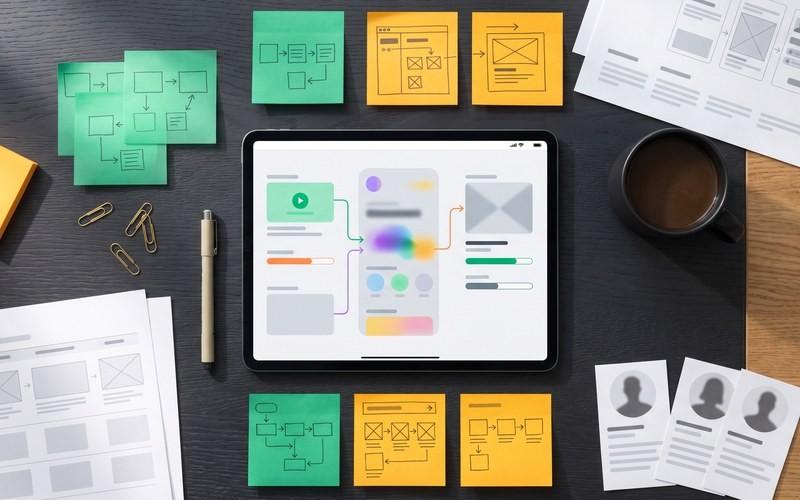
Canvas Developers decouples form ingestion acknowledgement from downstream synchronization using asynchronous queuing, strict retry budgets with exponential backoff and randomized jitter, and dead-letter queues. The architecture assigns immutable idempotency keys to incoming qualified enquiries while preserving consent telemetry, marketing attribution tags, and accessible interaction states across handoffs. Front-end prototypes model core operational screens—including a System Health Overview, Failed-Job Inspector, and Controlled Retry Action—while isolating durable storage in partitioned PostgreSQL tables or Redis Streams.
Outcome
Downstream dependency outages produce a visible degraded state and immediate intake acknowledgement without corrupting completed records or dropping qualified enquiries. Automated scaffolding paired with disciplined engineering review and rigorous acceptance testing reduces rework while ensuring backend data integrity under network partitions.
In distributed web applications, modeling Wireframing & Prototyping form submission recovery workflows helps engineering teams mitigate dropped lead records when downstream customer relationship management (CRM) platforms or marketing webhooks encounter service disruptions. Establishing explicit failure boundaries during the early prototype phase allows architects to define graceful degradation paths before deploying production queues.
By validating role-specific operational screens and client-side error states in initial prototypes, cross-functional teams can reduce silent ingestion failures, preserve marketing attribution tags, and maintain accessible user consent across downstream handoffs.
Why Do Form Enquiries Drop During Dependency Outages: The Ingestion Problem
Mapping Qualified Enquiry Flows Across Prospects, Sales Operators, and Content Administrators
Modern lead generation architectures connect disparate user groups through a single digital interaction: the submission of a qualified enquiry. For prospective buyers, the interface must deliver instantaneous feedback and accessible confirmations without exposing network latency. Sales operators depend on real-time ingestion into CRM databases to initiate outreach within operational service-level agreements. Simultaneously, content administrators require visibility into CMS form configurations to verify that field schema changes do not disrupt pipeline routing.
When engineering teams approach Wireframing & Prototyping form submission recovery, they map how each stakeholder role interacts with the transaction lifecycle. A prospect requires immediate, clear confirmation that their enquiry has been acknowledged. In contrast, sales operators need triage metadata indicating lead qualification status, routing priority, and payload timestamps. Content administrators require administrative dashboards that trace form revisions against live ingestion endpoints.
Identifying Silent Ingestion Failures and Downstream Timeout Dropped Records
The primary vulnerability in conventional lead intake stems from synchronous, coupled request handling. When a web form POST request directly awaits responses from external CRM APIs, email notification providers, and enrichment microservices, any transient network partition or dependency degradation triggers an HTTP 504 Gateway Timeout or 500 Internal Server Error. If the front-end application fails to retain the serialized state, the prospect experiences a broken interface, and the backend silently drops the record.
During form submission recovery development, our approach prioritizes decoupling ingestion acknowledgement from downstream synchronization. Without decoupled architectures, client-side retry attempts risk duplicate submissions or complete abandonment, permanently stranding qualified enquiries. Establishing architectural clarity during the initial prototyping stage prevents unrecoverable lead drop-offs before production code deployment.
What Constraints and Failure Paths Govern Form Recovery Across Services?
Managing Downstream Dependency Outages with Strict Retry Budgets and Idempotency
When downstream dependencies such as sales CRMs or email dispatchers suffer brownouts, unconstrained retry loops can trigger thundering herd problems that exacerbate service degradation. In our recovery architecture, the client or edge ingestion worker assigns a unique, immutable idempotency key (such as a UUIDv4 header) to every incoming qualified enquiry. This key guarantees that multiple delivery attempts by background queue workers process the payload exactly once, preventing duplicate lead creation.
To prevent infinite retry cycles from exhausting computational resources, engineering teams configure strict retry budgets governed by exponential backoff with randomized jitter. If downstream ingestion endpoints fail after three consecutive attempts or an allotted time budget, the message moves safely to a persistent dead-letter queue (DLQ). Incorporating this pipeline logic into Wireframing & Prototyping integration exercises ensures technical and business teams align on queue retention policies before infrastructure provisioning.
Preserving Consent Telemetry, Marketing Attribution, and Form Accessibility Across Handoffs
Recovering a dropped submission requires more than saving basic contact inputs; it requires preserving the legal and operational context of the original payload. Every ingested record must bundle immutable consent telemetry—including explicit opt-in timestamps, privacy policy versions, and user IP hashes—alongside marketing attribution data such as UTM campaign tags, ad group identifiers, and referring URLs. Losing these parameters during asynchronous recovery corrupts downstream conversion tracking and invalidates regulatory compliance audits.
Simultaneously, accessible interaction states must remain functional across network retries. In accordance with W3C WCAG Technique ARIA21, dynamic client-side recovery states must manage aria-invalid and descriptive text carefully, ensuring that screen readers receive assistive status announcements without prematurely flagging valid fields during transient background retries. Sustaining these accessibility guarantees across all handoffs is a mandatory design constraint in rigorous form submission recovery development.
How Should the Recovery Console Architecture and Core Operational Screens Be Structured?
Isolating Component Boundaries: Interactive Front-End Prototypes vs. Persistent Queue Storage
A critical architectural boundary separates client-facing interaction design from durable backend infrastructure. Modern design tools allow teams to simulate operational workflows with high fidelity. For example, in interactive prototyping workflows, component variants support state memorization and cross-frame sharing across matching objects. However, these tools function strictly as visual simulators; they cannot manage distributed transactions, enforce queue persistence, or provide ACID consistency guarantees.
In mature Wireframing & Prototyping development, engineering teams use front-end prototypes exclusively to model state transitions, exception dialogs, and operator ergonomics. The actual persistence layer—utilizing partitioned PostgreSQL tables, Redis Streams, or durable message brokers—remains an independent, isolated backend system. This separation prevents teams from conflating interactive UI proofs with the distributed infrastructure needed to guarantee message delivery.
Designing the Core Console Views: System Health Overview, Failed-Job Inspector, and Controlled Retries
Operational stability depends on providing internal teams with actionable visibility into transient bottlenecks. To meet production recovery console requirements, our architectural design specifies three core operational views:
- System Health Overview: An aggregated monitoring screen that displays live queue depth, processing latency, DLQ growth rates, and the connectivity status of downstream CRM and marketing webhook targets.
- Failed-Job Inspector: A forensic detail interface presenting the complete qualified enquiry payload, chronological network attempt logs, specific HTTP response codes, and preserved consent telemetry, allowing operators to diagnose schema mismatches or timeout failures.
- Controlled Retry Action: A secure execution interface that provides single-record re-dispatch, batch retries with throttle ceilings, and audited payload editing to resolve downstream schema validation rejections without dropping lead history.
Structuring these screens during wireframing and prototyping ensures that sales operators and DevOps engineers can manage partial service disruptions safely without manual database intervention.
What Acceptance Tests and Tradeoffs Verify Resilient Form Handling Without State Corruption?
Verifying Visible Degraded States and Lead Record Integrity Under Network Partitions
Verifying a resilient form submission architecture requires rigorous acceptance testing that subjects the ingestion pipeline to simulated network partitions. When downstream CRM endpoints experience latency spikes or drop connections entirely, the system must satisfy verifiable acceptance criteria:
| Acceptance Criteria | Expected System Behavior | Verification Method |
|---|---|---|
| Visible Degraded State | The interface renders a calm intake acknowledgement confirming receipt without exposing raw gateway error codes or freezing form fields. | End-to-end integration testing with mocked downstream network partitions. |
| Payload Immutability | All form inputs, attribution UTM tags, and consent telemetry remain uncorrupted and preserved in persistent storage. | Database assertion comparing submitted payload schema against dead-letter storage records. |
| Idempotent Re-execution | Repeated delivery attempts with matching idempotency headers resolve to a single backend record without duplication. | Automated webhook replay tests verifying deduplication across retries. |
These acceptance checks confirm that downstream dependency outages produce a visible degraded state without corrupting completed work or confusing prospective leads.
Evaluating Architectural Tradeoffs: Synchronous User Confirmation vs. Asynchronous Ingestion Queues
Engineering teams must evaluate fundamental architectural tradeoffs when selecting between synchronous confirmation patterns and asynchronous queuing models. A fully synchronous ingestion model provides immediate validation against downstream CRM schemas; however, it tightly couples client availability to external API uptime, directly increasing dropped submission risks during upstream brownouts.
Conversely, an asynchronous ingestion pattern—returning an immediate HTTP 202 Accepted while delegating sync operations to durable background workers—delivers fault isolation and responsive acknowledgement times. The operational tradeoff is increased system complexity, requiring dead-letter consoles, reconciliation workers, and retry telemetry. Balancing these design decisions during early Wireframing & Prototyping development enables organisations to select the appropriate resilience model for their lead volume and operational capacity.
How Does Canvas Developers Scaffold and Harden Prototypes Under Engineering Oversight?
At Canvas Developers, our engineering team balances AI acceleration with rigorous architectural discipline. In our approach to Wireframing & Prototyping vibe coding, AI coding agents rapidly generate interactive UI scaffolding, error notification variants, and synthetic mock payloads. This automated scaffolding noticeably accelerates initial design iterations and shortens feedback cycles across cross-functional teams. However, generative tools alone cannot resolve complex distributed systems challenges such as transactional boundary isolation, database race conditions, or strict GDPR consent auditing. This disciplined engineering review ensures that rapid interface exploration never compromises backend data integrity or operational resilience.
Senior engineers direct all AI tooling, enforce clean system architecture, and retain complete authority over code reviews and production release gates. When building robust Wireframing & Prototyping form submission recovery solutions, our specialists harden early UI prototypes with durable message brokers, cryptographic payload validation, and resilient network backoff policies. We support client projects through two distinct engagement structures: Private / Local AI Engineering using privately hosted open-weight models inside client infrastructure, and commercial workflows using Claude Code or OpenAI Codex with client-approved configurations.
Organizations seeking to reduce dropped enquiry risks and strengthen ingestion resilience can engage our Dhaka-based engineering team to conduct a comprehensive architectural review. You can share your existing technology stack, lead routing workflows, technical constraints, and reliability objectives through the contact form at Canvas Developers to initiate a scoped engineering assessment.