Executing reliable ai crm follow-ups with hubspot requires bridging conversational staff requests with strict CRM data integrity. When sales and account management teams ask an internal system to identify stalled deals or unanswered customer communications, the underlying integration must reliably query ticket queues, evaluate contact ownership, and create auditable follow-up actions without flooding pipelines with redundant tasks.
This walkthrough outlines our architectural approach to structuring an automated follow-up engine on HubSpot. We examine how role-based permissions, scheduled queue evaluations, and programmatic task creation operate under production API limits, contrasting custom integration against native workflows to determine technical viability.
Automating HubSpot Follow-Ups: Core Roles, Permissions, and API Boundaries
Building a resilient pipeline for ai crm follow-ups with hubspot starts with establishing explicit API boundaries and granular permission scopes. Within the HubSpot developer platform, engagement records such as tasks, calls, and notes fall under CRM activity objects. To manage these programmatically, the service architecture connects via a dedicated Private App token configured with least-privilege scopes: crm.objects.contacts.read and crm.objects.contacts.write for task manipulation, alongside crm.objects.owners.read to resolve internal representatives.
Operational reliability depends on enforcing strict API boundaries. According to the official HubSpot Tasks API guide, creating and associating engagement tasks requires a structured payload defining the due date in hs_timestamp, task status in hs_task_status, and associated object records through standard association type definitions. Our backend service acts as an intermediary, throttling outbound requests against HubSpot platform limits—such as the standard 100 to 190 request burst limit per 10-second window across private apps—preventing HTTP 429 rate-limiting errors during automated batch syncs. By routing interactions through a specialized backend connector designed for our HubSpot developer platform integrations, systems isolate hubspot task automation logic from direct user input, ensuring credential isolation and structured validation.
Screen-by-Screen Walkthrough: Queue Lookups, Deduplication, and Task Creation
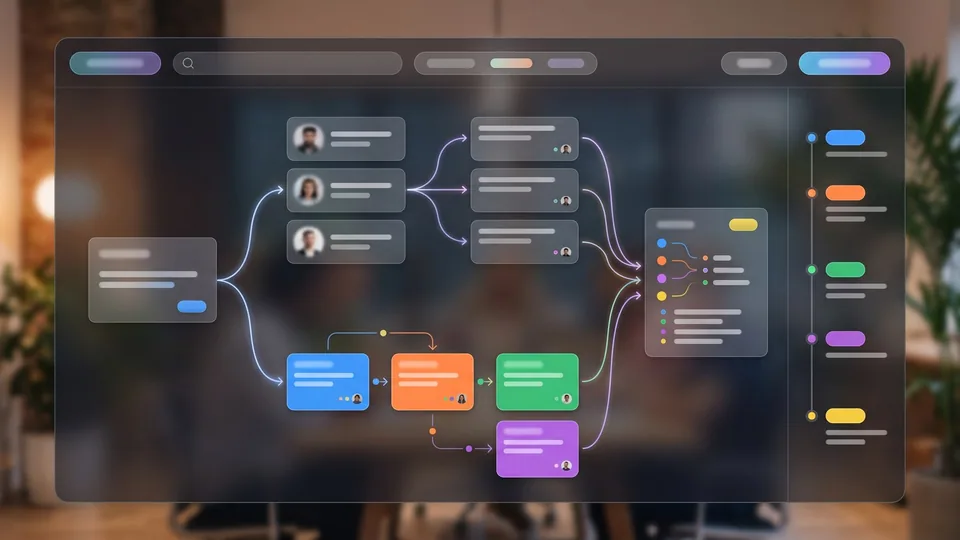
A dependable crm follow-up workflow requires a predictable user interface where team members can prompt the assistant, review queued candidate records, and confirm batch actions before updates hit the CRM timeline.
Querying Records Waiting on Response Under Role-Based Access Controls
The interaction begins in the internal agent console when a staff member submits a prompt requesting all qualified leads awaiting a reply for more than 48 hours. Before running the query, our authentication layer checks the user's role-based access controls to determine whether they hold permission to view unassigned or cross-territory contacts. Once validated, the backend service translates the prompt into a filtered CRM search query targeting contacts or deals whose last customer activity timestamp exceeds the configured threshold. The search interface renders a paginated candidate queue displaying the contact name, associated company, primary account owner, and elapsed time since the last touchpoint.
Previewing Owner Assignments, Duplicate Detection, and Activity Log Updates
When executing HubSpot ai crm follow-ups, the console renders a pre-execution verification screen detailing prospective task assignments. Our approach enforces an automated deduplication check prior to task creation: the engine scans open tasks associated with each candidate record to identify existing follow-up items with pending NOT_STARTED statuses. If an open task already exists, the interface flags the record with a warning state and deselects it by default, preventing duplicate notifications.
For records requiring intervention, the supervisor can reassign owners via a dropdown or approve the generated task copy. Upon final authorization, the application issues batch API calls to write the tasks, linking them directly to the target record via HubSpot association type IDs. Every generated item and manual override is recorded in an immutable audit log, preserving complete operational traceability. In failure tests where HubSpot returns an association error or invalid owner ID, the console halts the specific item, logs the response payload, and prompts the operator for remediation.
Build vs. Buy for CRM Follow-Ups: Native HubSpot, Third-Party Apps, or Custom Code
When evaluating ai crm follow-ups build or buy decisions, engineering teams must weigh rapid initial deployment against long-term operational autonomy, rate limits, and total cost of ownership.
Decision Matrix: Evaluating Workflow Fit, Rate Limits, Fees, and Exit Costs
Organizations typically evaluate three paths: native HubSpot automation (such as Sales Hub workflows), third-party middleware connectors, or a custom agent service.
| Evaluation Criteria | Native HubSpot Automation | Third-Party Middleware | Custom Agent Architecture |
|---|---|---|---|
| Workflow Fit | Predefined trigger-action rules; limited cross-object deduplication | Visual multi-step connectors; generic logic across standard triggers | Bespoke business rules, tailored LLM reasoning, and custom approval consoles |
| Data Ownership | Retained inside the HubSpot portal | Transit logs cached across third-party middleware clouds | Complete client ownership; deployed in client-controlled infrastructure |
| Rate Limits | Subject to portal execution quotas per subscription tier | Restricted by both middleware task caps and HubSpot API quotas | Direct API handling with intelligent batching and retry backoffs |
| Recurring Fees | Requires seat licenses or higher HubSpot subscription tiers | Monthly subscription fees scaling with task execution volume | Predictable infrastructure compute costs without per-task penalties |
| Exit Costs | Low exit friction, but logic remains proprietary to HubSpot | Moderate; multi-step flows must be rebuilt upon migration | Portable code and data models adaptable to any CRM or database |
When Custom Agent Engineering Is the Wrong Choice
Commissioning a custom hubspot integration is the wrong choice when an organization only needs simple, rule-based follow-up tasks triggered by calendar intervals or standard deal stage movements. If a team operates with standard pipeline stages and does not require cross-object deduplication, sentiment analysis of recent email exchanges, or human-in-the-loop review screens, native HubSpot workflows or verified Marketplace apps deliver a faster, lower-maintenance outcome without custom software overhead.
Engineering and Safety: AI-Assisted Scaffolding with Human Code Review
At Canvas Developers, our engineering methodology pairs AI-assisted scaffolding with rigorous human code review to build robust hubspot api action agents. We utilize modern AI coding tools and harness frameworks to rapidly scaffold data models, TypeScript API interfaces, and boilerplate test suites. This approach can shorten early feedback loops and reduce initial implementation friction during API mapping.
However, automated code generation cannot replace engineering oversight. Experienced software engineers direct every architectural decision, audit OAuth token management, and conduct mandatory code reviews before release. In CRM automation, automated scaffolding frequently misinterprets object association hierarchies or overlooks concurrency edge cases. Our engineers implement deterministic acceptance checks, including mock API failure tests, token revocation recovery tests, and strict boundary validations against API payload limits.
Through our AI automation agents engineering service, clients choose between two delivery models depending on their governance requirements: Private / Local AI Engineering, utilizing privately hosted open-weight models within client-controlled infrastructure, or Claude Code and OpenAI Codex Engineering for teams utilizing approved cloud AI tools. This ensures every automated workflow operates with enterprise-grade data privacy and human accountability.
Scoping Your HubSpot Follow-Up Integration with Canvas Developers
Transitioning from manual pipeline monitoring to automated follow-ups requires balancing clear business logic with secure CRM architecture. Canvas Developers, operating from our engineering office in Dhaka, designs and develops custom business systems, SaaS platforms, and secure CRM integrations tailored to your operational constraints.
Whether you require a dedicated custom hubspot integration, an internal approval dashboard, or assistance hardening an existing prototype, we structure projects through milestone-based scoping and thorough QA assurance. Reach out through our contact form to outline your current sales stack, team workflow constraints, and follow-up objectives for an engineering assessment.